
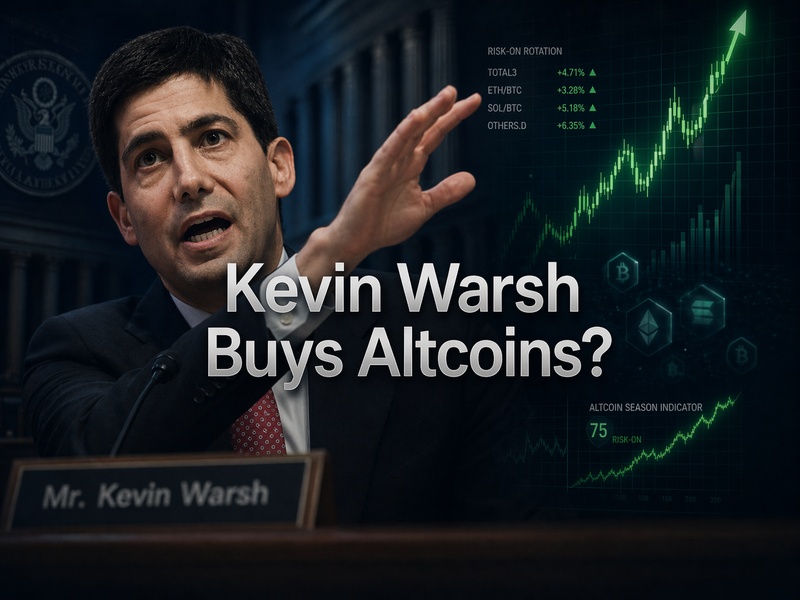
On April 21, 2026, Kevin Warsh testified before the U.S. Senate Banking Committee as a candidate for Fed Chair. He has not been confirmed yet, but the hearing itself already matters for the market. Warsh did not promise an immediate rate cut. He pushed a different idea: the Fed’s balance sheet should be smaller, monetary policy should be clearer, and under that framework lower rates can become possible over time. For crypto, that alone is enough to put a softer regime back on the table.
What Happened on April 21
Warsh did not come out and promise a quick rate cut. He made it clear that he had not made any commitments on rates and did not say in advance whether he would support an immediate cut.
But the market heard the main point. The discussion shifted away from the idea that tight money would stay in place for a long time with no alternative, and back toward the possibility that the monetary regime ahead could become softer. That is what matters for risk assets.
The strength of this story is that it is not built on one soft line meant to please the market. It rests on a deeper framework: a smaller Fed balance sheet, fewer policy mistakes, and lower rates inside a more stable system. For the market, that is not noise. It becomes a new anchor for expectations.
Why the Market Moves Before the Fed
The market almost never waits for the actual Fed decision. It starts repositioning earlier, once the view on the future price of money begins to change.
If market participants start to believe that conditions may be easier a few months from now, that first flows through yields, the dollar, and broader risk appetite. Only after that does the move reach crypto.
That is why, for altcoins, the official day of a Fed rate cut is not the key point. By then, part of the move is often already priced in. What matters much more is the moment the market stops treating expensive money as the only possible path.
That is where the first repricing of risk begins.
Why This Is Bullish Specifically for Altcoins
The first wave almost always goes into Bitcoin. It is the most liquid and the easiest asset in the sector for the market to understand. If demand holds, Ethereum comes next. After that, capital starts spreading into large liquid altcoins.
That is how the early phase of altseason usually begins. Not on command, not on the day of the Fed decision, and not because of a single news item. First, the market accepts a softer regime as a real possibility. Then it starts buying risk. Only after that does the expansion reach altcoins.
That is the bullish core of the Warsh story. He has not taken over the Fed, and he has not formally changed anything. But the market once again has a reason to look at future rates more softly than it did not long ago. For high-beta assets, that is already enough for the first repricing to begin.
Why the Theme Looks Strong Right Now
There is still no full clarity on rates. That is exactly where the strength of this setup comes from. While the market is still debating the future path instead of trading a fully settled decision, risk starts repricing early.
That is a constructive regime for crypto. When the market sees a path toward easier conditions, capital first stops hiding only in defensive assets and then starts looking for higher return potential. That is what creates the base for an early move in altcoins.
An additional plus is that this logic lines up with a broader return of risk appetite. When demand starts spreading beyond just a few of the largest assets, that is always better for altcoins than a narrow defensive market.
What Needs to Line Up in the Market
One hearing is not enough. The market needs confirmation.
- Bitcoin has to hold its structure.
- Ethereum has to look stronger than a normal bounce.
- Large liquid altcoins have to attract steady demand.
- The dollar and yields must not reverse the softer scenario.
- The advance has to broaden across the market instead of staying trapped in just a few of the largest assets.
If that combination is there, the market is genuinely starting to price in a softer regime ahead. If it is not, then this was only the first impulse without real continuation.
How We Use This in Practice
We do not buy one name and one hearing. First, we check whether the market is actually getting softer in its expectations. Then we look at whether demand is moving from Bitcoin into Ethereum and then into liquid altcoins. Only after that does it make sense to expand spot exposure.
In this phase, it makes more sense to work systematically than to guess every local move by hand. We first confirm market phase through Market Median, then look at imbalances in open interest, funding, and liquidations screeners. When the market enters a broader risk-expansion phase, that is when it makes sense to increase systematic work on strong coins in spot.
Where Spot-Bot Fits In
When the market is only beginning to move into a softer regime, the main task is not to miss the direction and not to lose discipline. That is where systematic spot work often looks stronger than trying to chase the market aggressively by hand.
If Bitcoin holds structure, Ethereum confirms demand, and liquid altcoins start joining in, it makes sense to increase work on strong coins through trading bot. Not to chase noise, but to build exposure consistently in a phase where the market is starting to come alive more broadly and more cleanly.
FAQ
Has Warsh already been confirmed as Fed Chair?
No. On April 21, 2026, he testified before the Senate as a candidate, but the confirmation process is not complete yet.
Did he explicitly say rates need to be cut right away?
No. He did not make any promise on rates and did not say in advance whether he would support an immediate cut.
Then why is the market reacting at all?
Because the market prices not only the current decision, but the future regime. If there is a credible path toward a softer trajectory, risk starts repricing before any official move.
Why does this matter especially for altcoins?
Because altcoins depend more heavily on expanding risk appetite. When the market starts looking for higher return potential again, capital moves deeper into the sector.
When does this scenario break down?
When yields move higher again, the dollar strengthens, Bitcoin loses structure, and demand fails to expand into Ethereum and liquid altcoins.
Conclusion
The Warsh story is bullish not because rates are already being cut. And not because he is already running the Fed. Neither of those things has happened.
It is bullish because on April 21, 2026 the market once again got a reason to discuss a softer monetary regime as a real near-term possibility. For crypto, that is already enough. Altcoins rarely wake up on the day of the official Fed decision. They usually start moving earlier, at the moment the market stops fearing expensive money and starts paying for risk again.
If that shift is confirmed through Bitcoin, Ethereum, liquid altcoins, and broader market participation, then this is no longer just a strong macro thesis. It becomes a real spot phase. And that is exactly the kind of phase where it makes sense to scale systematic work through trading Spot Bot instead of chasing the market after the main move has already passed.
The crypto market remains high risk. Any macro scenario still has to be confirmed by price, market structure, and disciplined position management. This is not investment advice.