
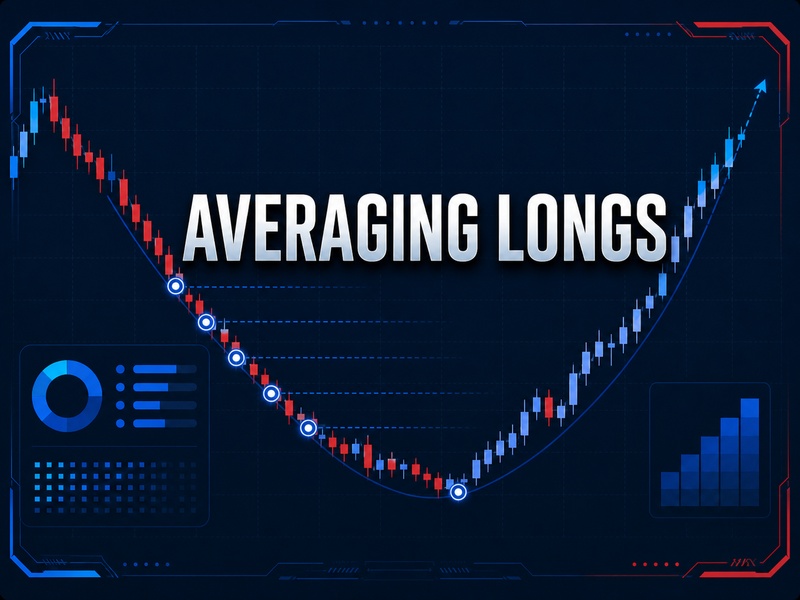
Averaging into a long position looks simple: buy an asset, price moves lower, buy more at a cheaper level, and the average entry price improves. In a live market, this structure breaks quickly without a capital limit, an asset-quality filter, and a clear exit plan.
For a medium-term investor, averaging is a way to build a position in a strong asset step by step. The first buy is almost never perfect. The investor’s job is to survive an early entry, preserve capital for a deeper drawdown, and avoid turning one coin into the main risk of the portfolio.
What Averaging Into a Long Position Means
Averaging into a long position means buying more of an asset below the first entry price to reduce the average price of the whole position.
A simple example:
- First buy — at $1.
- Second buy — at $0.80.
- The average position price moves below $1.
- The asset no longer needs to return to the first entry price for the position to break even.
The problem starts when an investor buys every dip without limits. Price can decline in steps, and capital can run out before the market forms a reversal.
How Investor Averaging Differs from Trader Averaging
A trader works with a short setup: entry, confirmation, invalidation, exit.
A medium-term investor works with a horizon of weeks or months. The goal is to build a position in an asset that still has liquidity, market interest, and a healthy structure. The perfect entry point is secondary. What matters more is distributing capital so that a mistake on the first buy does not break the whole plan.
Three rules matter for an investor:
- Do not buy the full size at once.
- Do not average into a weak asset just because the price has dropped.
- Preserve capital for deeper drawdowns and reversal confirmation.
A good average price has no value if the asset loses liquidity, sector interest, and the ability to recover with the market.
Which Assets Are Suitable for Averaging
Only assets that can be held medium-term should be averaged. Thin coins, delisting candidates, low-volume assets, and coins under heavy unlock pressure should be excluded before the first buy.
Before building a position, check:
- The coin trades on major exchanges.
- Daily volume is healthy.
- There are no fresh delisting risks.
- There is no critical unlock in the coming days.
- The asset is not weaker than its sector.
- The sector still attracts market interest.
- The decline does not show signs of a full capital exit.
Averaging works better when the drawdown is tied to the general market phase. If the problem is inside the asset itself, lowering the average price does not solve the core risk.
The Main Mistake: Averaging Without a Limit
The most expensive mistake is failing to define the maximum position size before the first buy.
An investor buys the first part, then the second, then the third. Price keeps falling. Each new entry looks logical because the average price improves. Over time, one coin takes too much of the portfolio, while free capital is already gone.
Before entering, define:
- How much capital is allocated to the asset.
- How many position-building points there will be.
- Where follow-up entries are allowed.
- When averaging stops.
- Under which scenario the thesis is invalidated.
If 10% of the portfolio is allocated to a coin, all follow-up entries must stay within that limit. Going beyond the limit turns an investment plan into risk concentration.
Basic Position-Building Structure
The position is better divided into several parts. The first buy should be moderate, especially if the market has not confirmed a reversal yet.
Example allocation:
- First buy — 20% of the planned position.
- Second buy — 20%.
- Third buy — 25%.
- Fourth buy — 35%.
A more even version:
- 25% — first buy.
- 25% — drawdown to a strong zone.
- 25% — deeper market drawdown.
- 25% — reversal confirmation.
The main principle: the first buy should not be the largest if the market has not shown strength yet. The higher the asset volatility, the more capital should be kept for lower zones.
Where to Add to the Position
Adding size should be tied to conditions, not to the desire to improve the average price.
Technical zone.
Price reaches strong support, an accumulation zone, a daily level, or a weekly level. Adding to the position is acceptable if the asset keeps liquidity and does not fall out of its sector.
Market capitulation zone.
Liquidations hit the market, open interest declines, and altcoins move into oversold territory. These zones often offer better prices, but they require free capital and discipline.
Confirmation zone.
Price stops falling, forms a base, volume returns, and the asset starts showing strength relative to the market. This entry may be more expensive, but the risk of further downside is lower.
Part of the position can be built during drawdowns. Part of the capital should be kept for confirmation, when the asset already shows signs of recovery.
Why You Should Not Buy Every Red Candle
A red candle is not the same as a good price. An asset can fall for weeks, creating dozens of false pauses.
Before adding to the position, check:
- Is the whole market falling, or only this coin?
- Is there volume on the decline?
- Is capital leaving the sector?
- Is there pressure from unlocks, transfers to exchanges, or negative news?
- Is the higher-timeframe structure intact?
- Does the asset bounce with the market?
If the coin falls harder than the sector, bounces worse, and loses volume, adding should stop. The average price will move lower, but the quality of the position will deteriorate.
How to Account for the Market Phase
The same drawdown has a different meaning in different market phases.
In a strong market, pullbacks often become accumulation zones. Leaders hold structure, capital returns quickly to assets, and dips are bought.
In a sideways market, averaging requires patience. Price can stay inside a range for a long time, locking capital.
In a falling market, follow-up entries should be rare and limited. The main task is to preserve capital until signs of stabilization appear.
Before building a position, we look not only at the coin, but at the whole market: Market Median, the share of coins above MA200, median RSI, overbought and oversold zones, liquidations, open interest, and sector behavior.
Averaging Through Levels
The simplest option is to define follow-up buying zones from the first entry price in advance.
Example:
- First buy — current price.
- Second — a 10–15% decline.
- Third — a 25–30% decline.
- Fourth — a deep 40–50% drawdown or reversal confirmation.
For large liquid assets, the step can be smaller. For volatile altcoins, the step should be wider. If an altcoin can easily move 20–30% in a few days, adding every 5% will quickly use the entire limit.
Averaging Through Market Events
A stronger approach is to add not by percentage decline, but by market event.
Suitable events:
- Broad market liquidations.
- Open interest decline after a sharp drop.
- Median RSI moving into a deep weakness zone.
- Price returning to a strong weekly zone.
- Sector recovery after pressure.
- Asset breaking out of accumulation with rising volume.
This approach requires observation, but it reduces the risk of mechanically averaging into an asset that keeps weakening.
When Averaging Should Stop
Every position needs a limit. Even if an investor does not use a classic stop-loss, there must be a logical stop.
Follow-up entries stop if:
- The coin loses liquidity.
- Delisting risk appears.
- The project receives a serious fundamental hit.
- The asset remains consistently weaker than its sector.
- The market moves into a prolonged decline.
- The capital limit has already been used.
- The position has become too large for the portfolio.
An investor protects the portfolio instead of trying to prove the market wrong.
How to Calculate the Average Price
The average price is calculated through the total invested amount and the total number of coins purchased.
Example:
- Bought 100 coins at $1 — invested $100.
- Bought 150 coins at $0.80 — invested $120.
- Bought 250 coins at $0.60 — invested $150.
Total invested: $370. Total coins purchased: 500. Average price: $0.74.
Now the asset does not need to return to $1 for the position to move into profit. But this works only if the price recovers. If the asset keeps falling because of fundamental weakness, the average price does not protect capital.
How to Take Profit After Averaging
Averaging without an exit plan often ends the same way: the investor sits through a drawdown, price returns to the average, nothing is realized, and then a new pullback starts.
Exit structure:
- Close part of the position near the average price or in a small profit if the size has become heavy.
- Take part of the position off near strong resistance.
- Reduce part of the position during growth acceleration and signs of overheating.
- Keep the remainder for the medium-term scenario if the market confirms strength.
After a difficult position build through a drawdown, the first partial take-profit should not be delayed. Returning part of the capital reduces pressure and restores flexibility.
Mini Case: Early Entry into a Strong Asset
An investor selected a liquid coin from a strong sector and bought the first part after a local pullback. Price continued to decline together with the market.
The position had been divided into four parts in advance. The first buy took only 25% of the limit. The second happened on a deeper drawdown, the third after market capitulation, and the fourth after price returned above the local range.
The first entry was early, but the plan did not break. The average price moved lower, and capital for better zones remained available.
Mini Case: Averaging a Weak Coin
An investor bought an altcoin after a sharp drop, expecting a bounce. Price continued to fall, and every new buy looked attractive.
After several weeks, the asset became clearly weaker than the market: bounces were short, volume declined, and the sector did not recover. The position took too much of the portfolio, and free capital ran out.
The mistake was the absence of a limit and an asset-quality filter. Without those two conditions, averaging quickly turns into holding a weak position.
Mini Case: Adding After Confirmation
An investor did not buy the full size during the decline. He took the first part near support and kept capital for confirmation.
After sideways movement, price broke above the range, volume started returning, and the sector became stronger than the market. The investor added part of the position at a higher price, but with a lower risk of continued decline.
The average price ended up higher than it would have been with aggressive buying during the drawdown, but the quality of the entry improved. For a medium-term investor, this is often more important than a perfect price.
How Crypto Resources Helps With Averaging
At Crypto Resources, we treat averaging as a market-regime and asset-quality decision first. Market Median helps assess the market phase, median RSI, the share of coins above MA200, and overbought and oversold zones. This is the base filter before building a long position.
After that, we assess movement quality through open interest, funding rate, liquidations, premium index, pump and dump screeners. This makes it easier to separate a normal market drawdown from a structurally weak move where the asset loses strength faster than the market.
For a manual investor, this reduces the risk of buying every dip blindly. For automated execution, Spot-Bot can be used within a predefined position-building logic. The result depends on the market, the selected asset, settings, and capital discipline.
Basic Discipline Rules
- Do not enter with the full size on the first buy.
- Define the position limit first.
- Do not average into a coin only because the price has dropped.
- Keep capital for a deeper drawdown.
- Divide follow-up entries by levels or events.
- Check the asset’s strength relative to the market and sector.
- Stop averaging when the thesis is invalidated.
- Take partial profit after recovery.
- Do not turn one asset into the main portfolio risk.
- Trade a size that does not force emotional decisions.
FAQ
Can long positions be averaged on futures?
For a medium-term investor, spot is safer. Futures add leverage, funding rate, liquidation risk, and extra pressure on decision-making.
How many times can a position be averaged?
It is better to define 3–5 position-building points in advance. If there are more follow-up entries, control over position size usually starts to weaken.
Is it better to buy equal parts or increase size lower?
For volatile altcoins, it is logical to keep more size for deeper drawdowns. The first buy should be a test buy if the market has not confirmed a reversal yet.
What should I do if the full position is already built and price keeps falling?
Stop adding and reassess the thesis. If the asset still meets the original criteria, the position can be held according to the plan. If the conditions are broken, risk should be reduced.
When should profit be taken after averaging?
Part of the position can be reduced near the average price or in a small profit, especially if the size has become heavy. The remainder can be managed under the medium-term scenario if the market confirms strength.
Conclusion
Averaging into long positions works under three conditions: there is a capital limit, the asset is high quality, and follow-up entries follow a plan. Without these conditions, averaging quickly turns into an attempt to rescue a losing position.
A medium-term structure should be simple: select a liquid asset, define the maximum position size, divide the entry into parts, add only under predefined conditions, stop when the thesis is invalidated, and know in advance where profit will be taken.
Cryptocurrencies remain a high-risk market. Averaging lowers the average price, but it does not remove the risk of further decline. Any strategy requires capital control, asset review, and execution discipline.