
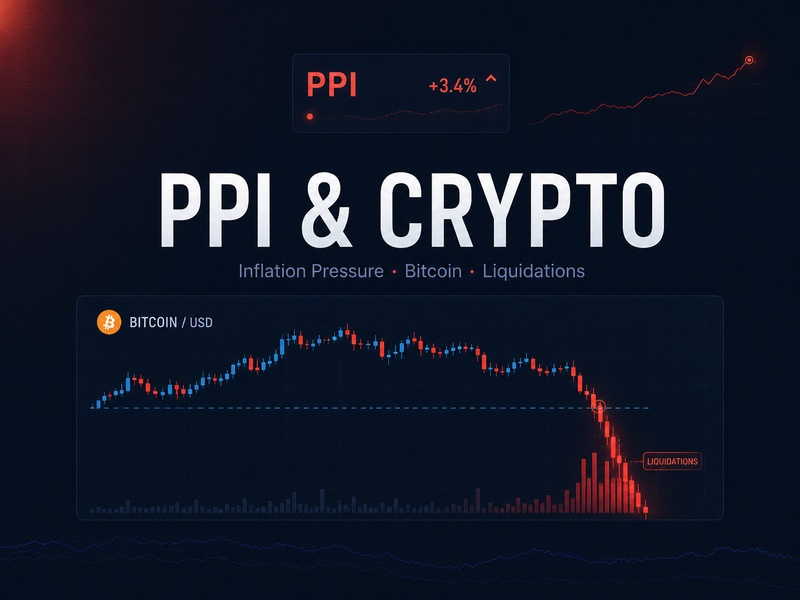
April PPI in the U.S. came in well above expectations: the Producer Price Index rose 1.4% month over month and 6.0% year over year. For the market, this signaled that inflation pressure remains high and the Fed has less room for softer policy.
Crypto reacted quickly. Bitcoin moved below $80,000, altcoins dropped harder, and the move accelerated through leverage and liquidations. This is standard behavior for a market with heavy speculative capital, short holding periods, and overheated positioning.
PPI sets the backdrop. The actual trade setup comes from the market reaction after the release: level holds, open interest, funding, liquidations, and Bitcoin’s behavior around key zones.
What PPI Is
PPI stands for Producer Price Index. It shows how prices received by producers for goods and services change over time.
For markets, three things matter:
- PPI can point to future pressure on consumer inflation;
- rising production costs pressure corporate margins;
- high PPI reduces the probability of softer Fed policy.
When producer prices rise faster than expected, businesses have less room to keep old prices. Part of the cost moves into final prices, while part of it pressures profits. For the Fed, this is an uncomfortable mix: inflation stays high while the economy absorbs additional pressure.
Why High PPI Pressures Bitcoin
On major macro data days, Bitcoin often trades like a risk asset. When the market gets a hot PPI print, it reprices expectations around rates, the dollar, yields, and liquidity.
The chain is straightforward:
- PPI comes in above expectations.
- The market lowers expectations for rate cuts.
- Bond yields and the dollar get support.
- Risk appetite falls.
- Bitcoin loses part of its speculative demand.
- Altcoins move harder through thin liquidity and leverage.
When money gets more expensive, the market pays less for risk. This affects tech stocks, small-cap equities, Bitcoin, and especially altcoins.
Why Altcoins Fall Harder Than BTC
Altcoins are more sensitive to macro shocks because of market structure. Many coins have thinner order books, lower liquidity, and a higher share of aggressive leverage.
If an altcoin had already rallied before the release, open interest expanded, and funding became skewed, a hot PPI print can easily become a trigger for deleveraging. First BTC weakens, then traders reduce risk across altcoins, and the move is amplified by stops and liquidations.
That is why the first red candle after the report is not always a safe discount. Sometimes it is only the start of leverage cleanup after overheating.
Why Liquidations Accelerate the Drop
The macro release sets the direction, but derivatives often define the speed of the move.
If the market was heavily long before the release, high PPI can trigger the first selloff. Price breaks a level, stops fire, and leveraged positions start getting closed. Exchanges force-sell assets from traders who can no longer hold the move against their position.
In these moments, the chart shows the result. Open interest, funding, and liquidations show the mechanics behind that result.
If price falls and open interest does not reset, continuation risk remains high. If liquidations have already passed, open interest drops, and BTC reclaims the level, the market can shift into a technical rebound.
How Traders Should Read PPI
PPI should be read through the gap between the actual number and expectations. The same print can create a different reaction if the market had already priced in a hot or soft report.
We look at:
- actual data versus forecast;
- year-over-year dynamics;
- core components excluding food, energy, and trade services;
- dollar reaction;
- yield reaction;
- whether BTC holds key zones;
- open interest changes;
- funding;
- long and short liquidations.
“PPI above expectations” gives the macro backdrop. The trade is confirmed by market behavior after the release.
What to Do Before the PPI Release
Before the release, the trader’s job is to remove unnecessary risk.
A normal checklist:
- Check the exact release time.
- Reduce leverage.
- Close random positions.
- Mark key BTC levels.
- Check market-wide open interest.
- Check funding on overheated coins.
- Do not open a new trade before the release without a prepared scenario.
If a position is already open, it needs a clear invalidation level. On major data days, the market often makes sharp moves in both directions, and a random entry quickly turns into a bet on noise.
What to Do During the Release
The first candle after PPI is often the most dangerous one. It mixes algorithms, stops, liquidations, and emotional entries.
At the moment of publication, we evaluate structure:
- BTC holds the level or breaks it;
- open interest expands or resets;
- funding remains skewed or starts normalizing;
- liquidations come in one wave or continue as a cascade;
- altcoins fall together or part of the market holds better.
If the structure is not confirmed, the entry is better skipped. On macro data days, a bad entry point can ruin even a correct market idea.
What to Do After the Release
After the first reaction, the main task is to understand whether the market has absorbed the shock.
For a long setup, we need signs of stabilization: price stops making new lows, open interest resets, liquidations fade, BTC reclaims an important zone, and altcoins stop underperforming the broader market.
For a short setup, it is better to wait for a rebound. Shorting the lows after a strong selloff is dangerous: part of the move has already happened, and the market can sharply buy back flushed positions. A more practical scenario is a short from technical recovery if BTC fails to reclaim the key zone and altcoins remain weaker than the market.
How PPI Is Connected to Liquidity
Crypto is sensitive to the cost of money. When the market expects rate cuts, risk assets have an easier environment: capital flows more actively into growth stocks, Bitcoin, and altcoins.
High PPI worsens that backdrop. If inflation remains high, it becomes harder for the Fed to cut rates. Money stays expensive, bond yields look more attractive, the dollar gets support, and speculative assets lose part of their demand.
For Bitcoin, this does not always mean a breakdown of the larger trend. For intraday and medium-term trading, the background becomes stricter. Longs need more confirmation, and altcoins that have already rallied become more vulnerable.
How We Apply This in Crypto-Resources
On days like this, we first look at the market regime, then derivatives, and only then a specific coin.
Market Median helps assess the broader backdrop: whether the market is overheated, cooling down, neutral, or already oversold. The same PPI release works differently in an overheated market and in a market that has already cleared leverage.
Open interest screeners show where leverage is building. Funding helps identify which side traders are already overpaying for. Liquidations show where forced resets have taken place. Premium Index helps detect the gap between spot and futures.
Trading robots Spot-Bot and ST-Bot do not remove macro risk. Their role is to execute predefined rules, respect position size, and prevent every impulse from turning into an emotional trade. On PPI days, this matters especially: the market punishes late entries, excess leverage, and trading without a plan.
Common Mistakes Beginners Make
Buying an altcoin only because it has fallen hard. After a hot PPI print, the drop can continue if BTC has not held its level, open interest has not reset, and funding remains skewed.
Shorting immediately after a large red candle. If liquidations have already passed and price is sitting in a local flush zone, the risk of a sharp rebound is high. It is better to wait for a return to the level, a weak recovery, and confirmation that buyers have not returned.
Ignoring the calendar. A technically reasonable trade opened a few minutes before PPI can break purely because of macro volatility.
Looking only at the chart. On macro data days, price without open interest, funding, and liquidations gives an incomplete picture.
Practical Checklist
Before the release:
Reduce unnecessary risk, remove random trades, mark BTC levels, check open interest and funding on assets that have already rallied hard.
During the release:
Do not trade the first candle without a prepared scenario. Watch whether BTC holds key zones and whether liquidations turn into a cascade.
After the release:
For longs, wait for stabilization and level reclaim. For shorts, look for a rebound if the market remains weak. With altcoins, work only where the move is confirmed by derivatives and does not look like a late entry at the end of the impulse.
Mini Cases
BTC loses a level after a hot PPI print
PPI comes in above expectations, the dollar and yields get support, and BTC breaks an important zone. If open interest is high and long liquidations are only starting, a countertrend long carries elevated risk. It is more rational to wait for a reset and watch the reaction on a level reclaim.
An altcoin rallied before the release and falls harder than the market
The coin has already made a strong move, funding is positive, and open interest has expanded. After PPI, BTC weakens and the altcoin falls faster. This may be leverage cleanup after overheating, not an automatic buy zone.
The market drops sharply but quickly reclaims the level
After the first candle, liquidations pass, open interest declines, and BTC returns above the broken zone. In this scenario, shorting the lows becomes dangerous. The working area shifts to a retest and a check of buyer strength.
FAQ
Why does crypto fall after PPI?
High PPI strengthens expectations of tighter Fed policy. Money remains expensive, the dollar and yields get support, and risk assets lose demand.
Is PPI more important than CPI for Bitcoin?
CPI usually has a stronger market impact, but PPI matters as an early signal of inflation pressure. If producer prices rise faster than expected, the market starts pricing the risk of higher future inflation.
Can traders buy the dip after high PPI?
Only after stabilization is confirmed. A level reclaim, open interest reset, fading liquidations, and funding normalization are needed. Buying the first red candle often turns into catching a falling knife.
Why do altcoins fall harder than BTC?
Altcoins have lower liquidity, thinner order books, and more speculative leverage. When BTC loses a level, altcoins often move wider.
What is the main filter on PPI day?
Market reaction. Traders need to watch BTC, the dollar, yields, open interest, funding, and liquidations. The report headline gives the backdrop, but it does not give the entry point.
Conclusion
PPI changes the cost of risk. When producer inflation comes in above expectations, the market reprices Fed policy, the dollar, yields, and liquidity.
Bitcoin reacts first. Altcoins get an amplified move through leverage, liquidations, and thin order books.
For traders, the structure after the release matters more than the fact of the drop itself. If the market is overheated, open interest is high, funding is skewed, and BTC loses a level, long setups require patience. If the drop has already flushed leverage and price reclaims the key zone, a late short becomes dangerous.
First market regime, then derivatives, then the trade.
Cryptocurrency trading involves high risk. Macro data can sharply change volatility, liquidity, and derivatives market behavior. Every trade should have a predefined position size, invalidation level, and risk control.