
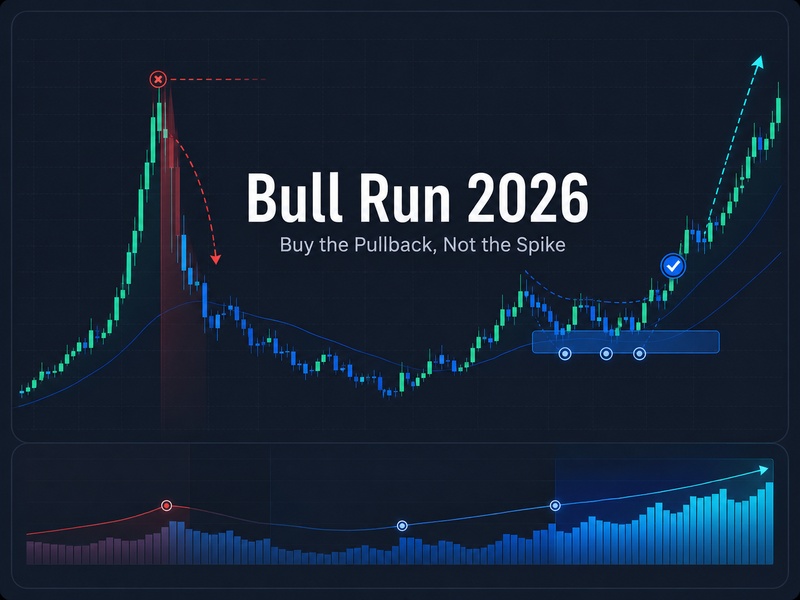
In May 2026, the crypto market started moving again. Strong green candles returned to the charts, bull market talk came back into the feeds, and beginners started following the same familiar route: opening the list of top gainers and looking at coins that had already made their move.
TON after a strong rally. ZEC after a sharp impulse toward the highs. Other assets that had already covered most of their move in a short period of time. From the outside, it looks like the market is only accelerating and that you need to buy whatever is already flying.
This is how late entries appear. Early participants are already in profit, part of the liquidity has already been taken, open interest may already be inflated, the funding rate may already be overheated, and the invalidation zone is already too far away.
In a strong market, buying starts with the entry area. There are two practical setups: wait for a pullback in a strong asset, or find a coin where the move is not yet obvious, while open interest is already building fuel.
Why Beginners Buy Late
Beginners rarely buy when the market is calm. A range feels boring, a decline feels scary, and the early stage of growth does not give enough confidence. Confidence appears when the move is already visible to everyone.
By that point, the trade conditions are often worse:
- the coin has already grown by dozens of percent;
- the candle has turned vertical;
- the asset has appeared in feeds and discussions;
- late buyers enter with leverage;
- open interest rises sharply;
- the funding rate shifts toward overheating;
- the invalidation zone is far from the entry.
Such an entry may still continue higher if the market is pushed up again. But the risk is already worse. The later the buy, the less room there is for error.
A Green Candle Shows a Move That Already Happened
A strong green candle confirms a fact: the market has already covered part of the move. After a sharp rise, the asset’s structure changes. Late buyers add leverage, sellers start catching the reversal, liquidity becomes denser, and the price gets more reasons for a pullback.
Before buying after an impulse, we need to understand whether the asset is holding the new range, whether there was a normal pullback, whether open interest has collapsed, whether volume remained after the move, and whether the funding rate is overheated.
Without these answers, the trade is built on emotion. A bull market can sometimes carry bad entries, but that does not make them high-quality trades.
Buying After a Pullback
A strong market does not require buying the first candle. A cleaner entry often appears after overheating is reduced.
A pullback shows whether there is demand in the asset after the impulse. A strong coin does not have to return to the beginning of the move. It only needs to remove excess leverage, hold an important zone, and start building volume again.
A pullback entry needs several signs: price holds above the zone where the last impulse started, the decline does not break the structure, open interest does not reset completely, the funding rate returns to calmer values, and new demand appears after the market has been cleaned up.
This entry is calmer. There is an invalidation zone, a clearer position size, and less dependence on feed noise.
Finding Coins Before the Main Move
In a rising market, some assets are already on display. Everyone sees them, shares them, and late buyers enter them.
At the same time, there are coins where the move is not yet obvious, but participation is already growing. This is where an open interest screener is useful.
Open interest shows the number of open positions in derivatives. Its growth does not give a buy signal by itself. It shows that participation is coming into the asset and that energy is building inside the market.
For selection, the most interesting setups are where price has not gone vertical yet, open interest is rising before a strong impulse, volume is starting to wake up, the funding rate is not overheated, and the asset is holding its range.
Such a coin is often more interesting than an asset from the top gainers list. In top gainers, the market has already shown the result. In an open interest screener, we can look for preparation before the move.
How to Read Open Interest
Open interest growth only matters together with price.
If price is ranging or rising moderately while open interest expands, the market may be building fuel. If price has already made a strong move, open interest has risen sharply, and the funding rate is overheated, a late entry carries higher risk. If price falls together with open interest, participants are closing positions, and the asset may be losing attention.
For buying at the start of a bull market, the cleaner setup is usually where open interest rises before the main move, while price has not yet moved far from the base.
What to Check Before Entry
A bull market does not remove discipline. It punishes late entries, oversized positions, and emotional buying faster.
Before a trade, we need to check:
- market phase;
- asset strength;
- whether there was a pullback after the impulse;
- how open interest behaves;
- where the funding rate is;
- whether there were large liquidations;
- whether volume remains after the pullback;
- where the invalidation zone is.
If the entry reason comes down to the coin already going up, it is better to skip the trade. A strong market gives many opportunities, but not every green candle gives a proper entry area.
Common Beginner Mistakes
At the start of a bull market, beginners often apply the broad green market backdrop to any individual trade. It feels like the market will forgive everything. In reality, even strong assets move in waves, take liquidity, flush leverage, and return to the zones where the move began.
Common mistakes:
- buying a coin only after it appears among top gainers;
- entering without a pullback;
- increasing position size because of fear of missing the move;
- ignoring open interest;
- not checking the funding rate;
- buying after vertical growth without checking liquidity;
- treating a strong market as a guarantee of a good trade.
In a bull market, buying really does become the main working side. But even the right idea becomes a weak trade if it is bought too late.
Market Median, Screeners, and Spot-Bot
We start with the broader market phase through Market Median: where the market sits, whether it is overheated, how market breadth looks, where median RSI is, and what share of assets trades above MA200. Then we move to individual coins through open interest, funding rate, liquidation, and premium index crypto screeners. Spot-Bot can be used for disciplined spot trading with a pre-selected configuration: first the market phase and asset selection, then the entry area, position size, and scenario review zone. The bot does not replace risk control, but it helps remove manual noise and keeps every green candle from turning into an emotional decision.
Mini-Cases
The coin has already grown by 80–100%.
A beginner sees a strong chart and buys at market. A cleaner scenario is to wait for a pullback, then check structure, open interest, funding rate, and liquidations. If overheating has not been reduced, the entry remains weak even in a bull market.
The coin is ranging, but open interest is rising.
Price has not printed a large candle yet, but the number of open positions is increasing noticeably. The asset goes onto the watchlist. Next, we need volume, a calm funding rate, and a clear invalidation zone.
The coin rises sharply, open interest expands, and the funding rate is overheated.
The chart looks strong, but a late entry already carries higher risk. A more disciplined option is to wait for leverage to be flushed and for a new structure to form.
Work Routine
Before entry.
We check market phase, asset strength, open interest, funding rate, liquidations, and the distance to the invalidation zone. If the asset has already made its main move, we do not buy it because of fear of missing out.
During the trade.
We watch whether the pullback turns into a structural break. We control position size and do not add to an overheated asset without new confirmation.
After the move.
We take profit according to the plan. If the coin returns to the top gainers list after a strong move, we evaluate it again through current data.
FAQ
Can you buy a coin after a strong rally?
Yes, if a normal pullback appears after the impulse, structure holds, the funding rate cools down, and open interest does not show dangerous overheating.
Why are top gainers dangerous for beginners?
They show a move that has already happened. Beginners often buy an asset after early participants have already taken profit.
What is better: waiting for a pullback or finding new coins through open interest?
Both approaches can work. A pullback fits strong assets after an impulse. An open interest screener helps find coins where the move is not yet obvious.
Does open interest growth always mean future price growth?
No. It shows growing participation, not direction. It needs to be read together with price, volume, funding rate, liquidations, and the broader market phase.
What matters most for a beginner at the start of a bull market?
Do not buy a green candle only because the market woke up. You need structure, a pullback, clear risk, an invalidation zone, and confirmation through data.
Conclusion
At the start of a bull market, green candles create the feeling of easy decisions. This is exactly when beginners most often buy late, increase risk, and become fuel for the next pullback.
Buying in a strong market should be built from data. We wait for a pullback in an asset that has already shown strength, or we look for coins where open interest is building before the main move.
If the market has already moved without us, the trade can be skipped. In a bull market, the market pays for a proper entry area and risk control, not for rushing.
Risk Disclaimer
Cryptocurrencies remain a high-risk market. Working with buys, leverage, and volatile assets requires risk control, understanding of liquidity, and readiness for sharp moves against the position.