
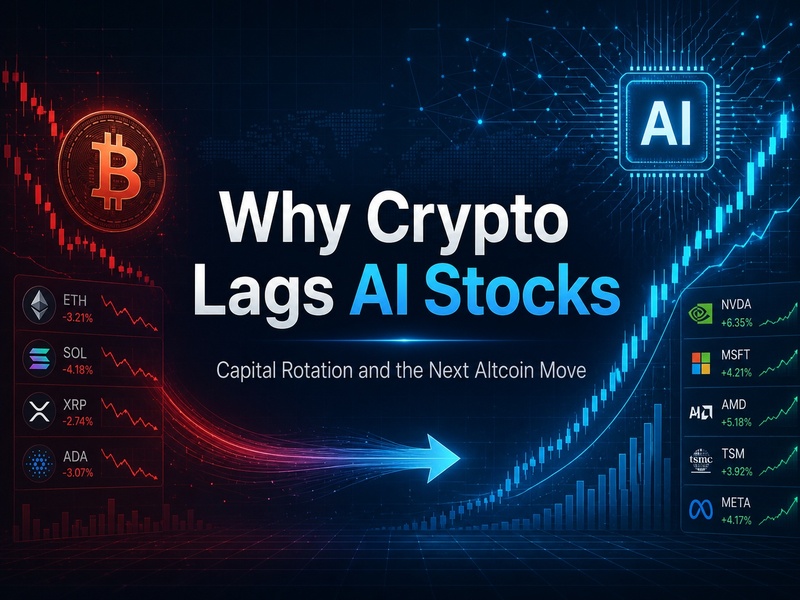
Crypto can lag stocks even when the equity market looks strong. Rates, inflation and Fed policy matter, but they are not the whole story. Money moves toward the market where the growth narrative is clearer, liquidity is deeper and investor interest is stronger.
In 2026, part of that capital is moving into AI stocks, large-cap tech, thematic ETFs, new IPO expectations and short-term money market instruments. For Bitcoin and altcoins, this creates a difficult setup: the market does not have to fall every day, but fresh money reaches crypto later.
Why Crypto Competes With More Than Crypto
The crypto market is often viewed from the inside: Bitcoin, ETH, altcoins, memes, DeFi and new listings. Institutional capital compares crypto with every other place where money can work.
An investor has several options:
- Keep money in money market funds and short-term government debt.
- Buy AI stocks and large technology companies.
- Enter thematic ETFs.
- Hold liquidity for major IPOs.
- Return to Bitcoin and altcoins.
If the first four options look clearer, crypto receives less inflow. That is why altcoins can stay weak even while equity indexes are rising.
Crypto competes for the same speculative capital that can move into AI, stocks, funds or cash. While money is busy elsewhere, broad altcoin growth gets delayed.
Why Rising Stocks Do Not Guarantee Rising Crypto
Growth in Nasdaq or S&P 500 does not automatically mean Bitcoin and altcoins are ready to rise. Indexes can move higher because of a narrow group of large companies. The broader market, small caps and risk assets can remain weak at the same time.
Crypto needs more than a rising equity market. It needs broader demand for risk.
The rotation is visible in market behavior:
- Money goes only into AI and the largest tech names — crypto lags.
- Part of capital stays in money market funds — less liquidity remains for risk.
- Funds wait for major IPOs — altcoins do not receive aggressive inflow.
- BTC rises alone — the broader coin market does not confirm the move.
- Altcoins fail to hold momentum — an early long turns into a stuck position.
Strong stocks alone do not launch an altseason. Altcoins need the moment when capital starts moving beyond the clearest and most liquid destinations.
What Money Market Funds Are and Why They Pressure Crypto
Money market funds allow large investors to park capital in a calmer format. They are usually linked to short-term debt instruments and offer a clear yield profile without heavy volatility.
For crypto, this is direct competition. If an investor can sit in cash with yield, there is no urgency to buy volatile altcoins right now.
After deep corrections, the pressure increases. Holders are tired, new buyers are cautious, and part of the capital waits for a cleaner setup. Even good news in this environment often produces only a short bounce.
A large amount of money in defensive instruments is not an immediate buy signal for crypto. It is fuel that may reach the market later. First, investors need a reason to leave cash.
Why AI Takes Attention Away From Altcoins
Artificial intelligence has become one of the strongest market narratives. Money is flowing not only into individual AI companies, but also into the infrastructure around them: chips, data centers, cloud services, energy, software and related ETFs.
Altcoins lose this competition for several reasons:
- AI already has a clear growth story.
- Large tech companies are more liquid than most altcoins.
- Funds can explain AI exposure to investors more easily.
- Media attention reinforces interest in assets that are already rising.
- Retail demand moves toward markets where momentum is more visible.
Many altcoins depend on a steady flow of new buyers. When those buyers are focused on AI stocks, ETFs or IPO expectations, altcoins can stay in a weak range for a long time.
On the chart, it looks simple: stocks reach new highs, selected AI names keep rising, while crypto remains below local bases or moves into another pullback.
What This Means for Bitcoin
Bitcoin usually holds up better than altcoins. It has deeper liquidity, clearer institutional status and a stronger role as the base crypto asset. When capital returns to crypto, it often tests BTC first.
But strong Bitcoin does not equal a ready altseason.
There can be a market where BTC holds a range or rises slowly while altcoins remain weak. Bitcoin dominance rises, while the broader coin market fails to build proper continuation.
Capital rotation into altcoins needs additional signs:
- BTC holds the recovered range.
- ETH and large altcoins stop lagging.
- The share of coins above MA200 starts rising.
- Median RSI moves above 50 and holds there.
- New impulses are not erased immediately after the first bounce.
Until these signs appear, the market remains selective. In this structure, it is better to focus on strong assets rather than buy every coin that has dropped.
Why Altcoins Lag Bitcoin More Strongly
Altcoins depend more heavily on free liquidity. Most coins have thinner order books, weaker institutional demand and greater dependence on retail sentiment.
When there is little money in the market, even limited selling pressure can move price sharply. When liquidity returns, the same coins can recover quickly. But sustained demand has to come first.
Main reasons behind altcoin weakness:
- Thin liquidity.
- Weak demand after long drawdowns.
- Holder disappointment after previous dumps.
- Attention moving into AI and the stock market.
- Fear of unlocks and fresh selling.
- No strong broad narrative inside crypto.
An altcoin can look cheap for months. The fact that it has dropped does not make it a good buy. A buy is confirmed by returning demand, not by the depth of the drawdown.
Which Signals May Show Capital Returning to Crypto
One green session after a flush is not a liquidity return. It can be short covering, a technical bounce or a reaction to news.
A stronger setup needs several signs:
- BTC holds the recovered range for several sessions.
- ETH and large altcoins start moving together with BTC.
- The share of coins above MA200 rises.
- Median RSI holds above 50.
- Open interest grows together with price.
- Funding does not move into extreme values.
- Liquidations stop being a constant wipeout of longs.
- Growth appears not only in memes and thin tickers, but also in liquid sectors.
A strong signal is expansion. If only one asset is rising, the market has not confirmed capital return yet. If sectors, large altcoins and market breadth start joining, expanding the spot list becomes reasonable.
How to Separate Liquidity Return From a Regular Bounce
After a strong decline, the market almost always bounces. Some traders treat the bounce as the start of a new trend and enter too early. Then price returns to the range, while weak altcoins print new local lows again.
A regular bounce often looks like this:
- A sharp green candle after liquidations.
- Fast growth on short covering.
- Open interest does not confirm new demand.
- Funding remains unstable.
- Market breadth does not recover.
- Only selected tickers remain strong.
Liquidity return is different because the market holds. It does not simply bounce; it maintains the recovery. Dips are bought, weak coins stop falling first, and leaders form cleaner structures.
Until then, broad altcoin longs remain premature.
How We Use This in Crypto-Resources
We do not assess capital return by headlines. We need market data.
Market Median gives a breadth snapshot: median deviation, Median RSI, the share of coins above MA200 and market behavior after an inflection. This shows whether the market is seeing real breadth recovery or only a local bounce in several coins.
Open interest, funding, liquidations, premium index, pump and dump screeners show where movement is confirmed by positioning and where late acceleration is happening without a proper base.
Spot-Bot is suitable for disciplined spot work with strong assets when the market confirms liquidity return. Trading bots: ST-Bot and ST12 are used for futures scenarios where pumps, pullbacks, entry filters and risk management matter.
Tools do not replace the market regime. They help read data faster and work by predefined rules.
Mini-Cases
AI rises, crypto stays in a range.
Broad altcoin longs are premature. Money is already in risk, but not in crypto. The working approach is to watch BTC, market breadth and the first large altcoins that stop lagging.
Bitcoin holds, but altcoins keep falling.
This is selective demand. BTC can be stronger than the market while altcoins remain without inflow. Spot buys are better limited to assets that confirm structure, volume and correlation with the guide asset.
Capital leaves defensive instruments.
If the market starts buying risk more actively, crypto can regain interest quickly. Usually BTC and large assets react first, then sectors, then higher-risk altcoins.
FAQ
Why can crypto fail to rise when stocks are rising?
Because stock growth can be narrow. If money goes only into AI, large-cap tech or selected ETFs, it does not automatically flow into Bitcoin and altcoins.
Why do AI stocks affect altcoins?
They compete for the same speculative capital. When an investor sees a strong and clear trend in AI, it is easier to keep money there than to buy weak altcoins without demand confirmation.
When will capital return to crypto?
After a shift in liquidity expectations and market confirmations: stable BTC, improving breadth, strong large altcoins, healthy open interest and funding without extremes.
Can altcoins be bought before confirmation?
They can, but only with limited risk. A cheap asset can remain cheap for a long time. Without breadth recovery, this is an early bet rather than a confirmed regime.
How does Market Median help in this phase?
It shows the broad market, not one coin. Through median deviation, Median RSI and the share of coins above MA200, it becomes easier to see whether demand is returning to the market or whether this is a regular bounce after a decline.
Conclusion
Crypto is lagging for more than one reason. Capital is currently choosing areas where the growth story looks clearer: AI, large-cap tech, ETFs, IPOs and money market funds. While these areas keep market attention, altcoins have a harder time receiving broad inflow.
The next strong altcoin move must be confirmed by data. BTC holds its range, ETH and large altcoins stop lagging, market breadth improves, open interest confirms demand, and funding is not overheated.
Capital rotation must be treated as a given. What matters is not where money should be according to a trader’s expectations, but where it is going now. When capital starts returning to crypto, it will be visible not only in Bitcoin, but also across a broad list of coins.
Risk Disclaimer
The cryptocurrency market remains volatile. Any decision requires personal risk control, limits and real-time data checks. Screeners, bots and market indicators help bring more discipline to the process, but they do not provide guaranteed results.