
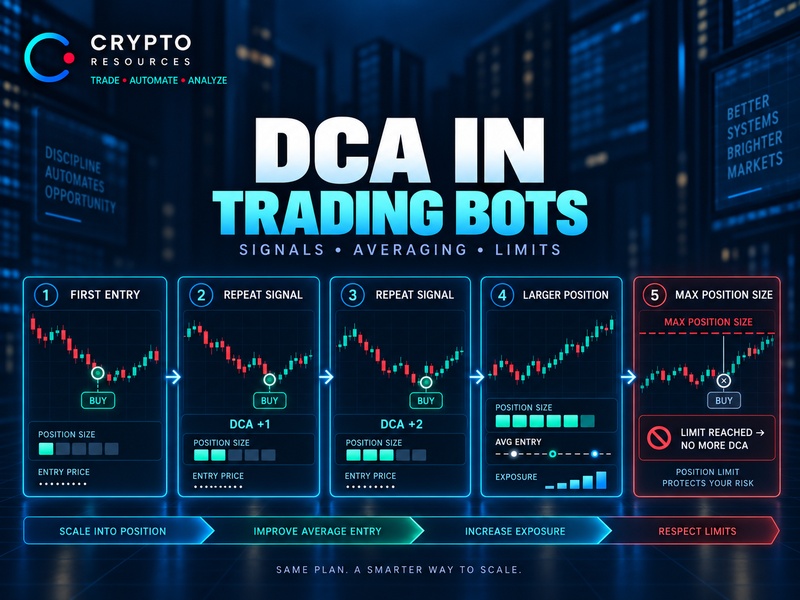
DCA is often explained too simply: price moves against the position, the bot adds more size, the average entry improves, and a smaller reversal is needed to get back to breakeven.
That is only half of the picture.
Every additional order also increases position size, margin usage and total exposure. If the next entries and the maximum position size are not defined in advance, DCA stops being a controlled position-management tool and turns into simple exposure accumulation.
In a trading bot, DCA is better treated as a predefined rule for adding to an existing position.
The real issue is not just when to add. It is why another entry is allowed, how large it can be and where the process stops.
What DCA Means in Automated Trading
Traditionally, Dollar Cost Averaging means splitting capital across several purchases instead of entering the full position at once.
In trading bots, the term is used more broadly. It usually means adding to an open position when a predefined condition is met.
A move against the initial entry does not have to be enough on its own to trigger another order.
DCA may be activated:
- after a specified price move;
- after a repeat trading signal;
- when another set of conditions is met;
- after a defined cooldown period;
- only while the position remains below a preset limit.
A controlled setup should define four things before the first trade:
when to add → how much to add → how often → up to what maximum size.
Without those limits, the final position can grow far beyond what the initial entry suggests.
DCA, Averaging and Martingale Are Different Mechanisms
These terms are often used interchangeably, but they describe different mechanics.
DCA defines when another entry is allowed. The next order may have a fixed size and, for example, appear only after another valid strategy signal.
Averaging describes what happens after size is added: the average entry price changes.
The averaging logic itself can be separate. A bot does not have to add immediately while the market is moving hard against the position. It can wait for the impulse to slow, for a pullback or for another confirmation before placing the next order.
Martingale is different again. In the classic model, the size of the next position increases after an unfavorable outcome, often according to a progression.
That makes exposure and margin requirements rise much faster.
DCA therefore does not automatically mean martingale.
What matters is what triggers the next entry and how the next order size is calculated.
Why a Repeat Signal Is Different From a Simple Price Move
One of the simplest DCA models is to add every time price moves a fixed percentage against the initial entry.
It is easy to automate, but price alone does not explain why the next entry should be better.
An asset can move another 2%, then another 2%, and keep going. If every step automatically creates a new order, the bot keeps increasing exposure while the market is still moving against the position.
A repeat-signal model works differently.
The bot adds only when the market once again meets the strategy conditions.
For example:
first signal → position opened → market continues moving → new signal → limits checked → DCA.
That does not make the second entry safe or guarantee a reversal. It simply means the additional order has its own trading rationale instead of being triggered only by a worse price.
This approach fits naturally with systems that combine several inputs such as volume, open interest, CVD, funding, liquidations, RSI or VWAP.
The Average Entry Improves, but the Position Gets Larger
The math is straightforward.
If the next order is opened at a better price in the same direction, the average entry moves toward the new fill.
For a long position, buying lower reduces the average entry price. For a short position, adding higher raises the average short entry.
A smaller reversal is then needed to get the whole position back to breakeven.
That is the attractive part of DCA.
The less attractive part is that the position is now larger.
If the first entry is 100 USDT and the bot adds another 100 USDT three times, total exposure reaches 400 USDT.
The average entry improves, but the amount at risk is four times larger.
With futures, leverage, margin and funding add another layer.
So DCA cannot be judged only by the new average price. Every additional order also increases total exposure.
Maximum Position Size Is the Main DCA Limit
A bot that can keep adding needs a hard ceiling.
Even fixed-size DCA can build an oversized position if enough entries are allowed.
One of the simplest controls is Maximum Position Size.
Before placing another order, the bot checks the current position. If the next DCA would push it above the configured limit, the order is skipped.
The logic is:
repeat signal → DCA conditions checked → position limit checked → additional order or skip.
This makes the maximum position part of the strategy from the start, rather than an emergency brake applied after exposure has already grown too far.
Other controls can also matter: the number of open instruments, trade direction and total system exposure.
A single position may still be within its own limit while several positions together create too much market risk.
How DCA Works in Trap Radar Bot
In Trap Radar Bot, DCA is separate from opening a new position.
The first signal from a specific Trap Radar can open a trade. If the same Radar later triggers again on the same asset and in the same direction, the bot can add a fixed amount to the existing position.
The DCA amount is set in advance.
Before adding, the bot checks the relevant limits, including maximum position size and the cooldown between signals.
The sequence is:
first signal → position → new signal from the same Radar → cooldown and limits checked → fixed DCA → new average entry.
DCA can be enabled or disabled separately.
New entries and additions to existing positions are controlled independently as well. A user can stop the bot from opening new trades while still allowing DCA on positions that are already open, if that fits the strategy.
Long and Short are configured separately, with their own conditions, sizing and DCA rules.
So there are two different decisions:
Can the bot open a new position?
and
Can it increase an existing one?
Those should not be treated as the same risk.
DCA and Averaging Are Separate in Crypto Resources
In Trap Radar Bot, DCA and averaging are two separate position-management mechanisms.
DCA is triggered by a new signal from the same Radar and adds a predefined fixed amount.
Averaging uses separate logic compatible with the ST-Bot mechanism.
If the market moves against the position, the bot does not have to add immediately. An averaging order can come later, after a specific move, a pullback and the required conditions.
Averaging has its own settings, including distance between entries, the size of the next order and additional filters. VWAP filtering can also be used.
The same position can therefore have two different scaling paths:
DCA after a repeat signal
and
averaging based on separate market logic.
Both increase position size and change the average entry, but they do so for different reasons.
DCA Does Not Automatically Reduce Risk
A better average entry can look like lower risk.
It is not that simple.
After another entry, the market needs a smaller reversal to return the trade to its average price. But if the move continues against the position, the loss is now being calculated on a larger amount of exposure.
That becomes even more important in futures.
Leverage, funding, available margin and liquidation distance all react to the larger position.
Before enabling DCA, the more useful question is not:
“How much will the average entry improve?”
but:
“What will the position size be if every allowed DCA is triggered?”
That number shows the real size of the scenario.
Looking only at the initial entry and treating later additions as small separate trades is an easy way to underestimate total exposure.
When DCA Actually Makes Sense
DCA fits strategies where additional entries are part of the model from the start.
The strategy accepts that the first entry may not be the only one, and another valid signal gives the bot a reason to add within a predefined risk budget.
That is very different from adding just because the current position is losing money.
A losing position is not a trading signal by itself.
If the strategy cannot explain why another entry is justified, DCA becomes little more than a bet that price will eventually come back.
Some strategies do not need additional entries at all.
If a model is built around one entry and an exit when the setup is invalidated, DCA can simply distort the original risk profile.
The presence of DCA therefore does not make a trading bot better.
It is only useful when the next-entry condition, order size and maximum final position are known before the first trade is opened.
DCA Only Works Inside Defined Boundaries
An additional entry changes two things at once: the average price and the total exposure.
That is why DCA should remain a bounded process rather than an automatic response to a growing loss.
A controlled sequence looks like this:
signal → first entry → new confirmed signal → limits checked → DCA → larger position managed → exit.
The trader defines the size of every addition and the maximum position in advance. The crypto bot executes those rules.
That is the real difference between controlled DCA and endless averaging:
additional entries should stop at a predefined risk limit — not when the account runs out of free margin.
Risk Disclaimer
This material is for informational purposes only and does not constitute investment advice. DCA, averaging, automated trading, futures and leverage involve risk. Before using real capital, independently assess maximum position size, conditions for additional entries and acceptable total exposure.