
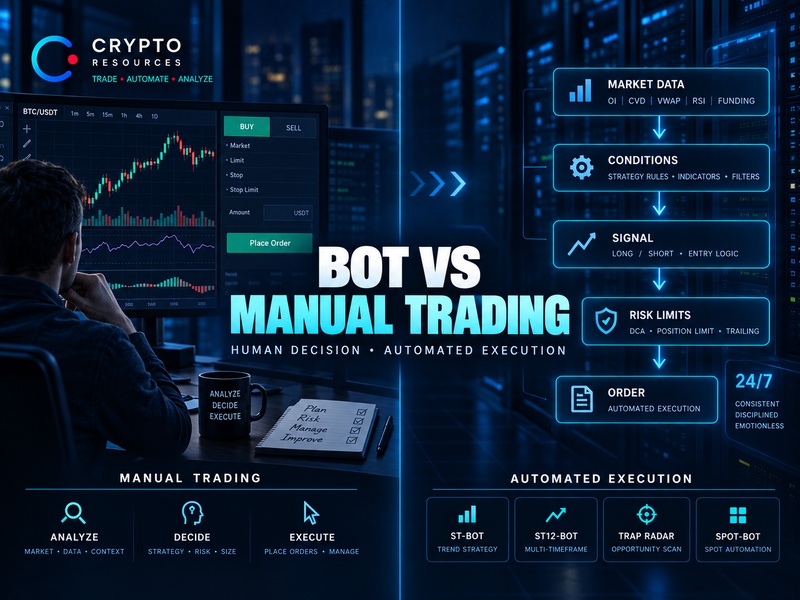
Manual and automated trading are often treated as two opposite choices: either the trader makes every decision personally, or the algorithm takes over completely.
In practice, the dividing line is somewhere else.
A trading bot does not necessarily replace the trading decision. It primarily automates the execution of predefined rules.
The trader still defines the strategy logic, position size, acceptable risk and exit conditions. The bot takes over the repetitive part of the process: monitoring the market, checking conditions and carrying out allowed actions without requiring someone to sit in front of the terminal all day.
That is why the useful question is not “which is better, a bot or a human?” but which parts of the trading process are worth automating.
What the Trader Does Manually — and What Can Be Automated
Even a simple manual strategy involves a long chain of repetitive actions.
You monitor the market, wait for the required conditions, check the instrument, determine position size, place the order, verify execution, add to the position if necessary and manage the exit.
If the strategy uses several inputs — such as RSI, VWAP, open interest, funding, volume and liquidations — the trader has to check the same set of conditions again and again.
Automation turns that sequence into formal rules:
market data → strategy conditions → signal → limits → position size → order → management → exit.
A bot works best when each condition can be described clearly.
If the rule is “open a position when A, B and C are within predefined ranges, provided the position size remains below X,” that can be formalized.
It is much harder to automate something like “the market feels unusual today, so I would rather skip this setup.” That introduces context that cannot always be reduced to a few numerical parameters.
Automation therefore works best on top of a strategy that is already clearly defined, not as a substitute for having one.
Speed and 24/7 Market Monitoring
Crypto markets do not close in the evening and they do not stop for weekends.
A person cannot monitor dozens of instruments around the clock. An algorithm can.
That matters most in strategies where short-lived market events are important. A sharp increase in volume, a change in open interest, a liquidation cluster or a move away from VWAP can appear overnight and disappear before the trader is back at the screen.
As long as the execution process is running, the bot continues checking the market against its rules.
There is also the delay between a signal and the actual action.
A manual trader has to notice the setup, verify the indicators, make the decision, calculate the position and then send the order.
An automated system moves through the same logic programmatically. Once the rules are formalized, much of the manual delay disappears.
But speed by itself does not make a strategy better.
A bot executes bad rules faster too.
If the logic is wrong, automation simply reduces the time between a bad signal and a real position.
Discipline Without Emotion — and Without Doubt
One of the clearest advantages of automation is consistency.
A manual trader may increase position size after a winning streak, skip a valid entry after several losses, close a profitable trade too early or hold a losing position for too long.
A bot does not feel fear, excitement or the urge to “win back” the previous trade.
If the conditions are met and the limits allow the action, the algorithm executes it.
But the same discipline makes hard limits essential.
A bot will not decide on its own to stop after several bad entries unless that stop condition is already part of the strategy.
The same applies to DCA. If a repeated signal allows another entry, the algorithm will add to the position. Then it may add again, as long as the configured limits still allow it.
An automated system therefore has to define not only when to enter, but also when to stop increasing risk.
Initial order size, maximum position size, spacing between additional entries, number of open trades and total exposure all become part of the strategy itself.
Where Manual Trading Still Has an Edge
Humans still have an advantage when market context becomes unusual.
An algorithm works with what has been described in advance.
A trader can take into account factors that are not part of the strategy settings: a sudden macro event, exchange-specific problems, an unusual market structure or a setup that technically passes the filters but looks very different from normal conditions.
That does not mean the trader will make the right call. Manual trading is still vulnerable to emotions and poor interpretation.
The difference is that a person can consciously break their own rule.
A bot can only do that if the exception has already been coded into the system.
The more a strategy depends on subjective interpretation, the harder it is to automate completely without losing some of that logic.
If the strategy is built around measurable inputs — price, volume, OI, funding, CVD, VWAP, RSI, liquidations and other objective conditions — automation becomes much more natural.
Bot Errors Scale Faster
Manual trading is limited by the trader’s own capacity.
If a person is actively managing three positions, a mistake is usually limited to those three trades.
A bot can monitor far more instruments at the same time. That means a bad rule can scale much faster.
If the strategy calculates position size incorrectly, the same mistake can be repeated across several signals.
Correlation creates a similar problem.
Five small altcoin positions may look like five separate trades, but if they are strongly correlated, the account may effectively be carrying one large directional bet on the broader market.
DCA can magnify the same effect. Each additional entry may be valid on its own, while the combined exposure becomes excessive.
That is why automation requires control at the system level, not only at the individual-trade level.
The system should define limits for:
- maximum position size;
- total exposure;
- number of simultaneous trades;
- DCA and averaging;
- leverage;
- exit conditions.
The more actions the bot can perform on its own, the more important those boundaries become.
How This Model Works in Crypto Resources
Crypto Resources separates strategy logic from execution.
The bot connects to Bybit or Binance through API access, while funds remain on the exchange account. The user defines the strategy parameters and risk limits, and the execution process monitors conditions and sends trading instructions to the exchange.
ST-Bot, ST12-Bot, Spot-Bot and Trap Radar Bot are designed for different tasks.
ST-Bot runs its own futures logic, ST12-Bot uses a longer trading horizon, Spot-Bot works in the spot market, while Trap Radar Bot automates scenarios built around Trap Radar conditions.
A signal, for example, can combine OI, CVD, liquidations, volume, funding, RSI and VWAP.
In manual trading, the trader has to wait for those conditions, check the instrument, determine position size and place the order personally.
With automation, the flow becomes:
conditions match → bot checks limits → position size is calculated → order is sent → position is managed according to the configured rules.
The user defines position size, maximum exposure, DCA, Take Profit, Smart Take, Trailing and other parameters in advance.
The responsibility split is straightforward:
the bot is responsible for consistent execution; the trader is responsible for the rules and the level of risk.
Automation Does Not Mean “Set It and Forget It”
Running a bot 24/7 does not mean the system no longer requires attention.
Markets change. Volatility changes. A strategy that works well in one regime may behave worse in another. The API can lose connection, the execution process can stop, and the exchange can change parts of its infrastructure or trading rules.
The trader’s role does not disappear after automation. It moves to a different level.
In manual trading, most of the workload sits inside every trade:
see → decide → enter → manage → exit.
With automation, attention shifts toward the system:
validate strategy → define risk → configure limits → monitor execution → review results → adjust the configuration when needed.
That is less about constantly pressing buttons and more about managing a trading process.
The Crypto Resources execution app can run on Windows or Linux/VPS. For continuous trading, a VPS is usually more practical because the bot remains online without requiring a home computer to stay on.
At the same time, 24/7 operation means continuous monitoring of conditions — not continuous trading. A properly configured bot may do nothing for long periods if the market does not match the strategy.
A Bot Does Not Replace the Trader — It Changes the Trader’s Job
Automation is strongest where trading rules are repetitive and can be described precisely.
A bot can monitor the market around the clock, track more instruments, react faster to signals and execute the same rules without emotional deviation.
A manual trader remains stronger where context matters, where a situation needs interpretation and where it may be necessary to deliberately step outside a predefined model.
The purpose of automation is therefore not to prove that an algorithm “trades better than a human.”
The practical division is simpler:
the trader defines the strategy and acceptable risk → the bot executes the repeatable part of the process.
If the strategy is poorly defined, automation will not fix it.
If the rules are clear, tested and tightly limited, a bot can remove a large amount of mechanical work and make execution more consistent.
So the real question is not “Can a bot replace the trader?” but “Which parts of the trading process are worth automating?”
Risk Disclaimer
This material is for informational purposes only and does not constitute investment advice. Both automated and manual trading, futures and leverage involve risk. Before using real capital, independently assess the trading strategy, risk settings and acceptable position size.