
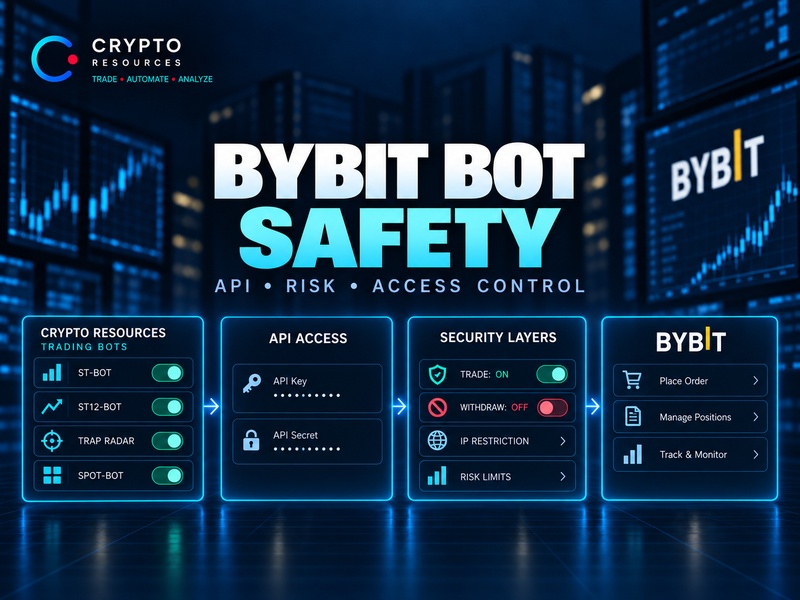
Connecting a trading bot to an exchange account naturally raises security concerns. An external application can interact with Bybit, view positions and submit trading orders — which means it receives access to a real subset of account functions.
But trading-bot security cannot be reduced to one question: can the bot withdraw funds?
A properly configured API key can have withdrawal access completely disabled while still allowing the bot to open, modify and close positions within its trading permissions.
That leads to an important distinction: access to funds and the ability to create trading risk are not the same thing.
The security of automated trading therefore depends on several layers at once: API permissions, key protection, infrastructure, strategy settings and capital limits.
What Does a “Safe Trading Bot” Actually Mean?
Automated trading involves two fundamentally different types of risk.
The first is account-access risk: who has the API key, which permissions have been granted, where connections are allowed to originate and how securely the API Secret is stored.
The second starts after the connection is already working: how large a position the bot can open, how much leverage it can use, how many times it can add through DCA and how much total exposure it can create across several instruments.
These two layers are easy to confuse.
You can secure the API perfectly and still configure a strategy so aggressively that a few losing trades put heavy pressure on the account.
You can also run a conservative trading model while storing the API Secret insecurely or granting the application permissions it does not actually need.
It is therefore more useful to evaluate the full chain rather than some abstract idea of whether a bot is “safe”:
API access → infrastructure → trading permissions → strategy → position limits → monitoring.
A weak point anywhere in that chain increases overall risk.
What a No-Withdrawal API Key Actually Protects
Bybit separates API permissions by function.
Under the current V5 permission structure, derivatives trading falls under ContractTrade, which covers orders and positions. Wallet and Withdraw permissions are handled separately.
This makes it possible to create a trading API key that can execute a strategy without being able to withdraw assets from the account.
For an external trading bot, that is the logical baseline. If the application only needs to analyze conditions, open positions and manage them, it has no reason to receive withdrawal access.
Crypto Resources uses this model: funds remain on Bybit or Binance, while the bot connects through a trading API without withdrawal permission.
This meaningfully limits one category of potential damage. But there is an important boundary.
Withdraw OFF does not mean Trade OFF.
If the key still has trading permissions, it can continue to submit real orders. Disabling withdrawals protects against one type of action, but it does not protect the account from incorrect or excessively risky trading.
Why Trading Permissions Still Need Limits
Permissions for Order and Position are necessary because without them a trading bot cannot do its job.
But those same permissions also create trading risk.
If the system calculates order size incorrectly, it can open a position that is far too large. If repeated entries are enabled, the bot can keep increasing exposure. If leverage is set too high, an adverse move affects margin much faster.
None of this means the API is malfunctioning. The exchange is simply executing commands that were explicitly allowed.
That is why limits need to exist at two levels.
On the Bybit side, the API key should receive only the functions it needs.
Inside the bot itself, the strategy should have its own restrictions: maximum position size, number of additional entries, DCA rules, leverage and exit conditions.
This matters even more in automation. A trader may decide to stop after the second or third bad entry. An algorithm does not reconsider its instructions: if the rule allows another action, it will execute it.
That discipline is both one of the strengths and one of the risks of automated trading.
IP Restrictions, API Secret and Infrastructure
The next security layer sits around the API key itself.
Bybit allows API access to be restricted to specific IP addresses. For a bot running on a VPS with a static IP, this is particularly useful: the key can be tied to the server from which trading requests are expected.
A home computer is less straightforward. If the internet provider uses a dynamic public IP, the connection may need to be reconfigured after that address changes.
There is also an operational issue: API-key status and expiration need to be monitored. A connection should not be configured once and then forgotten indefinitely.
The API Secret deserves separate attention. It is used to sign private requests and should be treated like a password.
A practical security model is fairly conservative:
- use a dedicated API key for each service;
- grant only the required trading permissions;
- keep Withdraw disabled;
- use IP restrictions where a stable address is available;
- store the API Secret like a password;
- delete unused or compromised keys;
- check API status periodically.
None of these controls improve the trading strategy itself. Their purpose is to reduce the attack surface around the account.
The Main Risk Often Sits Inside the Strategy
Once access to Bybit is configured correctly, most of the remaining risk moves into the trading algorithm itself.
A futures bot can be technically secure and still trade with an oversized position.
DCA can improve the average entry price, but every additional order increases total exposure.
Leverage allows a larger market position to be controlled with less margin, but it also reduces the room available for an adverse move.
Several small positions do not necessarily mean small overall risk either. If they are all opened in the same direction across highly correlated altcoins, the account may effectively be carrying one large directional bet on the broader market.
That is why limiting only the first order is not enough.
An automated system should define in advance:
- initial position size;
- maximum total position size;
- DCA or averaging rules;
- leverage;
- exit conditions.
In Crypto Resources, these parameters sit inside the execution layer of each individual bot.
For example, Trap Radar Bot may receive a signal after a combination of OI, CVD, liquidations, volume, funding, RSI or VWAP conditions is met. But that signal does not automatically become an unlimited position.
The bot still applies direction, entry size, maximum position, DCA and exit settings.
The flow is:
market conditions → strategy signal → execution limits → API order to Bybit.
Without the execution-limit layer, even a good signal can be traded with poor risk control.
Why Demo Matters for Security
Demo is often treated only as a way to see whether a strategy makes money. For automation, it has another important role: checking whether the system itself behaves correctly.
Bybit Demo uses virtual funds and provides a separate Open API. Demo and Testnet are not the same environment: Demo is designed for simulated trading closer to the main market environment, while Testnet remains a separate testing infrastructure.
For a trading bot, Demo makes it possible to run the full workflow without exposing real capital.
The important thing is not only whether a trade wins or loses, but how the execution layer behaves: what position size is created, whether the maximum limit is respected, whether DCA works as intended, and whether Take Profit, Smart Take, Trailing and other exits trigger correctly.
Execution errors are much cheaper to find on virtual positions than after a live order has been sent.
A successful Demo run still does not guarantee identical behavior in Live. Real trading differs in liquidity, fill prices and slippage.
That is why moving to real funds should be treated as a separate stage: a new Live API connection, a small initial position size and another round of validation under real execution conditions.
How Security Works in Crypto Resources
Crypto Resources uses an external automation model: the trading bot runs separately from the exchange and communicates with Bybit or Binance through API access.
Funds remain on the exchange account. The bot connects through trading permissions without withdrawal access.
From there, the user defines the limits of the strategy itself: position size, maximum exposure, DCA, entry conditions and exit rules. Depending on the selected bot, this can include Take Profit, Smart Take, Trailing Stop and other position-management logic.
ST-Bot, ST12-Bot, Spot-Bot and Trap Radar Bot use different trading logic, but the execution principle remains the same: the bot operates within the configuration defined by the user.
The execution application runs on Windows or Linux/VPS. For 24/7 automation, always-on infrastructure is more practical because stopping the external application also stops new execution logic from running.
The same setup can be tested in Demo before moving to Live.
The result is a layered model rather than a single security setting: Bybit limits API permissions, the user limits what the strategy is allowed to do, and the execution layer operates within those predefined boundaries.
Security Is a System of Limits
A Bybit trading bot can be connected without withdrawal permission. That is an important protection layer, but it only addresses access to assets.
For automated trading, it matters just as much what the bot can do through the trading permissions it has been granted.
Security therefore starts with API permissions, IP restrictions and Secret protection, but continues inside the strategy itself: position size, leverage, DCA, total exposure and exit rules.
The next layer is execution validation through Demo and small Live exposure. Another is reliable infrastructure and continuous monitoring of the system.
So the question “Is it safe to use a trading bot on Bybit?” is better reframed as:
How tightly have you limited what the bot can access — and what it is allowed to do with trading capital?
The clearer those boundaries are before launch, the more controlled the automation becomes.
Risk Disclaimer
This material is for informational purposes only and does not constitute investment advice. Automated trading, futures and leverage involve risk. Before going live, independently review API permissions, strategy settings and acceptable position size.