
Crypto markets run around the clock, but much of the actual trading process is repetitive: check the conditions, filter the asset, calculate position size, place the order, manage the open trade and exit according to predefined rules.
All of that can be automated. What automation cannot decide on its own is the most important question — why should the trade be opened in the first place?
A trading bot does not create an edge by itself. It executes logic that already exists. Automation can make a sound strategy more consistent. It can also make a weak strategy repeat the same mistakes faster and with perfect discipline.
On Bybit, there are two main approaches: use the exchange's built-in trading bots or connect an external system through the API. Both are forms of automated trading, but their architecture and flexibility are very different.

What Does It Mean to Automate Trading on Bybit?
A manual trade starts with a trader making a decision. They assess the market and click Buy or Sell.
In an automated system, that decision is converted into explicit rules.
A strategy might allow an entry only when price is positioned a certain way relative to VWAP, RSI is within a defined range, open interest is expanding, volume confirms the move and funding remains within acceptable limits.
When the required conditions line up, the system generates a trading signal.
But a signal does not automatically have to become a trade.
Before sending an order, the system can check market liquidity, the age of the asset, allowed direction, the number of existing positions, current exposure and other restrictions. Only then is the position size calculated and the order sent to the exchange.
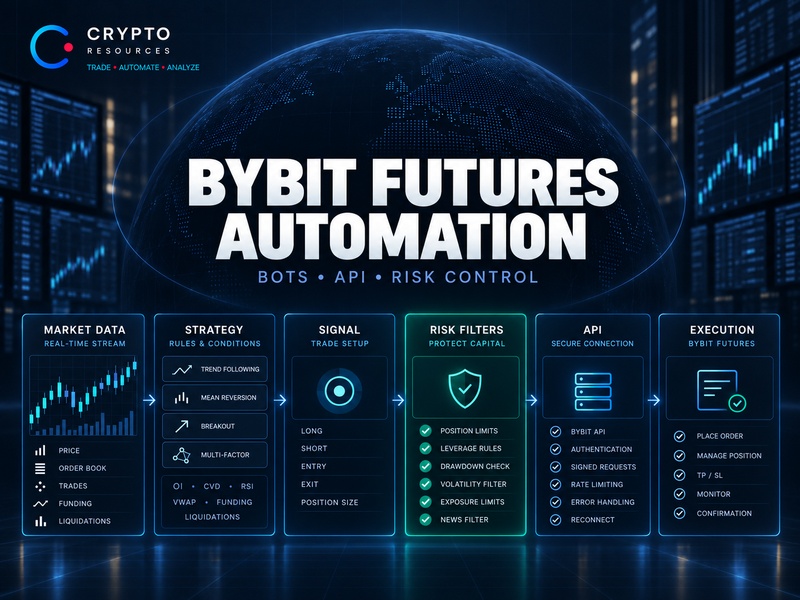
The full process looks like this:
market data → strategy conditions → signal → filters → position size → order → position management → exit.
That entire chain — not simply automated order placement — is what turns a trading idea into a complete automated system.
Bybit's Built-In Bots vs an External API Bot
Bybit has its own Trading Bot infrastructure, including tools for automating both futures and spot trading.
These bots run directly inside the exchange. The user selects one of the available bot models and configures the parameters supported by Bybit. No separate application or external API connection is required.
This approach works well when the trading objective fits a model already built into the exchange.
For example, Futures Grid automates trading around a predefined grid structure. The trader configures the parameters, while Bybit handles execution.
An external trading bot works differently.
The strategy runs outside the exchange. A separate system receives data, evaluates its own conditions and sends trading instructions to Bybit through the API.
This makes it possible to use custom indicators, additional data sources, filters, repeat-entry rules and independent position-management logic.
The question is therefore not which approach is universally better. The trading logic comes first; the execution architecture is chosen around it.

A Trading Bot Does Not Start With an Order
An open position is the most visible output of a bot, but architecturally it is already one of the final stages.
The process begins with data.
A simple strategy may need nothing more than candles and price. A more complex model can also use volume, open interest, funding, CVD, liquidations or conditions across several timeframes.
The strategy rules are then evaluated.
Suppose a system is designed to trade overheated moves. A high RSI alone is a weak trigger: strong assets can remain overbought for a long time. The strategy may therefore combine RSI with distance from VWAP, changes in open interest, volume and liquidation structure.
When the required conditions line up, a signal is generated.
Then the filtering begins.
Even a valid signal should not automatically turn into a position if the maximum position size has already been reached, the asset is blacklisted or additional market filters fail.
Only after those checks does the system create an order.
A Signal and a Trade Are Not the Same Thing

This is one of the most important distinctions in a properly designed automated system.
A signal answers:
"Do current market conditions match the strategy?"
The execution layer answers a different question:
"Are we allowed to open this specific trade now, and at what size?"
Suppose the strategy identifies valid conditions on five instruments at the same time. Each signal may be acceptable on its own, but five similar positions can create excessive portfolio-level exposure.
That is why restrictions sit between the signal and the exchange.
A system can limit the number of simultaneous positions, position size, total exposure, trading direction, market volume, funding, listing age, whitelist and blacklist status.
This layer is particularly important in futures trading. A bad signal creates a bad entry. Bad exposure controls can turn several ordinary losing trades into a problem for the entire account.
What Happens After a Position Is Opened?
A bot that can only enter trades is only half automated.
Once a position is open, the system has to manage it.
The simplest model uses predefined take profit and stop loss levels. More flexible systems may use trailing exits, respond to changes in market conditions or react to new signals.
DCA and averaging require even more discipline.
Adding to a position at a better price improves the average entry, but it also increases total exposure. An automated system therefore needs not only rules for the next order, but also a hard ceiling on position size.
A controlled setup defines in advance when another entry is allowed, how large it can be, how much time must pass between additions and how far the position may be scaled.
The same principle applies to repeated signals. Five identical signals in a row should not automatically mean a fivefold increase in exposure.
Why Futures Bots Need Tighter Risk Controls
In spot trading, the purchased asset remains in the account. A sharp price decline creates an unrealized loss, but the price move itself does not trigger forced liquidation of the position.
Futures add another layer of risk.
Leverage increases market exposure relative to the margin being used. Funding creates periodic payments between market participants. A sharp move can push a position toward liquidation, while high volatility increases the risk of slippage.
Automation does not remove any of these risks.
In fact, an algorithm can increase risk with perfect consistency if that is what its rules instruct it to do.
Position size, maximum exposure, leverage and additional-entry rules are therefore just as important as the original signal. These are the parameters you set before launching a Bybit futures bot.
How an External Bot Connects to Bybit
The connection between an external trading system and the exchange is the API — a programmatic interface that allows an application to access permitted data and perform authorized actions.
API permissions are separated by function. A trading system can receive access to orders and positions without being granted permission to withdraw funds.
For a bot whose job is limited to trading, withdrawal permission is not required.
This follows a basic security principle: an application should receive only the permissions it actually needs.
But removing withdrawal access does not make the API key risk-free. A key with trading permissions can still open and close real positions.
A faulty strategy, incorrect order size or compromised API key can therefore still cause serious damage.
API security is not just about disabling withdrawals. It also means limiting permissions, storing credentials securely and monitoring the actions performed by the connected system.
Where Does an External Trading Bot Run?
A native Bybit bot runs on the exchange's own infrastructure. An external system needs its own continuously running process.
That can be a home computer. As long as the software is running and the connection is active, the bot can receive data and send commands.
Turn the computer off, however, and the trading logic stops with it.
For around-the-clock automation, traders usually rely on an always-on machine or VPS. At that point, operational reliability becomes part of the trading system: reconnection logic, error handling, logs and process monitoring all matter.
This becomes especially important once a position is already open.
If the bot enters a trade and then stops running, the remaining position-management logic may never execute. Monitoring is therefore part of the trading infrastructure, not an optional technical detail.
Automation Should Not Start With Real Money
Launching a new strategy directly on a main account is an expensive way to discover mistakes.
The logic should be tested first.
Historical testing shows how the rules would have behaved on past data. It is useful for finding obvious weaknesses and configuration errors, but it is not a forecast of future returns.
Live markets include slippage, changing liquidity, funding and market regimes that may not exist in the selected historical period.
There is also the problem of overfitting. If parameters are optimized too aggressively against historical data, the strategy may explain the past extremely well while performing poorly after deployment.
The next stage is demo or paper execution. At this point, the full pipeline can be tested: whether signals appear correctly, position size is calculated as expected, the correct orders are sent and positions are managed properly.
Only after that does it make sense to move to small real exposure and scale gradually as live data accumulates.
How This Architecture Works in Crypto Resources
Crypto Resources bots use the external automation model: the system connects to Bybit or Binance through API access and executes predefined trading logic.
Different bots are designed for different tasks.
ST-Bot uses its own futures-entry logic, ST12-Bot operates on a longer trading horizon, Spot-Bot is designed for spot trading, while Trap Radar Bot allows execution to be built around Trap Radar conditions.
Trap Radar is a good example of the separation between a signal and a trade.
Conditions can include OI, CVD, liquidations, volume, funding, RSI, VWAP and other parameters. When the required combination is met, a signal is created. The trading bot then applies its own position limits and trade-management rules.
In other words, a market condition does not turn directly into an unrestricted exchange order.
The execution layer controls position size, DCA, limits, take profit, trailing and other parameters. Before live deployment, a setup can be checked through demo trading and backtesting.
The API is used for trading operations and does not require withdrawal permission.
The value of this architecture is not that the algorithm will be right on every trade. It is that trading logic becomes formalized, while execution becomes consistent and reproducible.
Where Trading Automation Usually Breaks Down
One of the most common mistakes is automating an untested idea too quickly.
A trader sees a few successful historical examples, turns the strategy into a bot, adds high leverage, larger position sizes and aggressive averaging. The result is a system that becomes extremely efficient at reproducing an unverified risk model.
Another problem is controlling each individual position while ignoring total account exposure.
Ten small trades can effectively behave like one large directional position if the assets are highly correlated with each other and with the broader market.
Uncontrolled DCA creates the same type of problem. The average entry improves, but position size keeps growing.
Another weak approach is to simply "set it and forget it." Automation reduces manual work, but it does not remove the need to supervise the system itself. An API can return an error, a connection can fail, exchange conditions can change and the market can shift into a regime the strategy was never designed to handle.
Automation Is an Execution Layer
A Bybit Futures trading bot does not have to be complicated. In many cases, a small number of transparent rules is more practical than a system built from dozens of indicators that nobody can clearly explain anymore.
But the execution pipeline still has to be complete.
The system receives data, evaluates trading conditions, filters the signal, limits position size, sends the order, manages the open trade and controls the exit.
If one of those layers is missing, automation simply moves a manual trading problem into code.
The job of a good futures bot is therefore not to constantly find trades. It is much more practical: execute predefined rules accurately, remain within defined limits and leave control of risk with the trader.
FAQ
What is a Bybit Futures trading bot?
It is either a program or a built-in exchange tool that executes predefined trading rules on the futures market, including condition checks, order placement and position management.
Can Bybit trading be automated through an API?
Yes. The Bybit API allows external applications to access permitted data and perform trading operations within the permissions granted to the API key.
Does a trading bot need withdrawal permission?
No, if the system is only used for trading. An API key should be granted only the permissions required for its actual function.
How is an external bot different from a built-in Bybit bot?
Built-in bots operate within models and parameters provided by the exchange. An external API bot can use custom signals, filters and independent position-management rules.
Does using a trading bot reduce risk?
Not by itself. Risk still depends on the underlying strategy, position size, leverage, total exposure, DCA rules and exits.