
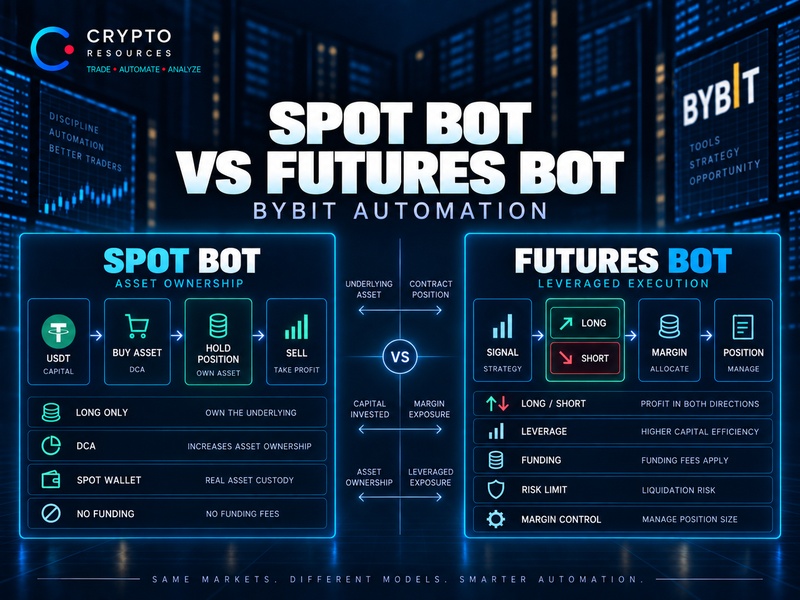
A Spot Bot and a Futures Bot can follow the same basic process: read market data, wait for a setup, open a position and close it according to predefined rules.
What changes is the risk after entry.
On Spot, the bot buys the asset itself. If the strategy buys 100 USDT worth of BTC, roughly that amount of BTC appears on the account.
On Futures, the bot opens a contract position. Long and Short, leverage, margin, funding and liquidation risk all become part of the trade.
So choosing between a Spot Bot and a Futures Bot changes more than the market being traded. It changes how the position has to be managed once the signal turns into an order.
A Spot Bot Works With the Underlying Asset
In regular Spot trading, the bot buys an asset using funds already available on the account.
The basic flow is:
USDT → buy BTC → BTC held on the account → sell BTC later.
If borrowed funds are not used, there is no futures-style leverage and no separate liquidation mechanism caused by insufficient margin.
Price can move sharply against the entry, but the purchased asset remains on the account until it is sold.
That does not make Spot risk-free.
The bot can still buy a weak asset, build an oversized position through DCA or leave capital tied up in a falling market for a long time.
The difference is simple: position size is directly linked to the capital actually used to buy the asset.
A Futures Bot Works With a Contract Position
On Futures, the bot does not buy the asset in the same way it would on Spot. It opens a contract position.
That creates two directions:
Long → trading upside
Short → trading downside.
Margin also becomes part of the model.
The notional value of the position can be much larger than the capital allocated as margin.
A 1,000 USDT position, for example, does not necessarily require 1,000 USDT of the trader’s own capital to be locked. Required margin depends on leverage and margin settings.
So a Futures Bot has to look beyond the size of the first order.
It needs to track the full notional position relative to available margin.
Leverage Changes Capital Usage, Not Signal Quality
Leverage does not make a good signal better.
It changes the relationship between position size and the margin required to open it.
With the same notional position, PnL from the same price move does not increase simply because the leverage setting is higher. Higher leverage requires less initial margin and, all else equal, leaves a smaller buffer before liquidation.
That becomes especially important if a Futures Bot can also use:
- multiple positions;
- DCA;
- averaging;
- high total exposure.
Limiting only the first entry is not enough.
The maximum position size needs to be known in advance, along with the margin load created by all permitted additional entries.
Short Is One of the Main Differences With Futures
A regular Spot Bot mainly follows this structure:
buy → sell later.
Futures allow a bot to automate a full Short strategy:
Short signal → open Short → price moves lower → close position.
That matters for strategies built around overheated pumps, funding imbalances, rising OI, abnormal volume, liquidations or other signs that a move is becoming vulnerable.
The same market condition can be detected on Spot.
But a regular Spot Bot cannot turn it into a classic Short position without borrowed assets or another margin mechanism.
Futures therefore give the system a second full trading direction.
Funding Exists in Perpetual Futures, Not Regular Spot
Another difference appears after the position is opened.
A regular Spot position does not pay funding simply for holding the asset.
In perpetual futures, Long and Short positions exchange funding payments.
With small rates and short holding periods, the effect may be minor. Over longer trades or during extreme funding, it can materially change the cost of the position.
A Futures Bot can use funding:
- as part of the signal;
- as an entry filter;
- as part of the holding-cost calculation.
Regular Spot trading does not have this layer.
DCA Looks Similar on Spot and Futures but Changes Risk Differently
The DCA flow can look almost identical:
first entry → additional signal → new order → new average entry.
The effect on risk is different.
On Spot, another entry means more of the trader’s own capital has been converted into the asset.
On Futures, it increases contract exposure and adds to the margin load.
So two DCA setups that look the same on paper can create very different positions.
On Spot, maximum position size tells you how much capital can end up tied to the asset.
On Futures, you also need to account for leverage, margin usage and the remaining buffer before liquidation.
A Falling Position Ends Differently on Spot and Futures
Suppose the bot opens a Long and the market keeps falling.
On regular Spot, the asset loses value but remains on the account.
The bot can wait, close the position or add another allowed DCA entry.
On Futures, adverse price movement also reduces the margin buffer.
If the position reaches liquidation conditions, the exchange can close it automatically.
For a Spot Bot, the main question is:
how much capital are we willing to keep tied up in a falling asset?
For a Futures Bot, there is another one:
how far can the market move against the position before the current margin setup can no longer support it?
That is why the same signal should not automatically use the same position size on Spot and Futures.
Spot Does Not Mean “Safe”
Reducing the difference to Spot is safe, Futures are risky is too simplistic.
Spot removes some risks that are specific to Futures: leverage, funding and forced liquidation of a regular Spot position.
But the asset itself can still lose a large part of its value.
If a bot keeps buying a falling, illiquid altcoin without a hard position limit, the absence of a liquidation price does not solve the problem.
The capital simply remains tied up in a losing asset.
The real advantage of regular Spot is a simpler risk structure: position size is directly linked to the capital actually invested.
When Spot Automation Makes More Sense
Spot is a natural fit for strategies where the trader actually wants to buy and hold the underlying asset.
For example:
- gradual position building;
- Long-only strategies;
- buying pullbacks;
- accumulation through DCA;
- strategies that do not need Short exposure;
- longer holding periods.
If the strategy is built around buying the asset and selling it later, Futures may add complexity without adding much value.
In that case, automation is mostly about discipline and consistent execution.
When Futures Give the Bot More Flexibility
Futures make sense when the strategy itself needs more tools.
The most obvious one is Short.
If the system needs to trade market weakness, overheated pumps or dedicated Short setups, Futures allow that logic to be automated directly.
They also provide more flexible use of capital through leverage and margin.
But available leverage should not dictate trade size.
It helps to separate three things:
signal quality → position size → available leverage.
They are different variables.
Spot Margin Is a Separate Model
Regular Spot and Spot Margin should not be treated as the same thing.
Spot Margin uses borrowed funds. That introduces borrowing costs, leverage and liquidation risk.
So the statement “Spot has no liquidation” applies only to regular Spot trading without margin.
The trade still takes place on the Spot market, but risk now depends not only on the value of the asset, but also on borrowed capital and margin conditions.
For a trading bot, that becomes a separate model with its own position limits and borrowing constraints.
How Spot and Futures Are Separated in Crypto Resources
In Crypto Resources, these two markets are separated at the trading-system level.
SPOT Bot uses Long-only Spot logic: the bot buys the asset and manages the position without a futures Short side.
Futures strategies are handled separately.
ST-Bot and ST12-Bot use their own Futures logic, while Trap Radar Bot allows independent Long and Short setups built from Trap Radar conditions.
The difference also shows up in position management.
DCA on Spot increases the amount of the asset actually purchased.
DCA on Futures increases contract exposure and margin usage.
A Long on Spot means owning the asset.
A Long on Futures means holding a contract position.
A Short is not simply the opposite side of a regular Spot Bot, while on Futures it is a full strategy direction.
Trading robots: Spot Bot and Futures Bot are therefore better treated as two different automation tools, not the same algorithm with a market switch.
Choose the Risk Model, Not Just the Market
The Spot or Futures question is often reduced to potential returns.
For automated trading, the more useful question is what kind of position the system needs to manage.
If the strategy buys the underlying asset and can hold it for longer periods, Spot keeps the structure simpler.
If the strategy needs Short exposure, independent Long/Short setups and more flexible use of capital, Futures offer more options — together with stricter position-control requirements.
The biggest difference appears after entry:
A Spot Bot manages capital invested in the asset.
A Futures Bot manages a contract position, margin and allowed exposure.
The same trading idea can be used in both markets, but position sizing, DCA and risk limits should not be identical.
Risk Disclaimer
This material is for informational purposes only and does not constitute investment advice. Spot, Spot Margin, Futures, automated trading, DCA and leverage involve risk. Before using real capital, independently assess the strategy, maximum position size and acceptable total exposure.