
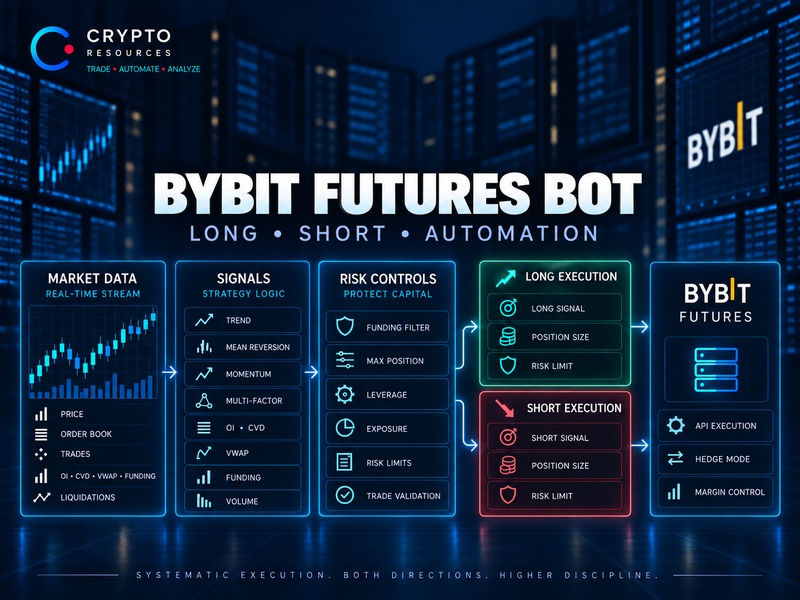
A futures trading bot has more variables to deal with than a system that simply buys an asset automatically. Beyond the signal itself, it has to account for trade direction, leverage, margin, funding and liquidation risk.
A Buy or Sell instruction alone is not enough.
Before an order is sent, the system needs to determine whether it is opening a Long or a Short, how large the position should be, which limits apply and what happens after entry.
On Bybit, this logic also depends on position mode. In One-Way Mode, you can only hold one net position per contract. In Hedge Mode, Long and Short positions can exist independently at the same time.
A futures bot is not an automated Buy/Sell button. It is an execution system where direction, position size and management rules are defined in advance.
How a Futures Bot Differs From a Spot Bot
In spot trading, the bot works with the underlying asset itself: it buys the asset and later manages the sale according to the strategy rules.
Futures add the ability to trade both directions.
A Long position is used when the strategy expects price to rise. A Short position allows the trader to profit from downside without owning the underlying asset first.
Leverage and margin also enter the picture.
Position size can be much larger than the capital allocated as margin. With the same notional position size, higher leverage reduces the amount of initial margin required and leaves less room before liquidation.
Funding adds another layer. In perpetual futures, Long and Short positions exchange funding payments depending on the current rate and market imbalance.
As a result, a Futures Bot has to manage more than the entry itself. It also needs to account for the cost of holding the position, total size and remaining risk capacity.
The signal is only the start of the trade.
Long and Short Do Not Have to Use the Same Strategy
Mirroring the exact same logic in both directions does not always make sense.
Markets are not perfectly symmetrical.
A Short setup after an overheated pump may look for rising open interest, elevated RSI, a strong deviation from VWAP, abnormal volume or a specific liquidation structure.
A Long setup after a sharp drop may depend on different conditions: oversold readings, a shift in CVD, participant capitulation, recovering volume or a return to a defined market structure.
Even the same indicator can behave differently depending on direction.
A high RSI is not a Short signal by itself. A low RSI does not automatically create a Long either. In a strong trend, both conditions can persist far longer than expected.
Long and Short are therefore better treated as two separate trading systems:
when the bot is allowed to look for Longs
and
when the bot is allowed to look for Shorts.
Each side can use its own signals, filters, position sizing and exit rules.
A Signal Does Not Automatically Mean a Trade
Suppose the strategy produces a Short signal.
The bot does not have to send a market order immediately.
Before execution, it can check:
- whether Short entries are currently allowed;
- whether the asset passes whitelist or blacklist rules;
- whether trading volume is sufficient;
- whether current funding is acceptable;
- whether the maximum number of open positions has been reached;
- whether total exposure is already too high;
- whether there is an existing position in the same asset;
- whether the new order fits within the configured position limit.
Only after those checks does the system calculate the order size and send the instruction to the exchange.
The full path looks like this:
market data → strategy conditions → Long/Short signal → filters → position size → Bybit API → position.
That layer between the signal and execution is what turns the system into a trading bot rather than a simple alert generator.
One-Way Mode and Hedge Mode Change How the Bot Operates
Bybit supports two ways of managing futures positions.
In One-Way Mode, you can only hold one net position per contract.
If a Long is already open, an opposite Short order will start reducing or closing that position. It does not create a separate independent Short alongside the existing Long.
In Hedge Mode, the two sides are separated.
A Long and a Short can be held on the same contract at the same time, and opening one side does not have to reduce the other.
That matters for automation.
Imagine a longer-term Long is already open while a separate short-term strategy produces a Short signal.
In One-Way Mode, both strategies start interacting with the same net position.
In Hedge Mode, they can remain separate:
Long → own entry → own size → own management
Short → own entry → own size → own management
This does not automatically reduce risk. Both sides still use margin and need to be included in total exposure calculations.
But Hedge Mode allows two trading logics to run independently instead of constantly offsetting each other.
Leverage Changes Position Scale, Not Signal Quality
Leverage is often treated as a way to “amplify” a good entry.
But leverage and signal quality are separate issues.
If a strategy identifies a valid setup, using more leverage does not make the setup itself stronger. It changes the relationship between position size and the amount of margin required.
With the same notional position, higher leverage means less initial margin and a smaller buffer before liquidation.
That matters even more in automation because the bot simply executes the parameters it has been given.
If high leverage, multiple open positions and additional entries are all allowed at the same time, account exposure can grow far beyond what the first trade suggests.
Risk control should therefore focus not only on initial order size, but also on the maximum position size after possible DCA or averaging entries.
Leverage is a capital-management tool, not a way to fix a weak signal.
Funding Affects the Cost of Holding the Position
Perpetual futures do not expire, so funding helps keep contract prices aligned with the spot market.
Depending on the current rate, one side pays the other.
A single funding payment may be small, but over a longer holding period it becomes part of the trade result. The effect is more noticeable when positioning becomes heavily skewed and one side is expensive to hold.
For a trading bot, funding can serve two different purposes.
The first is as part of the signal, showing an imbalance in positioning.
The second is as an execution filter, blocking a trade when the cost of holding the position becomes too high.
A strong setup can still be unattractive if the funding cost works heavily against the position.
More Signals Should Not Automatically Mean More Risk
A bot can track far more instruments at once than a human trader.
But five signals should not automatically become five open positions.
Suppose the system receives Short signals on several altcoins at the same time.
On paper, they are separate trades. In practice, if those assets are highly correlated with Bitcoin and the broader crypto market, they can behave like one large directional bet.
The same applies to Long positions.
Per-trade limits alone are therefore not enough. The bot also needs to account for the number of open positions and the combined directional exposure of the portfolio.
DCA and averaging increase that risk further. A small initial position can become much larger after several additional entries.
A good Futures Bot should not only know when to open a trade. It should also know when to skip a signal because total exposure is already too high.
How Long and Short Are Automated in Crypto Resources
Crypto Resources futures bots connect to Bybit through API, while the trading logic runs on the Crypto Resources side.
ST-Bot uses its own futures strategy, ST12-Bot operates on a longer horizon, and Trap Radar Bot can automate setups built through Trap Radar.
In Trap Radar Bot, Long and Short are configured independently.
Each direction can use its own Radar conditions, filters, position size, DCA, averaging and exit rules.
For example, a Short setup may look for an overheated move through a combination of OI, CVD, liquidations, volume, funding, RSI and VWAP.
The Long side does not have to mirror that setup. It can use a different set of conditions and separate limits.
Trap Radar Bot on Bybit uses Hedge Mode, allowing Long and Short positions on the same asset to exist independently.
The logic is split into two branches:
Long conditions → Long signal → Long limits → Long position
Short conditions → Short signal → Short limits → Short position
The API handles execution. Direction, filters and acceptable risk are determined before the order reaches Bybit.
Futures Automation Starts Before the Order
The most basic version of a futures bot looks like this:
signal → order.
For a real Futures Bot, that is not enough.
Before execution, the system needs to know the direction, allowed position size, existing exposure, holding cost and the rules for managing the trade after entry.
Only then does a signal become an actual Long or Short position.
The job of a futures bot is not to press Buy or Sell faster. It is to execute a predefined trading model consistently without moving outside the configured risk limits.
Bybit provides the tools needed for that: Long and Short positions, One-Way and Hedge Mode, margin controls, perpetual futures and API access.
The rest comes down to the rules of the strategy and the limits built around it.
Risk Disclaimer
This material is for informational purposes only and does not constitute investment advice. Futures, automated trading, Short positions, leverage and Hedge Mode involve risk. Before using real capital, independently assess the trading strategy, position size, leverage and acceptable total exposure.