
Crypto is often judged by the price of Bitcoin. If BTC falls, the market quickly moves into fear. If the price rebounds, talk of a reversal returns.
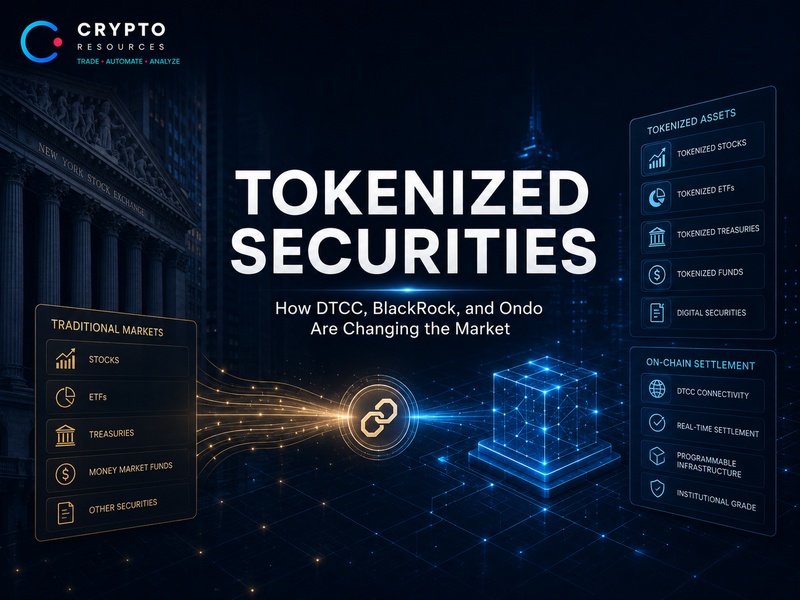
That focus makes sense for short-term trading. But it does not show what is happening in the market’s base infrastructure. While traders argue about the next candle, financial firms are preparing products where traditional assets take digital form on blockchain networks.
This is not about memecoins or another speculative sector. The companies involved are connected to securities settlement, ETFs, bank payments, asset custody, stock markets, and reporting.
Price still depends on interest rates, liquidity, ETF flows, and broader risk demand. But the infrastructure trend is moving on a separate track: the market is preparing a blockchain environment for assets that already exist in traditional finance.
Why a Weak Market Does Not Cancel the Institutional Trend
The first half of 2026 again showed a familiar weakness in crypto. A sharp drawdown does not always require an internal industry crisis. A tight macro environment, weak risk demand, and ETF outflows can be enough.
In that environment, the market sees a familiar set of signals:
- Bitcoin loses important levels;
- altcoins fall faster than the broader market;
- ETFs record outflows;
- liquidations amplify the move;
- investors reduce risk.
Financial firms work on a different timeline. They do not launch settlement systems for one trading week. They need a legal model, asset custody, clearing, reporting, liquidity, and compatibility with the existing market.
That is why price can remain weak while tokenization work continues.
DTCC: Tokenization Has Already Entered Live Settlement
One of the strongest signals comes from DTCC. This is part of the traditional U.S. market infrastructure and is connected to post-trade settlement for a large volume of securities transactions.
In July 2026, DTCC successfully processed live transactions with DTC-tokenized assets. This is an important step ahead of the full tokenization service launch planned for October 2026.
This does not mean the entire stock market has already moved onto blockchain. The important point is different: tokenization has entered the working environment of organizations that service the real securities market.
The initiative involved large companies from both traditional and digital finance. They included:
- BlackRock;
- Goldman Sachs;
- J.P. Morgan;
- Nasdaq;
- NYSE;
- Citadel Securities;
- Vanguard;
- Invesco;
- Broadridge;
- Ondo Finance;
- Chainlink;
- Circle.
DTCC did not test abstract tokens. It tested practical market scenarios: collateral, securities lending, Treasury transactions, equity transactions, tokenized asset transfers, and margin processes.
For crypto, this is a serious shift. Blockchain is starting to be used as a settlement environment for financial assets that already exist.
Ondo and BlackRock IVV: Tokenized ETFs Move Closer to the Market
Ondo Finance is moving in the same direction through tokenized securities. The company brought tokenized versions of BlackRock’s IVV ETF and Micron shares to Ethereum.
The key point is not the wrapper itself. It is the legal structure behind it. The market has already seen tokenized stocks offered through offshore schemes, synthetic instruments, and questionable models. That is not enough for large capital.
Institutional investors need:
- clear rights to the underlying asset;
- securities held inside a regulated custody system;
- reporting;
- voting;
- disclosure;
- a link between the token and the underlying security.
In Ondo’s model, the underlying securities remain in the traditional custody system. The tokens are issued on blockchain, while holders receive rights tied to the underlying securities. Broadridge handles voting, disclosure, and communication with holders.
That brings the model closer to traditional market standards.
What matters:
- recognizable traditional assets are being tokenized;
- Ethereum is being used;
- the underlying securities remain inside regulated infrastructure;
- investor rights are tied to the underlying securities;
- blockchain is being integrated into existing market rules.
There are still limits. These products should not be seen as open access to every stock for every user. Some structures operate within a narrow legal perimeter and may be unavailable to investors from certain countries.
But the direction is clear. A token is increasingly being used as a digital representation of a normal financial asset.
Open USD: Stablecoins Move Beyond Crypto Exchanges
At the same time, the payments layer is developing. Open USD shows that stablecoins are no longer interesting only to crypto exchanges and traders.
Visa, Mastercard, Coinbase, and more than 140 companies have gathered around the project. The model is built around a dollar stablecoin designed to simplify business payments and give participants a clear reserve-based economic structure.
Stablecoins have long been the base settlement unit inside crypto. The next stage is the use of dollar tokens in payment networks, corporate transfers, and international settlements.
For the market, this is a separate signal. Blockchain is becoming not only a place to trade cryptocurrencies, but also an environment for moving dollars.
Why This Matters for RWA
RWA means real-world assets in blockchain form: Treasury securities, money market funds, ETFs, private credit, real estate, stocks, and other instruments.
For a long time, the sector looked like a strong idea without a mature structure. An asset can be issued on blockchain, but that alone is not enough for institutional capital.
The institutional market needs:
- rights to the underlying asset;
- regulated custody;
- reporting;
- liquidity;
- compatibility with brokers and settlement systems;
- a redemption process;
- a legal link between the token and the asset.
If these elements are in place, RWA becomes part of financial infrastructure. If they are missing, it is only a token with the right packaging.
A tokenized asset can give the market several advantages:
- faster settlement;
- access to instruments outside standard exchange hours;
- transparent ownership records;
- the ability to use assets inside blockchain services;
- more flexible liquidity management.
But tokenization does not make an asset safe by itself. If the underlying instrument falls, its tokenized version carries the same risk. If the legal model is weak, blockchain does not solve the problem. If the regulator changes the rules, access to the product can be restricted.
What This Changes for Crypto
Institutional interest in crypto used to be mostly about buying Bitcoin, launching ETFs, or investing in crypto startups. Now a more serious layer is forming.
Companies are working across several directions at once:
- tokenized ETFs;
- tokenized stocks;
- tokenized Treasury securities;
- dollar settlement through stablecoins;
- custody and accounting for digital assets;
- integration with brokers, transfer agents, and settlement systems.
This does not guarantee fast growth for Bitcoin or altcoins. The market still depends on liquidity, interest rates, ETF flows, and investor sentiment.
But blockchain’s status is changing. It is starting to be used as a working environment for assets that already exist in the traditional financial system.
For a long market cycle, this matters more than one daily ETF inflow or one strong Bitcoin rebound.
Why Altcoins Do Not Rally Immediately
When large companies move toward tokenization, the market often expects altcoins to rise. But the link between infrastructure and token prices is not always direct.
A company can use blockchain without buying a public altcoin on the open market. It can work through a closed model, its own service, a fund, an ETF, a custody structure, or a stablecoin.
For a token, the important part is a direct link to cash flow:
- does the network receive fees;
- is demand for the network growing;
- is the native token required for settlement;
- is liquidity increasing;
- are real users coming in;
- is there a clear legal model.
That is why the RWA sector can develop faster than the price of most tokens. First, the framework is built. Then liquidity comes in. After that, the market starts to reprice the assets that actually benefit from new demand.
How to Evaluate This Type of News
Not every project labeled RWA has value. Not every BlackRock-related headline means a specific token should be bought. Not every stablecoin project creates demand for a public asset.
We look at practical signals:
- who is involved in the transaction;
- what asset sits underneath;
- who is responsible for custody;
- who records ownership rights;
- where settlement happens;
- which network is used;
- whether the token receives direct value;
- whether there are investor restrictions;
- whether the product is connected to real volume.
This filter helps separate working infrastructure from marketing. RWA and tokenization may become one of the main themes of the next cycle, but the sector will still include many weak projects.
Risk Disclaimer
Tokenization does not remove market, legal, or operational risk. The underlying asset can fall, liquidity can be weak, access rules can change, and the custody model can become a weak point.
This material is for informational purposes only and is not investment advice. Before working with tokenized assets, RWA products, stablecoins, or cryptocurrencies, you should independently assess the risks, jurisdiction, liquidity, and structure of the instrument.
Conclusion
Crypto can remain under pressure from macro conditions, ETF outflows, and weak risk demand. But a larger process is moving in parallel.
DTCC has already processed live transactions with tokenized assets and is preparing the launch of its tokenization service. Ondo is bringing traditional assets to Ethereum through a regulated model. Open USD shows that stablecoins are becoming relevant to major payment companies.
This is not about instant market growth. It is about new financial infrastructure.
When large companies build a blockchain environment for securities, ETFs, Treasury assets, and dollar settlement, the crypto market receives a more serious foundation for its next stage.