
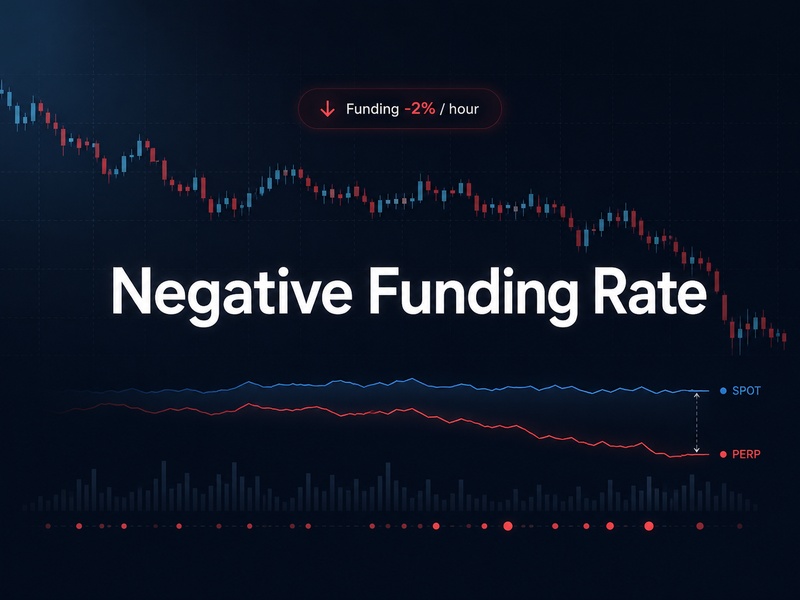
Negative funding in crypto is often treated as a direct signal: shorts pay longs, so buying looks like a way to collect the payment. In an extreme regime, that logic breaks quickly.
Funding at -2% per hour shows a strong imbalance in the perpetual futures contract. The futures price has moved too far away from the spot price, one side of the market is overloaded, and holding the position becomes expensive.
We open trades only when several factors line up: funding, open interest, liquidations, futures premium, and price behavior near a local extreme.
What Funding Is in Perpetual Futures
A perpetual futures contract has no expiration date. To keep the contract price from drifting too far from the spot market, exchanges use a funding rate.
Funding rate is a regular payment between traders.
When funding is positive:
- longs pay shorts;
- holding a long becomes more expensive;
- some long positions are closed.
When funding is negative:
- shorts pay longs;
- holding a short becomes more expensive;
- some short positions are closed.
The exchange calculates and processes funding, but the payment happens between market participants. For a trader, it is a market imbalance indicator, not only a position cost.

Why Funding Turns Negative
Negative funding appears when too many short positions build up in the contract. This often happens after a sharp drop, news-driven fear, a pump followed by reversal, or an attempt to push the asset lower.
A typical setup:
- The futures contract trades below the spot or index price.
- Many short positions are opened.
- Open interest stays high or keeps rising.
- Holding a short becomes more expensive.
- Funding moves into negative territory.
The stronger the imbalance, the higher the cost of holding a short. In extreme funding, some traders close manually, while some positions are forced out through liquidations.
What Funding -2% Per Hour Means
Funding at -2% per hour means shorts pay longs around 2% of the notional position size for one funding interval.
Example:
- a short is opened with $1,000 notional size;
- funding is -2% per hour;
- the funding charge is around $20;
- with $100 margin and 10x leverage, that is a meaningful load.
The risk is not limited to the funding charge. This type of funding usually appears in an unstable regime. Price may bounce sharply, continue moving against the position, or stay flat for a long time while the trader pays to hold it.
Negative funding does not remove risk for longs either. The funding payment can be easily outweighed by price moving against the position.
Why Hourly Funding Matters More Than Standard Funding
Hourly funding is dangerous because of the settlement frequency. If the rate stays extreme across several intervals, the holding cost builds up quickly.
For a short during negative funding, this is a direct expense. For a long, it creates the temptation to enter only for the payment. Both reactions are dangerous when the trader ignores price, open interest, and liquidations.
Funding at -2% per hour should not be read as a standard fee. It is a regime where the market is already overloaded. In this zone, a late entry is often worse than no trade.
What Futures-to-Spot Dislocation Means
Futures-to-spot dislocation appears when a perpetual contract trades at a clear premium or discount to the underlying market.
In calm conditions, arbitrage traders and market makers narrow that gap. In a stressed regime, the gap may widen.
The dislocation is affected by:
- large market orders;
- thin order books;
- high open interest;
- leverage;
- news shocks;
- liquidation risk;
- lack of opposite-side liquidity.
If futures trade too low relative to spot, negative funding makes shorts expensive. If futures trade too high, positive funding puts pressure on longs. Any futures trading bot has to account for this cost before entering.
On thin altcoins, the adjustment often comes through sharp candles, liquidations, and open interest reduction.
Why Extreme Funding Is Dangerous for Shorts
A short position pays funding when funding is negative. At normal values, this is a trading cost. At extreme values, it becomes a separate risk.
Main problems for shorts:
- The trade can be directionally correct but too expensive to hold.
- Price can stay flat while funding keeps being charged.
- Short closures can trigger a sharp bounce.
- High open interest can amplify movement against the overloaded side.
- A late short often enters during the final phase of the move.
The most dangerous zone is a short after a strong drop when funding has already turned sharply negative. At that point, the market may be close to a liquidation flush.
Why Negative Funding Is Not an Automatic Long Signal
A long position receives funding when funding is negative. But price can move against the position more than the trader receives in funding.
A long is worth considering only with additional signs:
- open interest has started to decline;
- a liquidation flush has already happened;
- price has stopped making new lows at the same speed;
- selling pressure is weakening;
- the asset returns into a local range;
- the broader market is not in a hard sell-off.
Negative funding alone shows an imbalance. The trading decision comes from the full data set.
How to Read Funding With Open Interest and Liquidations
Funding screener without open interest and liquidations does not give a full picture. We read the indicators together.
Negative funding + rising open interest
Shorts keep entering the market. If price has already dropped hard, overload risk appears. Entering against the move before signs of slowing remains risky.
Negative funding + falling open interest
Part of the positioning is leaving the market. After a strong move and a liquidation flush, this may point to weakening pressure.
Negative funding + liquidations + price stalling
This combination is suitable for evaluating a technical bounce. Part of the positioning has already been liquidated or closed, price has slowed, and funding still shows remaining imbalance.
Negative funding + new low without open interest reduction
This is a dangerous regime for longs. Sellers keep pressure on the market, while open interest does not show positioning relief.
Where Traders Make Mistakes
They buy only because funding is negative
The long receives funding, but price can keep falling. Funding does not replace an entry point.
They short late and ignore holding cost
At -2% per hour, a short becomes expensive. Even a correct idea can lose its economics.
They ignore open interest
Funding shows imbalance. Open interest shows how much positioning is still in the market. Without it, it is unclear whether there is fuel for a squeeze.
They expect a reversal immediately after extreme funding
The imbalance can last for a long time. The margin buffer can disappear before the market starts to normalize.
They enter before the funding settlement without calculation
A position opened before the funding settlement can receive an immediate charge. With leverage, that matters.
Operating Rules for Extreme Funding
Before entry
- Check the funding direction.
- Compare futures with spot or index price.
- Check open interest over recent windows.
- Check liquidations.
- Calculate time until the next funding settlement.
- Skip the entry if funding breaks the trade economics.
During the position
- Track funding until the next settlement.
- Do not average only because of a funding payment.
- Account for sharp bounce risk when shorts are overloaded.
- Check whether open interest is rising on a move against the open position.
- Use a protective scenario during strongly negative funding if the system supports it.
After funding
- Check the actual funding charge or payment.
- Review open interest after the settlement.
- Evaluate price reaction on the next candles.
- Do not hold the compensating position longer than its task requires.
- Recalculate risk for the main position.
Mini-Cases
Trading bot ST-Bot sees a short setup, but funding moves into an extreme
The asset rises sharply and then starts to reverse. The structure shows a short setup, but funding turns strongly negative. New entry is blocked. In this zone, the short is already expensive, and the market may be overloaded with short positions.
The short was opened before funding worsened
The trade is already in the market. Before the next funding settlement, funding moves sharply negative. The funding compensator bot can activate: it opens the opposite position before settlement and closes it right after funding is charged. The main scenario remains separate, while funding settlement risk is handled by a technical module.
Negative funding without open interest reduction
Funding is strongly negative, but open interest does not decline, there is no liquidation flush, and price makes a new low. A long only for the funding payment remains a weak idea. Sellers keep pressure on the market, and positioning relief is absent.
FAQ
What does negative funding mean in crypto?
Negative funding means shorts pay longs for holding positions on perpetual futures. It usually appears when the market is heavily skewed toward shorts.
Is funding -2% per hour high?
Yes. For a leveraged position, this is an extreme load. Several such funding events can quickly consume a meaningful part of the margin.
Can I open a long only to collect funding?
No. The funding payment can be smaller than the loss from price movement. Open interest, liquidations, price structure, and the broader market regime still matter.
Why does ST-Bot avoid entries during extreme funding?
Because extreme funding changes the trade economics. For a short setup, strongly negative funding means expensive holding cost and higher bounce risk.
What does the funding compensator bot do?
It opens the opposite position before the funding settlement and closes it right after the event. Its task is to reduce the impact of a specific funding window on an already open trade.
How We Use It
In our tools, extreme funding is used as a risk filter.
ST-Bot has entry filters. If funding moves into an extreme zone, the bot does not open a new short trade under the standard scenario. Strongly negative funding makes holding a short expensive and increases the risk of a sharp bounce against the overloaded side.
If a short is already open and funding moves sharply into negative territory, the funding compensator bot can activate. Before funding settlement, it opens the opposite position. Right after settlement, it closes it.
The compensator is designed to reduce the impact of a specific funding window on an already open trade.
The compensator helps to:
- reduce the impact of an extreme funding charge;
- avoid closing the main scenario only because of one funding window;
- limit the time spent in the opposite position;
- separate the trading signal from funding settlement risk;
- remove manual control around the funding moment.
The compensator does not fix a bad entry and does not guarantee a result. It works only with funding settlement risk. The final trade result still depends on spread, slippage, liquidity, price speed, and risk settings.
Conclusion
Negative funding in crypto shows an imbalance in a perpetual futures contract. Funding at -2% per hour points to an extreme regime: one side is overloaded, holding the position becomes expensive, and price reaction can be sharp.
We use funding as a risk filter. ST-Bot does not open new short trades during extreme funding, while the funding compensator can activate for already open positions. It works around the funding settlement and helps keep the trading scenario separate from the holding cost.
Risk Disclaimer
Futures instruments are sensitive to leverage, fees, funding, slippage, and execution speed. Before running a live strategy, test the settings in demo mode, evaluate the results across a series of trades, and define the acceptable risk per position in advance.