
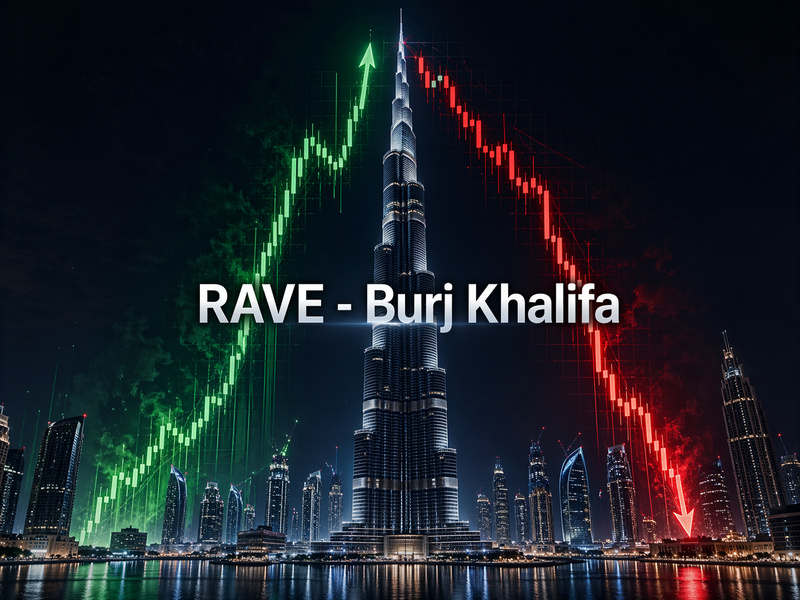
RAVE became a clear example of how a token with a tight free float, highly concentrated supply, and a heavy skew in perpetual futures can go nearly vertical within days and then collapse just as fast. In these setups, price temporarily stops reflecting the value of the project itself. The move is driven by supply structure, funding, liquidations, and a crowd convinced it has found an asset that is “too expensive” not to short.
We do not look at this as a story about one strange ticker. We look at it as a market structure that keeps repeating in different forms.
What We Call Crime Tokens
Crime tokens are not a legal term. They are market slang. The label is usually applied to tokens whose price can detach sharply from common sense not because of a strong fundamental shift, but because of a weak market structure.
These stories usually share the same traits:
- a large share of supply is concentrated in a small number of wallets;
- only part of the maximum supply is actually in circulation;
- spot liquidity is weaker than market cap and public noise make it appear;
- a strong skew builds quickly in perpetual futures;
- the crowd starts shorting the overheating move and becomes fuel for the next leg higher.
From the outside, it looks absurd. In reality, it is standard market mechanics pushed to an extreme.
Why the “Burj Khalifa” Pattern Appears

A “Burj Khalifa” pattern is a move with almost no base, almost no pauses, and almost no normal market feedback. Price goes up as if resistance does not exist.
Such a move usually stands on five pillars.
- The first is a tight free float. When only part of supply is actually available to the market, even a modest flow of orders can move price too far, too fast.
- The second is supply concentration. If a meaningful share of the token is held by a few large holders, the market stops being broad. In that structure, price depends less on collective valuation and more on control over supply.
- The third is a thin order book. A large market cap number does not make a market deep. If there is not enough opposing volume, price can be pushed higher far more easily than it seems from the outside.
- The fourth is deeply negative funding. When the crowd piles into shorts, it starts paying for its own stubbornness.
- The fifth is cascading liquidations. Once price moves higher, shorts begin to close by force. From that point on, the rally is no longer supported by investors. It is supported by the mechanics of the squeeze itself.
What Happened With RAVE
RAVE had almost every element needed for that structure. On the surface, the project had a clear narrative: music culture, offline events, Web3, charity, and visible partnership mentions. For the crowd, that is enough to start building a growth story around the asset.
But the move was not driven by narrative alone. What mattered far more was the limited free float, the high supply concentration, and a favorable setup for a short squeeze. In that structure, price can easily lose contact with the usual logic of asset valuation.
From there, the market followed a familiar script. First, the asset rallies hard. Then the crowd decides it is already too expensive and starts shorting aggressively. Funding turns deeply negative. After that, every new push higher turns short sellers into fuel for the next candle.
At that stage, the chart is no longer driven by fundamentals or news. It is driven by how many more shorts can be taken out.

Where the Market Broke Short Sellers
The crowd’s main mistake in these stories is simple: people see a ridiculous price and conclude that the market must reverse immediately.
But markets do not work that way.
If funding is deeply negative, shorts are paying to keep positions open. If open interest rises together with price, the system gets additional fuel. If liquidations begin, the move accelerates through forced closes.
That is why shorting an asset just because it looks insanely expensive is a weak trade idea. In these regimes, you can get the ending right and still lose everything on the way there.
Why It Is Dangerous to Short These Moves Emotionally
There are three reasons.
The first is that a vertical move can continue longer than a trader can remain solvent. The asset may eventually collapse, but the market can still wipe out early shorts first.
The second is that price in these stories does not move because of “fair value.” It moves because the market structure is still working. As long as negative funding, rising open interest, and liquidation cascades remain in place, the move higher can continue.
The third is that in low-liquidity tokens, the cost of being wrong becomes especially high. One emotional short without a hard risk limit can erase a long series of normal trades.
How We Identify These Tokens in Advance
We are not interested in a good story. We are interested in market structure. Before we even consider an asset like this, we check:
- what share of supply is actually in circulation;
- how concentrated the supply is in the top wallets;
- what is happening with funding;
- how open interest is changing;
- whether liquidation cascades are already unfolding;
- whether the strength of the move matches the news backdrop;
- whether spot looks like a real market or a thin facade.
If the picture is weak on those points, we do not argue with the move on ideology. We simply place the asset into a separate risk category.
Basic Rules of Discipline
In tokens like these, discipline matters more than opinion.
- Do not increase position size just because price already looks ridiculous.
- Do not average into a losing short against a vertical squeeze without a predefined risk limit.
- Do not confuse a large market cap on screen with deep liquidity.
- Do not treat noise on social media as a fundamental reversal.
- Do not build a trade thesis on a single candle.
In these stories, the market punishes overconfidence especially hard.
Common Mistakes
- The most common mistake is trying to catch the top just because “it cannot go any higher.”
- The second mistake is believing that negative funding by itself guarantees an imminent collapse. It guarantees only one thing: shorts keep paying.
- The third is looking only at the chart and not checking supply structure.
- The fourth is ignoring the difference between spot and perpetual futures. If the move is driven mainly by derivatives, the risk profile is completely different.
- The fifth is assuming that one strong red candle means the market is back to normal. After vertical blow-offs, an asset often stays toxic for a long time.
Operating Framework for These Stories
Before entry.
First, we check free float, supply concentration, funding, open interest, and liquidations. If the asset already looks like a mechanical anomaly, we do not apply standard liquid-market rules to it.
During the move.
We do not fight a vertical rally without confirmation. While the market is still being driven by a short squeeze, preserving capital matters more than trying to call the top ahead of everyone else. A pump short bot follows the same principle: no entry until the impulse shows confirmation.
After the break.
We do not buy just because the asset is already down 90–95%. First, the market has to clear the skew, absorb the shock, and show a new balance. A large red candle proves nothing on its own.
Two Short Cases
The first scenario is an emotional short. A trader sees vertical price action, calls the token trash, opens a position without a plan, and keeps paying funding while the market squeezes the position higher. That is not trading. That is arguing with the tape.
The second scenario is disciplined waiting. A trader sees the same anomaly but does not try to be a hero. They wait for signs of structural failure: loss of momentum, a drop in skew, a reversal in funding, and weaker liquidation pressure. This approach does not always give the perfect entry, but it keeps the trader in the game.
How We Use This at Crypto-Resources
For us, cases like this are not a reason to argue about fair value. They are a reason to identify the risk type quickly. When working with tokens like these, the key tools are crypto screeners for open interest, funding, liquidations, and pump/dump anomalies. They help us see where the market is still being driven by squeeze mechanics and where the structure has already started to break apart.
If the story looks toxic, the asset should go to the blacklist before the crowd finds a new reason to chase it higher.
FAQ
What is a crime token in the context of this article?
It is a market label for tokens whose price can distort sharply because of supply concentration, weak free float, and an aggressive skew in perpetual futures.
Why is the “Burj Khalifa” pattern dangerous to short?
Because vertical rallies in these assets are often driven not by normal demand, but by short-squeeze mechanics. As long as those mechanics remain alive, price can keep going higher for longer than a trader expects.
Can these tokens be traded on the long side?
Yes, but only as a separate class of anomalies and only with a hard risk limit. This is not the same thing as having an investment thesis.
Does a 95% drawdown from the high automatically make it a buy?
No. After collapses like that, the market often remains structurally weak for a long time. What is needed first is a new balance, not just a sharp drop.
What is the main takeaway from the RAVE case?
For a period of time, a token’s price can become a function of ownership structure and crowd positioning rather than a reflection of fundamental value. In these regimes, reading market mechanics matters more than arguing with them.
Conclusion
The RAVE case showed one simple thing again: the market can stay disconnected from common sense for a long time if the move has enough technical fuel behind it. A tight free float, high supply concentration, deeply negative funding, and liquidation cascades can easily turn a questionable asset into a vertical anomaly.
That is why we do not evaluate these stories with the phrase “too expensive.” First, we look at who controls supply, who is paying funding, where the skew is building, and who will become fuel for the next move.
Risk Disclaimer
This material is for informational purposes only and is not investment advice.
Trading low-liquidity and abnormally volatile tokens involves a high risk of partial or total capital loss.