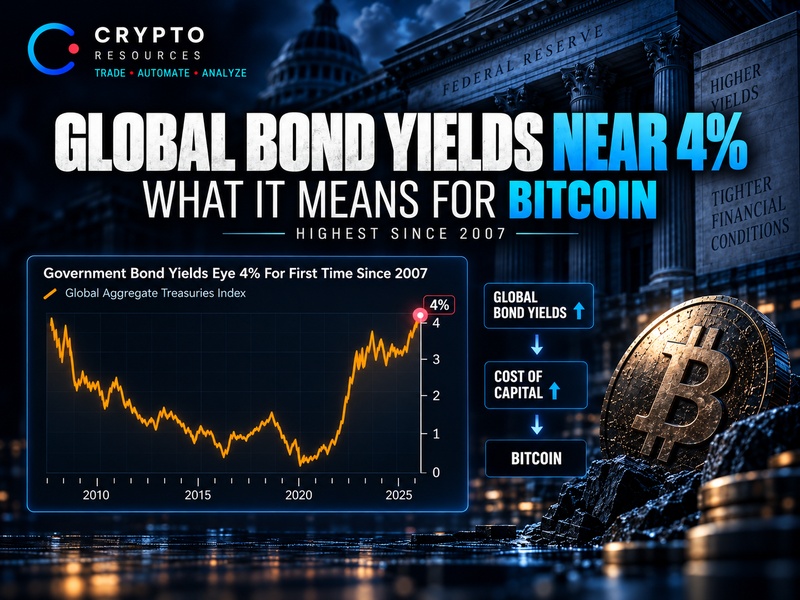
Average global government bond yields are approaching 4% for the first time since 2007.
That does not mean another 2008-style financial crisis is coming.
It does mean money has become expensive across several major economies at once.
For Bitcoin, and especially for altcoins, that is a difficult backdrop. Government debt offers increasingly attractive yields, financing costs are higher, and investors have less reason to take additional risk simply to generate returns.
At the same time, expensive money carries a growing cost for the economy itself.
The more expensive public and private debt becomes, the more pressure builds on government budgets, mortgages, lending, and refinancing.
The question is no longer only how high yields can go, but how long this regime can last without creating problems for growth and financial stability.
Why Global Yields Have Moved So High
Several forces are pushing on the bond market at the same time:
- persistent inflation;
- expectations for tight central-bank policy;
- heavy government borrowing;
- large fiscal deficits;
- higher term premium;
- weak demand at some bond auctions;
- expensive energy.
When investors demand higher yields to hold government debt, the repricing spreads through the financial system.
Governments borrow at higher rates.
Companies refinance at higher rates.
Mortgages and bank credit become more expensive.
For markets, the result is simple: the cost of capital rises.
Why This Is Negative for Bitcoin
Bitcoin competes for capital with more than equities and other cryptocurrencies.
It also competes with government bonds.
When safe government debt offers very little return, investors have more incentive to move further out on the risk curve.
When bond yields are high, more capital can stay in fixed income.
For crypto, the mechanism looks like this:
bond yields ↑ → real yields ↑ → cost of capital ↑ → demand for risk ↓
If the dollar strengthens at the same time, conditions become even tighter:
Treasury yields ↑ + USD ↑ = a tougher backdrop for Bitcoin
Global yields near 4% tell us one thing above all: money is expensive.
Why Altcoins Face Even More Pressure
Bitcoin remains the most liquid asset in crypto.
Altcoins sit further out on the risk curve.
When yields are high, that usually works against broad rotation:
- capital stays concentrated in BTC;
- BTC Dominance remains elevated;
- ETH/BTC stays weak;
- local pumps fade quickly;
- market breadth stays narrow.
This connects directly with the altseason framework.
As long as real yields and the dollar keep pressuring risk assets, strength in a handful of large altcoins is not enough.
For broader rotation to develop, the cost of capital at least needs to stop getting worse.
When Expensive Capital Becomes a Problem for the System
High bond yields tighten financial conditions even without another central-bank rate hike.
The longer they remain elevated, the more expensive it becomes to finance:
- government debt;
- corporate refinancing;
- mortgages;
- bank lending;
- new investment.
But 4% is not a magic threshold that automatically forces central banks to intervene.
The consequences matter more than the number.
If expensive capital starts materially slowing credit, damaging bond-market liquidity, or creating financial stress, maintaining the same policy regime becomes harder.
The first response does not have to be an immediate rate cut or another round of QE.
Authorities can start with more targeted measures:
- slower QT;
- changes in debt issuance;
- Treasury buybacks;
- bond-market liquidity operations;
- softer guidance on the future rate path.
If those measures are not enough and the economy continues to weaken, broader monetary easing can follow.
These tools are not interchangeable.
Treasury buybacks are not QE.
For Bitcoin, what matters is the outcome: are real yields falling, is the dollar weakening, and is capital becoming cheaper?
Not Every Drop in Yields Is Bullish for Crypto
Suppose yields finally peak and start moving lower.
The reason matters.
Inflation Cools While the Economy Holds Up
This is the cleaner setup.
Central banks no longer need to keep policy as tight, real yields fall, the dollar loses momentum, and the economy avoids a hard downturn.
That environment can support Bitcoin first and altcoins later.
Yields Fall Because of a Crisis
That is a very different situation.
If investors rush into government bonds because of recession fears, credit stress, or a broader flight to safety, crypto can initially come under pressure as well.
Yields are falling because investors want safety, not because financial conditions have suddenly become supportive.
Bitcoin may benefit later, after central banks or fiscal authorities respond to the stress.
So “yields down = BTC up” does not work without context.
What Would Actually Signal a Regime Change
For crypto, the important signal is not simply a peak in global yields.
Several things need to start changing together.
1. Global yields stop making new highs.
The cost of capital stops getting progressively worse.
2. US real yields move lower.
Inflation-adjusted government bond returns become less attractive.
3. The dollar loses momentum.
USD and the bond market stop working against risk at the same time.
4. Bitcoin holds its structure.
Crypto itself confirms the improvement in the macro backdrop.
If BTC Dominance then stops rising, ETH/BTC strengthens, and breadth expands, capital is beginning to move further through the crypto market.
That sequence matters much more than the 4% level itself.
How to Track This Regime With Crypto Resources
The bond market sets the macro backdrop. Its effects inside crypto show up in market structure and positioning.
Market Median shows whether Bitcoin’s move is spreading across the broader market.
BTC Dominance and ETH/BTC help show whether capital is staying in BTC or beginning to rotate further out.
Crypto Resources screeners track:
- Open Interest;
- liquidations;
- volume;
- Premium Index;
- sharp moves across individual coins.
Trading bots automatically execute predefined strategies once the required market conditions appear after the regime shifts.
Bond yields → real yields / USD → Bitcoin → OI and liquidations → breadth → individual setups.
Where the Market Can Get It Wrong
The first mistake is treating 4% as a critical line that central banks are required to defend.
No such fixed level exists.
The second is treating every bond-market operation as monetary stimulus.
Treasury buybacks, liquidity support, and QE are different tools.
The third is buying Bitcoin simply because yields have started falling.
You need to know why they are falling.
The fourth is watching only nominal yields.
For Bitcoin, real yields and the dollar matter just as much.
The fifth is assuming that a macro regime shift will immediately trigger altseason.
Even after conditions improve, capital usually reaches Bitcoin first.
Frequently Asked Questions
Why do rising bond yields affect Bitcoin?
Higher yields increase both the risk-free return available to investors and the overall cost of capital. Government bonds become more competitive with risk assets.
Do global yields near 4% mean another financial crisis is coming?
No. The comparison with 2007 refers to the level of yields, not to the overall condition of the financial system.
Why could high yields eventually change the backdrop for Bitcoin?
If expensive capital starts putting too much pressure on the economy or financial system, monetary and fiscal policy can eventually become less restrictive.
Are falling yields always positive for crypto?
No. Falling yields caused by cooling inflation are very different from falling yields caused by recession fears or crisis-driven Risk-Off.
What matters more for Bitcoin — nominal yields or real yields?
Both matter, but real yields give a better measure of government bond returns after adjusting for inflation.
What would confirm a real regime shift?
Global yields stop rising, US real yields move lower, the dollar weakens, and Bitcoin holds a strong market structure.
What to Watch Next
The next major shift starts when global yields stop climbing.
If they simply stabilize, markets get relief from additional tightening.
If real yields and the dollar begin falling without serious economic stress, the backdrop for Bitcoin improves significantly.
If expensive debt eventually forces financial authorities to change policy, markets will start pricing future liquidity rather than today’s bond yields.
The 4% level itself is not the story. The important moment is when the high cost of money starts changing the financial regime.
Risk Disclaimer
This material is for informational and analytical purposes only and does not constitute investment advice. Government bond yields, real yields, currency moves, and central-bank actions do not guarantee the direction of Bitcoin or other crypto assets.
Changes in bond markets can sharply affect the cost of capital, liquidity, and positioning. Any trading decision requires an independent assessment of market structure and risk.