
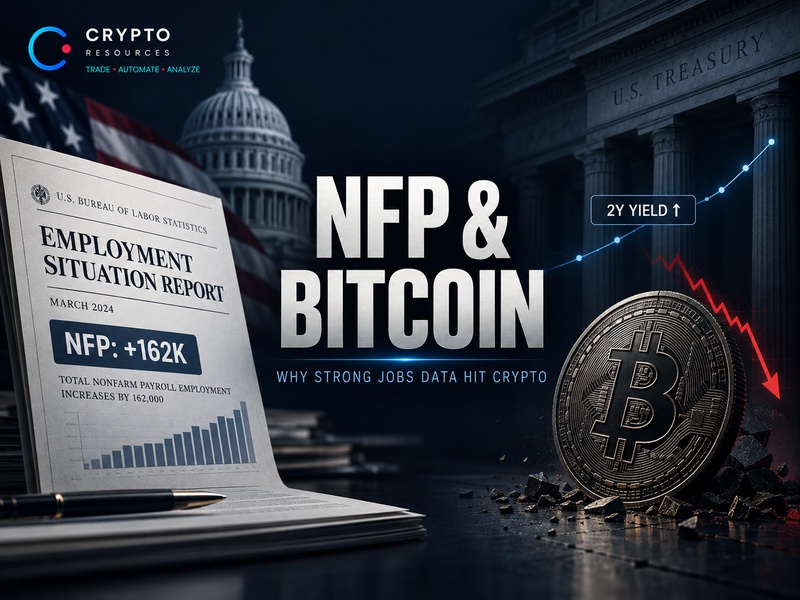
On September 4, 2026, the US labor market came in far stronger than expected. The economy added 162,000 nonfarm jobs, while the market had expected roughly 55,000. Unemployment held at 4.1%, and the June and July figures were revised higher by a combined 55,000 jobs.
The report was strong for the economy.
Bitcoin reacted the other way.
After the NFP release, the market sharply raised the probability of another Fed rate hike. The 2-year Treasury yield moved toward 4.4%, the 10-year approached 4.8%, the dollar strengthened, and Bitcoin slipped below $80,000 after trying to hold above $82,000.
A strong economy does not always help risk assets. If the data give the Fed more room to keep rates high, the cost of capital rises — and equities, Bitcoin, and especially altcoins come under pressure.
What the September 4 NFP Report Showed
Nonfarm Payrolls is one of the main monthly reports on the US labor market. It tracks the change in employment outside the agricultural sector and gives a broad read on job creation.
The August report came in well above expectations:
- Nonfarm Payrolls: +162,000;
- market expectations: around +55,000;
- unemployment rate: 4.1%;
- average hourly earnings: +0.3% month over month;
- wage growth: +3.1% year over year;
- June and July revised higher by a combined +55,000 jobs.
Employment growth was especially strong in restaurants and bars, as well as local government education.
Wages did not accelerate. Year-over-year growth slowed to 3.1%.
The report itself was not an inflation shock. The surprise was the resilience of the labor market.
That left the Fed with less reason to worry that high rates were weakening the economy too quickly.
Why Good Data Were Bad News for Bitcoin
The Fed watches both inflation and the health of the economy.
If the labor market weakens sharply, policymakers have to weigh the risk of recession and rising unemployment. That leaves less room for another rate hike.
A strong NFP report removes part of that constraint.
The economy is still creating jobs, unemployment is not rising, and household income remains supported. If inflation stays above target, the Fed has more room to keep policy restrictive.
Strong NFP → higher odds of a hawkish Fed → short-term yields ↑ → cost of capital ↑ → pressure on risk assets
Before the report, the probability of a September rate hike was around 50–52%. After the release, it moved toward 60–62%.
Bitcoin was not trading the job number itself. It was trading the change in expectations for Fed policy.
Why the 2-Year Treasury Yield Reacts First
The 2-year Treasury yield is particularly sensitive to expectations for monetary policy.
The higher the market expects the Fed rate to be over the next several quarters, the higher the yield investors demand from short-dated government debt.
After the strong NFP report, the 2-year Treasury yield rose by around 5 basis points and moved toward 4.4%.
The 10-year yield climbed back toward 4.8% at the same time.
The 2Y is a useful gauge of whether macro data are actually changing the market’s view of the Fed.
A strong NFP report with little reaction in the 2-year yield would suggest that investors saw no meaningful change in the rate path.
On September 4, short-term yields moved higher immediately.
How Higher Treasury Yields Pressure Bitcoin
Higher Treasury yields make risk-free dollar assets more attractive.
Investors can earn a higher fixed return on government debt without taking Bitcoin’s volatility.
Financing also becomes more expensive across the system. Borrowing costs rise, required returns increase, and riskier assets become less attractive.
Bitcoin does not pay a coupon or a fixed cash flow. The higher Treasury yields go, the higher the return hurdle for BTC becomes.
On September 4, the move ran through almost the entire chain:
NFP above expectations → rate hike odds ↑ → 2Y Treasury ↑ → 10Y Treasury ↑ → dollar ↑ → Bitcoin ↓
Treasury buybacks can reduce some pressure at the long end of the curve. A strong NFP report can simultaneously push rate expectations higher at the short end.
Crypto reacts to the combined effect through the cost of capital.
The Contrast With September 3
A day before the NFP release, the market received almost the opposite signal.
On September 3, Federal Reserve Governor Christopher Waller indicated that if inflation continued to slow, he would support keeping rates unchanged rather than raising them.
Treasury yields fell, expectations for a September hike weakened, and Bitcoin moved back above $80,000, trading around $81,000–82,000.
One day later, the strong NFP report arrived.
Rate hike odds rose again, Treasury yields moved higher, and BTC gave back part of the move.
Softer Fed expectations → yields ↓ → BTC ↑
Strong NFP → tougher rate expectations → yields ↑ → BTC ↓
The reaction will not be this clean after every macro release, but the September 3–4 sequence showed the link between rate expectations, Treasury yields, and Bitcoin clearly.
Why Altcoins Fall Harder Than Bitcoin
Bitcoin remains the largest and most liquid crypto asset.
Ethereum sits further out on the risk curve. Most altcoins sit further still.
When the cost of capital rises, the market often cuts exposure first in the most speculative assets.
BTC may lose a few percent while individual altcoins move much more.
Liquidity is the second reason.
Altcoins usually have thinner order books, less spot depth, and often a higher share of futures activity. The same capital outflow therefore has a larger effect on price.
The third factor is leverage.
Open Interest in active altcoin markets can rise faster than spot demand. When an external macro trigger starts a selloff, leveraged positions begin to close automatically.
A normal correction can quickly turn into a cascade.
How Liquidations Amplify the Macro Move
NFP itself does not close traders’ positions.
First, expectations for rates and yields change. Spot and derivatives markets react after that.
Once price reaches levels where a large amount of leveraged positioning is concentrated, liquidations begin.
For a long position, forced liquidation means a market sell.
Price falls → more positions are liquidated → additional selling hits the market → the move accelerates.
That is why a candle after a macro release can become much larger than the original move in spot.
Strong NFP and higher yields trigger the repricing of risk. Liquidations increase the amplitude.
Liquidation data alone are not enough to explain why the market started falling.
Why One NFP Report Does Not Decide the Fed
The strong labor report increased the probability of a rate hike, but it does not determine the Fed’s decision on its own.
Wages rose 3.1% year over year — slower than the previous month. That reduces the risk of additional inflation pressure coming directly from labor costs.
The next major inputs are inflation data.
August PPI is due on September 10.
CPI follows on September 11.
The FOMC meeting is scheduled for September 15–16.
For the Fed, labor-market strength and inflation matter together.
If CPI shows renewed price pressure, the strong NFP will add weight to the case for a hike.
If inflation comes in softer than expected, part of the September 4 move could reverse: rate hike odds may fall, short-term Treasury yields could move lower, and the backdrop for Bitcoin would become less restrictive.
What CPI Could Change for Bitcoin
After the strong NFP report, the market is heading into CPI with a more hawkish starting point.
Strong CPI + strong NFP
This is the most difficult combination for risk assets. The Fed has an inflation reason to keep policy tight and an economy strong enough to tolerate higher rates.
The 2Y and real yields could continue rising, the dollar gets support, and Bitcoin and altcoins remain under pressure.
Weak CPI + strong NFP
The economy remains resilient while inflation cools. The Fed gets room to avoid another hike without a sharp deterioration in growth.
Weak CPI + weaker future jobs data
Yields could fall faster, but a weaker labor market changes the reason behind the move. If investors start pricing recession risk, falling yields do not automatically mean higher Bitcoin.
After CPI, Treasury yields and rate expectations will matter more than the headline alone.
Where the Market Can Get It Wrong
The first mistake is assuming that a strong NFP report is automatically bearish for Bitcoin.
If inflation is already under control and the Fed is not planning to tighten policy, a strong labor market can support risk assets.
The problem on September 4 was not the 162,000 jobs themselves. It was the change in rate expectations.
The second mistake is focusing only on the next Fed decision.
Even if the Fed leaves rates unchanged in September, markets will keep repricing the path for later meetings.
The third is treating every drop in Treasury yields as bullish.
Yields can fall because policy is becoming easier, or because investors are buying government bonds on recession fears.
The fourth is blaming the entire selloff on liquidations.
Liquidations amplified the move. The macro impulse came first.
How to Track NFP and Market Reaction With Crypto Resources
Macro data set the initial direction. Inside crypto, market-specific metrics show how the move is developing.
Market Median shows how broadly the selloff has spread across the market. Open Interest helps show whether leverage is being reduced or whether traders are continuing to build positions against the move.
Crypto Resources screeners flag spikes in liquidations, volume, and Open Interest across individual coins. Premium Index helps identify the imbalance between futures and spot.
Trading bots do not try to predict the NFP release itself. They automatically execute a predefined strategy when the market forms the required conditions after the data are out.
Macro data → Treasury yields → Bitcoin → liquidations and OI → individual setups → automated execution.
Frequently Asked Questions
What is NFP?
NFP, or Nonfarm Payrolls, measures the monthly change in US employment outside the agricultural sector. It is part of the Employment Situation Report and is one of the main indicators of the US labor market.
What was the September 4, 2026 NFP result?
The US economy added 162,000 jobs in August versus expectations of around 55,000. Unemployment remained at 4.1%, while June and July were revised higher by a combined 55,000 jobs.
Why can a strong NFP report be bad for Bitcoin?
A strong labor market gives the Fed more room to keep rates high or raise them if inflation remains a problem. That pushes Treasury yields and the cost of capital higher, making risk-free dollar assets more competitive with Bitcoin and other risk assets.
Why did the 2-year Treasury yield rise after NFP?
The 2-year yield is highly sensitive to expectations for Fed policy. After the strong jobs report, markets raised the probability of a September rate hike, and short-term Treasuries repriced quickly.
Does NFP always move Bitcoin?
No. The reaction depends on how far the data deviate from expectations and whether they change the market’s view of the Fed. Some strong or weak reports have little effect on BTC.
What matters more than NFP now?
The next major releases are PPI on September 10 and CPI on September 11. They will show whether inflation supports a more hawkish Fed outlook ahead of the September 15–16 meeting.
Could weak CPI data bring Bitcoin back higher?
They could improve the backdrop if the market lowers the probability of a rate hike and Treasury yields fall. BTC will still depend on spot demand, the dollar, liquidity, and positioning.
What to Watch Next
After the strong NFP report, the near-term macro chain looks like this:
PPI → CPI → Fed rate expectations → 2Y Treasury → 10Y / real yields → dollar → Bitcoin
Lower short-term yields and lower rate hike odds without a new stress event in the economy would reduce some of the macro pressure on crypto.
If Bitcoin reclaims lost levels on spot demand, BTC Dominance stops rising, and ETH/BTC and market breadth recover, that pressure is easing.
If CPI comes in strong, rate hike odds could rise further while the 2Y and real yields move higher. In that case, the post-NFP selloff may turn out to be the start of a broader repricing of the cost of capital.
Strong NFP hurt Bitcoin not because good jobs are bad for crypto. It changed what the market expects money to cost.
That price remains one of the main macro filters for Bitcoin and altcoins.
Risk Disclaimer
This material is for informational and analytical purposes only and does not constitute investment advice. NFP, inflation data, Fed rate expectations, Treasury yields, and other macroeconomic indicators do not guarantee the direction of Bitcoin or other crypto assets.
Macro releases can cause sharp changes in volatility and liquidity. Trading decisions require independent assessment of market structure, positioning, and risk.