
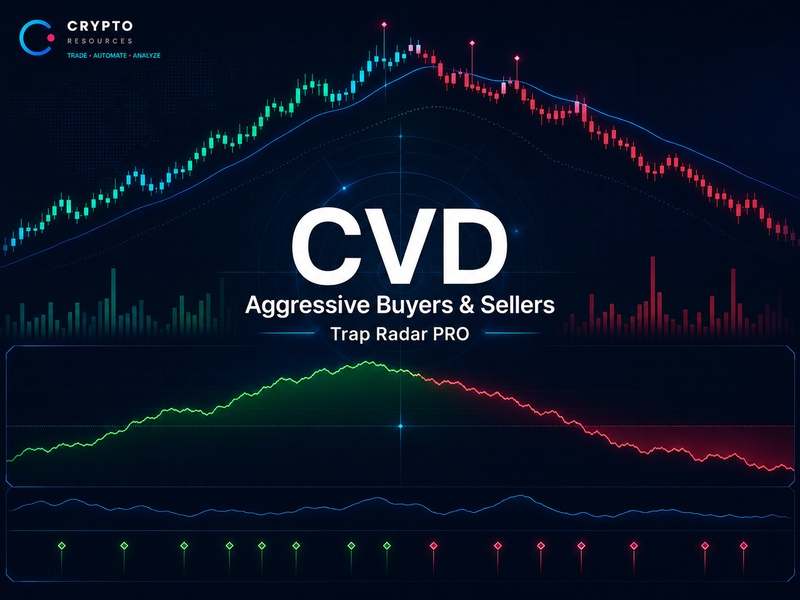
CVD trading helps identify which side is more active with market orders: buyers or sellers. When market buying is stronger than market selling, CVD rises. When pressure comes through market sells, CVD declines.
In crypto futures, this directly affects entry quality. Price can rise without real support from aggressive buyers, fall without steady seller pressure, or stay inside a range while pressure is already building under the surface. CVD helps detect that imbalance before it becomes obvious on a single candle.
In Trap Radar PRO, CVD is used together with price, open interest (OI), liquidations, volume, VWAP, RSI and the funding rate. Its role is to identify who is pressing the market with market orders and whether that order flow confirms the current structure.

What CVD Shows
CVD stands for cumulative volume delta. It tracks the accumulated difference between aggressive buying and aggressive selling.
When buyers are more active in taking liquidity with market orders, CVD rises.
When sellers are more active in hitting the market, CVD declines.
When the line barely moves, neither side has a clear edge.
For a trader, the line itself is secondary. The key is how it behaves relative to price. Price records the result. CVD reveals which side created pressure inside the move.
Basic regimes:
- Price rises, CVD rises.
- Price falls, CVD falls.
- Price rises, CVD is flat or declining.
- Price falls, CVD is flat or rising.
- Price stays in a range, CVD gradually shifts to one side.
These combinations help separate a move backed by real aggression from a move where price is already losing internal support.
Why CVD Matters for a Trading Scenario
A candle shows where price closed. CVD adds the execution layer: who pressed the market, how actively, and whether that flow matches the direction of price.
After a pump, dump, liquidation spike, sharp open interest increase or strong deviation from VWAP, price can still look strong. Inside the move, the balance between aggressive buying and selling may already be shifting.
Through CVD, we check:
- Whether aggressive buyers support the price rise.
- Whether aggressive sellers support the price drop.
- Whether price and order flow are diverging.
- Whether the crowd is entering late into an overheated move.
- Whether the opposite side appeared after liquidations.
- Whether pressure is being absorbed.
In Trap Radar PRO, CVD works best as a quality filter. It strengthens a signal when it aligns with price and nearby metrics. It weakens the setup when price moves one way while aggressive flow no longer supports the move.
When CVD Confirms a Move
Confirmation appears when price and CVD move in the same direction.
For a long scenario, a clean structure looks like this:
- Price rises.
- CVD rises.
- Volume supports the move.
- OI does not move into a chaotic flush.
- Price holds above VWAP or reclaims it after a spike.
This combination means aggressive buyers are active in the move. If price structure stays clean and risk is defined in advance, the setup becomes more actionable.
For a short scenario, confirmation is mirrored:
- Price declines.
- CVD declines.
- Volume stays elevated.
- OI confirms market participation.
- Price fails to reclaim the area after an overheated move.
This combination points to pressure from aggressive sellers. After a pump, short liquidations or a move above VWAP, CVD helps identify whether sellers have enough force to hold the pullback.
When CVD Warns About Weakness
Weakness appears when price moves but CVD does not confirm the move.
Price rises while CVD is flat or declining. The rise lacks proper support from aggressive buyers. This is a weaker entry area, especially when price is already far from VWAP, RSI is elevated, and OI is rising late in the move.
Price falls while CVD is flat or rising. Seller pressure may be fading, or aggressive buyers may be stepping in. This regime matters after a sharp drop, long liquidations and a volume spike.
CVD does not give a ready reversal signal. It captures a mismatch between price and aggressive order flow. The next step is to check the chart, OI, volume, liquidations and price position relative to VWAP.
In Trap Radar PRO, these mismatches can be used as filters. The Radar looks for the zone where price is already losing support from aggressive trades, rather than reacting to every move after a pump or dump.
CVD Divergences
A CVD divergence appears when price updates an extreme, while the aggressive side does not confirm it.
Common cases:
- Price makes a new high, CVD does not make a new high.
- Price makes a new low, CVD does not make a new low.
- Price stays in a range, CVD gradually rises.
- Price stays in a range, CVD gradually declines.
- Price makes a sharp spike, CVD reflects late crowd aggression.
For a short scenario, a push to a new high without a new CVD high is worth attention. Price has been pushed higher, but aggressive buyers no longer deliver the same impulse.
For a long scenario, a new price low without a new CVD low is worth attention. Sellers pushed price lower, but internal pressure inside the move is weaker.
A divergence needs context. It has to be linked with the zone, volume, OI, liquidations and price reaction after the extreme.
CVD and Liquidations
After a liquidation spike, CVD helps identify whether the opposite aggressive side has entered the market.
After long liquidations, the market receives forced selling. Price drops sharply, volume rises, and weak leverage leaves the market. If CVD starts turning upward after that, buyers are stepping in. For a long scenario, this is an important recovery filter.
After short liquidations, the market receives forced buying. Price rises sharply, shorts are forced out, and late buyers enter high. If CVD starts declining after that area, sellers are responding to the overheated move. For a short scenario, this is a pullback filter.
Liquidations show the hit to leverage. CVD shows the reaction after the hit.
A long scenario may include:
- Long liquidations.
- Strong downside move.
- Deviation from VWAP.
- Volume spike.
- CVD turning upward.
- First price move toward recovery.
A short scenario may include:
- Short liquidations.
- Strong upside move.
- Deviation from VWAP.
- Volume spike.
- CVD turning downward.
- First price move toward a pullback.
CVD helps separate liquidation noise from a situation where the opposite aggressive side appears after the spike.
CVD and Open Interest
The combination of CVD and open interest connects aggressive execution with positioning.
OI reflects positions. CVD reflects aggressive execution. Together, they help identify whether the market is adding risk in the direction of the move or the move is already losing structure.
Rising price, rising CVD and rising OI mean buyers are pressing the market while participants add positions. Early in a move, this can support continuation. Late in a move, this combination needs overheating control.
Rising price, rising OI and weak CVD create a more fragile picture. Positions are being added, but aggressive buying is not strong enough. For a long, that area is weaker, especially after a strong pump.
Falling price, falling CVD and rising OI point to seller pressure with positions being added. For a short scenario, this confirms market participation in the move.
Falling price, rising OI and a weak CVD decline suggest that seller pressure may be losing strength. If long liquidations happened nearby and price stops making fresh lows, the setup needs a recovery check.
An OI flush after a strong move shows that part of the market is leaving positions. At that point, CVD helps identify who takes initiative after the unwind.
Working combinations:
- Rising price + rising CVD + rising OI — buyers are pressing, positions are being added.
- Falling price + falling CVD + rising OI — sellers are pressing, positions are being added.
- Rising price + weak CVD + rising OI — risk of late overheating.
- Falling price + weak CVD decline + rising OI — seller pressure may be fading.
- OI flush + CVD reversal — the market exits an overloaded state, and the active side changes.
In Trap Radar PRO, CVD and OI are stronger inside the same configuration. One parameter tracks trade flow, the other tracks positioning load.
How Trap Radar PRO Helps Monitor CVD
Trap Radar PRO allows CVD to be used as one parameter inside a trading configuration. The Radar waits for several conditions to match instead of reacting to one metric alone.
A scenario can include:
- Price direction.
- CVD change.
- OI change.
- Volume.
- Liquidations.
- Deviation from VWAP.
- RSI.
- Funding rate.
- Exchange.
- Coin liquidity filter.
For a long configuration, the Radar can track conditions where buyers step in after a drop, price stops making new lows, volume rises, OI stabilizes, and the market returns toward VWAP or the nearest local value area.
For a short configuration, the Radar can track conditions where sellers take control after a pump, price weakens near the high, volume stays elevated, OI points to overheated positioning, and the market starts to pull back.
When the conditions match, the user receives a signal in Telegram or in the personal dashboard. The chart is then reviewed manually, or the scenario is passed to automated execution through an API/bot if that setup is configured.
Example Long Scenario

A long scenario through CVD is built around recovery after downside pressure.
The market falls, long traders are liquidated, price moves below VWAP, and volume rises. After that, CVD stops declining and starts turning upward. Aggressive buyers begin taking over after strong seller pressure.
To review the signal, the trader checks:
- Whether the local low holds.
- Whether CVD rises after the spike.
- Whether OI avoids a chaotic continued flush.
- Whether volume supports the recovery.
- Whether price returns toward VWAP or the nearest local value area.
- Whether the funding rate remains extreme against the scenario.
If price confirms recovery, the move can be managed with trailing. If CVD turns up but price fails to hold the low, the setup weakens.

Example Short Scenario

A short scenario through CVD is built around a pullback after an overheated rally.
The market rises quickly, short traders are liquidated, price moves above VWAP, and volume expands. After that, CVD stops supporting the rise or starts declining. Aggressive buyers lose control, and sellers start responding to the overheated move.
To review the signal, the trader checks:
- Whether the new high starts to weaken.
- Whether CVD declines after the pump.
- Whether OI avoids growing too aggressively.
- Whether volume supports the pullback.
- Whether price returns toward VWAP or the nearest local value area.
- Whether a new impulse of aggressive buying appears.
If the pullback develops, the move can be managed with trailing. If CVD declines but price accelerates upward again, the signal is no longer worth acting on.

Common Mistakes
- Reading CVD without price. Aggressive buying or selling only matters inside the price context.
- Reading CVD without OI. Without open interest, it is unclear whether positions are being added or the market is leaving them.
- Treating rising CVD as a ready long signal. On a late pump, rising CVD often reflects the crowd entering an overheated move.
- Treating falling CVD as a ready short signal. After a strong drop, falling CVD may be the final stage of pressure.
- Ignoring liquidations. After a spike, CVD has to be read differently because part of the move is created by forced position closures.
- Ignoring VWAP. The same CVD reaction has different meaning near the local value area and far away from it.
- Using CVD on weak coins without a liquidity filter. On those instruments, aggressive trades can distort the picture sharply.
- Expecting CVD to give a ready entry. CVD records pressure, while the decision is made through the full configuration.
How to Use CVD in the Workflow
CVD works best as an aggression filter inside a trading scenario.
Working sequence:
- Define the context: pump, dump, range, recovery or pullback.
- Check price relative to VWAP.
- Check CVD direction.
- Compare CVD with OI.
- Check volume.
- Account for liquidations.
- Check the funding rate.
- Filter weak coins by liquidity.
- Wait for price reaction.
- Make the decision based on the scenario.
This turns CVD into part of the trading system. It covers aggressive order flow, while the final decision is built through price, positioning, volume, liquidations and risk.
FAQ
What does CVD show in trading?
CVD shows the accumulated difference between aggressive buying and aggressive selling. Rising CVD points to stronger market buying, while falling CVD points to pressure from market selling.
How is CVD different from regular volume?
Volume shows how many trades were executed. CVD shows which side was more aggressive: buyers or sellers.
Why can CVD diverge from price?
Price can make a new high or low without confirmation from the aggressive side. This divergence helps identify move weakness, late crowd entry or opposite-side pressure.
How does Trap Radar PRO use CVD?
Trap Radar PRO can use CVD as part of a scenario together with price, OI, liquidations, volume, VWAP, RSI, funding rate and liquidity filters.
Can CVD be traded on its own?
No. CVD shows buying and selling aggression, but a trading decision needs context: price, OI, volume, liquidations, VWAP, funding rate and chart reaction.
Conclusion
CVD helps read aggressive buyers and sellers inside a move. It records who is pressing the market with market orders, whether that flow confirms price, and where the move starts losing internal support.
In Trap Radar PRO, CVD works best as part of a scenario. For a long, it helps identify buyers stepping in after downside pressure. For a short, it helps identify sellers taking control after an overheated rally. Together with OI, liquidations, volume and VWAP, CVD becomes a signal quality filter.
The workflow stays disciplined: context, conditions, signal, chart review, decision, management, statistics. CVD does not replace the system, but it helps understand which side is actually pressing the market.
Risk Disclaimer
Signals and scenarios do not guarantee results.
Any trading system requires testing, risk control and evaluation across a series of trades.
This material is educational and is not investment advice.