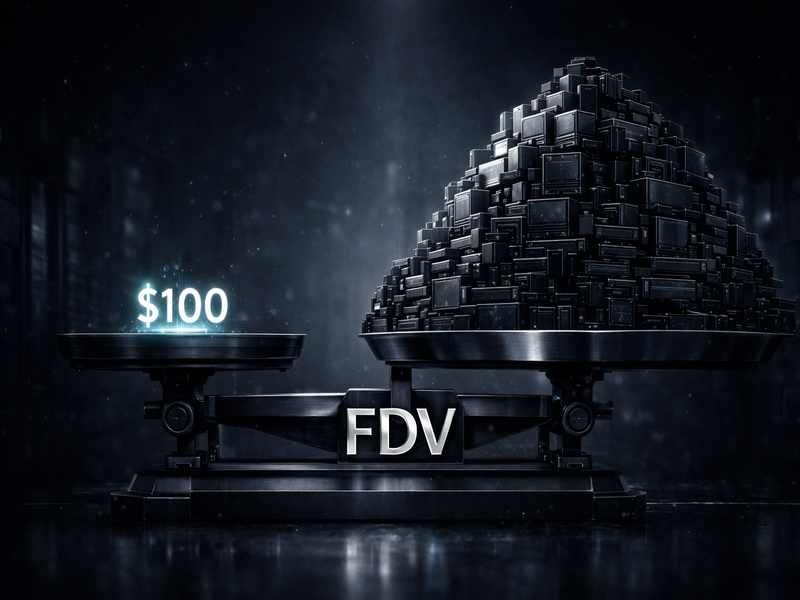
The price of a single coin often creates a false sense of affordability. An asset at $1 looks cheap, and an asset at $100 looks expensive, but the market does not work that way. First, we need to understand how many coins are already in circulation, how many can still reach the market, and how much capital would be required for that price to become reality. FDV helps answer that.
What FDV Is and How It Differs From Market Capitalization
FDV is the valuation of a project under the assumption that its full supply is already in circulation. The formula is simple: token price multiplied by total supply. Market capitalization is calculated differently: price multiplied only by circulating supply.
These two metrics answer different questions:
- market capitalization shows how much the market is currently paying for the coins already in circulation;
- FDV shows what the valuation would look like if the full issuance were already on the market.
The wider the gap between them, the higher the risk that the market has not yet absorbed the full weight of supply.
Why a Coin’s Price Without Supply Can Be Misleading
Beginners often focus only on the number on the screen. A coin at $0.80 looks cheap, and a $10 target can sound modest. But if a project has an enormous token base, price alone says very little. The heavier the asset is in supply terms, the more capital it needs to produce a meaningful move.
The sequence is clear:
- first calculate the scale of the market under that scenario;
- then assess whether that amount of capital is realistic;
- only after that does the target itself start to mean anything.
Without that, the conversation about a nice round number usually goes nowhere.
XRP as an Example of a Heavy Asset
XRP is a useful example because its supply is large enough for any attractive price target to run into basic math very quickly. As of early April 2026, XRP is trading around $1.32. Circulating supply stands at 61.41 billion XRP, total supply at 99.99 billion, and max supply at 100 billion. Current market capitalization is around $81.05 billion, while FDV is around $131.97 billion.
The popular retail scenario looks like this:
- if XRP trades at $100 with the current circulating supply of 61.41 billion coins, that implies about $6.14 trillion in market capitalization;
- if we calculate using the maximum supply of 100 billion, the result is about $10 trillion in FDV.
The issue is scale. The point is not that XRP is a bad asset. The point is that it is heavy in supply terms. For coins like that, an attractive price target looks convincing only until the first market cap calculation.
The asset can rise, but that kind of move has to be discussed through:
- market scale;
- the speed of capital inflows;
- the supply regime.
The idea that “it has been at $3 before, so $100 must also be possible” is far too weak for an asset like this.
Token Unlocking and Hidden Supply Pressure
The next part is new token supply reaching the market. After an unlock, coins become available for circulation, which increases movable supply. That does not mean they will be sold immediately, but it does mean the market has to absorb additional volume.
If demand does not grow at a comparable pace, price faces headwind. That is why it is not enough to look only at the chart and the current price. You need to understand:
- how many tokens can still reach the market;
- when that will happen;
- who will receive the new supply.
This looks different from project to project:
- in some cases, the main pressure comes from regular monthly token releases;
- in others, it comes from large one-time events that sharply increase supply.
For an investor, this matters: two assets with similar FDV can behave very differently if their supply expansion structure is different.
Full Unlocking and Mature Assets
Not all large assets carry the same dilution risk. For mature coins where most of the supply is already in circulation, the risk of hidden token overhang is usually lower. That does not mean those assets cannot fall. It means something else: their price action depends less on future token releases.
That is why mature assets and younger tokens should not be judged by the same standard:
- for a mature asset, the main question is usually market phase, liquidity, and demand;
- for a younger token, the future supply schedule always has to be part of the discussion.
How We Check a Coin Before Entering
We do not start with a dream price. We start with a short checklist.
- We look at circulating supply, total supply, and max supply.
- We compare market capitalization and FDV.
- We check whether there is a large gap between the current circulating amount and the full issuance.
- We open the unlock schedule and check the nearest dates.
- We identify who is receiving the new tokens: the team, investors, a foundation, the treasury, or the community.
- We assess whether the market can absorb the added supply without losing momentum.
This process quickly filters out stories where an attractive price hides heavy tokenomics.
Basic Rules of Discipline
FDV by itself does not say “buy” or “do not buy.” It shows how dangerous it is to make a decision based on price alone.
If an asset is already almost fully in circulation, the main question shifts toward demand and the market cycle. If an asset is still far from its full supply reaching the market, the main question shifts toward future supply expansion and the market’s ability to absorb it.
For beginners, the rule is simple: the less you understand the tokenomics, the smaller the position size should be.
The working order is this:
- first calculate supply;
- then check the schedule of tokens entering circulation;
- only after that discuss upside.
Common Mistakes
- Comparing coins by the price of one unit.
- XRP at $1.32 looks cheap to many people only because Bitcoin trades at a completely different level. That is the wrong comparison because the two assets carry very different supply weights.
- Judging FDV without the token release schedule.
- A high FDV alone still does not give the full picture. What matters more is how many coins will actually reach the market over the coming weeks and months.
- Assuming every supply expansion must be bearish.
- Not every unlock ends with selling pressure. Context, liquidity, demand structure, and the identity of the recipients all matter. But ignoring the calendar of new token supply is weak practice.
Working Framework for Assets Like This
Before entry.
- We calculate market capitalization and FDV.
- We check what share of supply is already unlocked.
- We open the token release schedule and mark the nearest dates.
During the position.
- We monitor whether demand is strong enough while supply is increasing.
- If a large increase in circulating coins is ahead, we do not cling to the old valuation as if it were absolute truth.
- We do not add to the position just because the coin looks cheap.
After the move.
- If the asset rallies on news while a large supply tail still remains ahead, we take profits pragmatically.
- Then we reassess the situation using the new inputs.
- After a new batch of tokens reaches the market, the market is no longer trading a clean story. It is trading a new factual supply level.
Mini Cases
- XRP.
- On the screen, the price looks moderate, but a supply-based calculation quickly shows the true scale of the task. At $100, the discussion moves into multi-trillion-dollar market capitalization. That is a completely different class of liquidity and capital inflow requirements.
- Younger tokens with incomplete supply release.
- A strong price impulse does not mean the supply issue has disappeared. If more unlock stages are still ahead, the market still has to absorb additional token volume.
- Bitcoin and Ethereum.
- Here, the gap between current market capitalization and full supply valuation is much smaller, so the main discussion is no longer about future unlocking but about market phase, macro conditions, and demand strength. For a beginner, this is a useful contrast: for some assets the key risk is tokenomics, while for others it is the market regime.
How to Apply This in Real Work
Understanding FDV alone is not enough if you do not know what kind of market regime you are operating in. In real work, it makes more sense to read supply structure together with broader market phase, open interest, funding, and liquidations. A practical way to do that is to use Market Median as a regime filter first, then add context through open interest, funding, liquidations, and premium screeners. If the goal is to make disciplined decisions rather than chase attractive prices, that sequence gives a cleaner picture than judging a coin by the chart alone.
For spot positioning in more mature assets, trading bot for spot becomes more useful once the broader regime is already clear and the task is to remove part of the routine from trade management. When market conditions become harsher and capital protection matters more, it makes more sense to filter the environment through Market Median and the screeners first, then decide on entry. That does not replace manual work on FDV and supply structure, but it helps turn that analysis into a consistent workflow.
FAQ
Is FDV always bad?
No. FDV is not a problem by itself. It shows how much supply a project may still bring to the market and how sensitive the current price is to future dilution.
Can you buy a coin with high FDV?
Yes, if you understand when and to whom the new tokens will become available, and you see demand that can absorb that volume. The problem begins when high FDV is combined with low circulating supply and nearby supply expansion.
Why is XRP a good example for explaining FDV?
Because it is a large, well-known asset with a very large supply. It clearly shows how an attractive target quickly runs into market cap math.
Is a fully unlocked asset always better?
Not always. It is simply more transparent in supply terms. After that, demand, liquidity, macro conditions, and the quality of the asset still matter. But the risk of an unexpected token overhang is usually lower.
Which matters more: FDV or market capitalization?
You need to look at both at the same time. Market capitalization shows the current state, while FDV shows the future supply burden. In real work, they complement each other.
Conclusion
FDV is not meant to bury coins. It is meant to set realistic boundaries for expectations. If an asset is heavy in supply terms, like XRP, discussing a target without calculating market capitalization is weak practice. If a project still has a long tail of new token supply ahead, ignoring that is even worse.
The sequence matters:
- first calculate the weight of supply;
- then talk about price.
That quickly filters out market fantasies and makes coin selection much cleaner.
Risk Disclaimer
This material is provided for informational purposes only and does not constitute investment advice.
The crypto market is volatile, and tokenomics, supply release schedules, and market conditions can change quickly.
Before entering a position, traders should assess risks, liquidity, and the asset’s supply structure independently.