
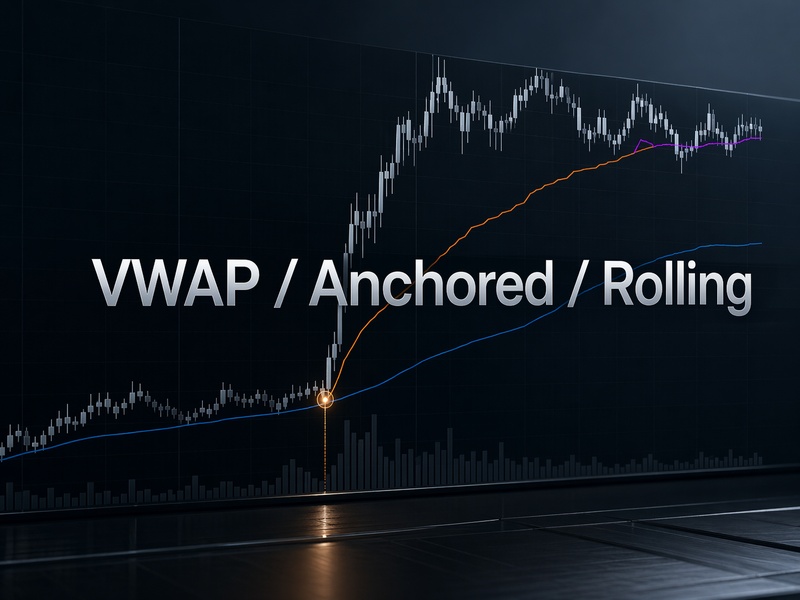
What Is VWAP
VWAP is the volume-weighted average price. It shows where the average price sits once real traded volume is included, not just price prints on their own.
That is the key difference between VWAP and a regular moving average. A moving average smooths price only. VWAP combines price and volume, so it gives a clearer view of the working average for the current period.
In most cases, VWAP is calculated from the start of the day or another selected session. As the period develops, new trades are added, and the line reflects the current average price of that period.
In trading logic, VWAP works as an average-price reference:
- above VWAP, the market is trading at a premium to the average price of the period;
- below VWAP, it is trading at a discount;
- near VWAP, price is closer to its working balance area.
VWAP does not produce a standalone signal. It shows how far price has moved from its average base.
What Is Anchored VWAP
Anchored VWAP is a VWAP tied to a specific starting point. Standard VWAP begins at the start of a period. Anchored VWAP begins at an event we select ourselves.
That anchor point can be:
- a local low;
- a local high;
- the start of an impulse;
- a range breakout;
- a strong liquidation candle;
- a news event after which the market clearly changed regime.
The purpose is to calculate the average price not from a calendar reset, but from a specific market event. That matters when the full day is not the main focus and a particular move is.
Standard VWAP answers the question of where the average price of the current period is. Anchored VWAP answers the question of where the average price has been since the selected event.
The strength of Anchored VWAP is precise context. The weakness is the anchor choice. If the anchor is random, the line loses meaning.
What Is Rolling VWAP
Rolling VWAP is a VWAP calculated on a fixed rolling window. It is not tied to the start of the day or to a single event. It only tracks the most recent section of the market.
In practice, the indicator keeps calculating the average price over the last N candles, the last few hours, or another chosen interval. Old data drops out and new data comes in.
That makes Rolling VWAP the fastest to adapt. It does not carry the whole day like standard VWAP, and it does not rely on an old anchor point like Anchored VWAP.
If standard VWAP shows the average price of the period, and Anchored VWAP shows the average price since an event, then Rolling VWAP shows the average price of the current active segment of the market.
It fits where:
- there is no single strong event to anchor from;
- the old anchor has already lost relevance;
- what matters is the local revaluation of the most recent segment.
What Is the Difference Between VWAP, Anchored VWAP, and Rolling VWAP
The difference lies in the calculation base.
Standard VWAP measures the market from the start of the period. It is the average price of the day, the session, or another selected interval.
Anchored VWAP measures the market from a chosen event. It is the average price of the move since a breakout, an impulse, a capitulation event, or another point we consider important.
Rolling VWAP only measures the latest window. It is the average price of the current local segment, not the full period and not the full move from the anchor.
That changes how each tool behaves.
Standard VWAP gradually becomes heavier as more data accumulates. Anchored VWAP also becomes heavier if a lot of time has passed since the anchor point. Rolling VWAP stays the most responsive because older data is constantly removed.
By use case, the split is clear:
- standard VWAP is for the overall average price of the period;
- Anchored VWAP is for logic around a specific event;
- Rolling VWAP is for the current local revaluation.
These tools are not interchangeable. They answer different questions.
How to Read These Tools in Market Logic
On a pump, VWAP shows how far price has moved away from its average base. That is not a reversal signal. It is a way to measure extension.
Anchored VWAP is more useful on a pump if it is anchored to the start of the impulse. Then it becomes clear whether the market is still holding the average price of that specific move or already losing it.
Rolling VWAP is useful when the whole move is not the main point and what matters is the state of the most recent segment. It shows faster whether the extension is still alive or whether the pump has already shifted into local digestion.
In a no-pullback trend, overly strict VWAP filtering can get in the way. Price can stay above the average for a long time without returning to it. In that type of regime, VWAP is better read as context, not as a hard prohibition.
In a sideways range after an impulse, Rolling VWAP is often more useful. It shows the local balance inside the range more clearly. Standard VWAP can act as the center of the period. Anchored VWAP only remains relevant if the market is still trading around the original event.
For entries and averaging logic, these tools work as a price-location filter:
- the market is still extended;
- the market has already returned to its base;
- the move is still impulsive;
- the move has already shifted into chop.
VWAP is a context filter. It is not standalone trading logic.
Where People Most Often Get It Wrong
The same mistakes appear again and again:
- VWAP is read like a regular moving average;
- Anchored VWAP and Rolling VWAP are blended into one logic;
- the anchor point is chosen without market meaning;
- deviation from VWAP is treated as a ready-made reversal signal;
- the filter is made either too strict or too loose.
For Anchored VWAP, the main mistake is a random anchor. If the point is chosen badly, the whole context that follows becomes weak.
For Rolling VWAP, the typical mistake is different: people expect long-term context from it, even though its job is to evaluate the latest segment quickly.
For standard VWAP, the mistake usually appears in a strong trend. Price can stay above the average price of the period for a long time, and that still does not mean a reversal.
How to Apply This in Trading Bot Settings
In a bot, a VWAP filter should be treated as an additional configuration condition, not as a standalone solution. It does not replace the core strategy, and by itself it guarantees nothing.
For ST-Bot when working with a pump, the logic can look like this:
- the base signal comes from the core strategy;
- the VWAP filter checks what zone the market is in relative to the average price;
- this makes it possible to define separately where entries are allowed and where averaging orders are allowed.
For short logic on a pump, the goal is not to pull entries closer to the average price. Quite the opposite: the user may want to keep adds inside the deviation zone and avoid shifting them into chop near the average, where the market can still make another squeeze higher.
If price is still trading in an overheated zone, that is one environment. If it has already spent a long time digesting near its base, that is a different environment. In this setup, VWAP is not judging whether the strategy is good or bad. It defines the zone in which the core logic is allowed to execute.
This matters even more for averaging. In a short configuration, adds can be tied to deviation from the average rather than to a return toward it. In that case, the filter is used to avoid moving averaging orders into a loose sideways zone.
The roles of the tools split like this:
- standard VWAP — a reference for deviation from the average price of the period;
- Anchored VWAP — a calculation from the start of an impulse or another event;
- Rolling VWAP — a local revaluation of the latest segment.
This logic should not be presented as universally correct. The outcome depends on the market, timeframe, core strategy, and settings. The safe claim is limited to the role of the filter: it adds one more rule for selecting the zone where entries and averaging are allowed.
In Crypto-Resources, this fits into broader configuration logic. Trading bot ST-Bot assume user-defined settings, Market Median provides regime context, and funding screeners help assess whether this type of filter makes sense in the current environment at all.
Mini Cases
- Pump with a fast deviation from the average price
Price moves sharply higher. Standard VWAP shows the fact of a strong deviation from the average price of the period. Anchored VWAP from the start of the pump shows the overheating of that specific impulse. Rolling VWAP is useful if the goal is to understand whether the most recent segment is still overheated or whether the move is already cooling off.
- No-pullback trending move
Price keeps moving higher with almost no pullbacks. Standard VWAP starts lagging materially. Overly strict filtering stops matching market structure. In that regime, Anchored VWAP from the breakout point gives more usable context, while Rolling VWAP helps focus on the current segment without dragging too much old history into the picture.
- Sideways range after an impulse
After a sharp move, the market shifts into a range. Here, Rolling VWAP is often more relevant than an old anchor because it shows balance inside the sideways structure more clearly. Standard VWAP gives the overall center of the period. Anchored VWAP only keeps meaning if the market is still holding around the original event.
FAQ
How is VWAP different from a regular moving average?
VWAP includes volume, while a moving average does not. That is why VWAP shows not just an averaged price, but an average price weighted by where the main traded volume actually went through.
When is Anchored VWAP the better choice?
When there is a specific event on the chart: a breakout, the start of an impulse, a liquidation candle, a strong news event, or capitulation. In those cases, it makes sense to calculate the average price from that point.
When is Rolling VWAP more useful than standard VWAP?
When a fast revaluation of the most recent segment is needed. It fits sideways conditions after an impulse, step-like moves, and regimes where the old base no longer provides useful context.
Can an entry be built on a VWAP filter alone?
No. VWAP shows where price is relative to its average base, but it does not replace market regime, move structure, volume, or the core logic of the strategy.
Is VWAP suitable for averaging orders in a bot?
Yes, if it is used as an additional configuration condition. It lets the user define in what zone relative to the average price adds are allowed, but it does not determine the outcome of the strategy by itself.
Conclusion
VWAP, Anchored VWAP, and Rolling VWAP serve different purposes. Standard VWAP shows the average price of the period. Anchored VWAP keeps the focus on a specific event. Rolling VWAP revalues the current segment the fastest. The correct choice depends on market context. In bot logic, this is not a replacement for the core strategy, but an additional rule inside user configuration.
Risk Disclaimer
Any filter changes strategy behavior, but it does not remove market risk.
Before changing settings, new conditions should be tested on historical data and in a controlled environment.