

Stablecoin market cap is once again holding near record levels. The total market is around the $300 billion area, while Federal Reserve reports have already referenced a level near $320 billion.
For crypto, this matters more than another data point on USDT and USDC. It shows that a large pool of dollar liquidity is already sitting inside crypto infrastructure.
That capital does not have to buy Bitcoin, Ethereum, or altcoins immediately. But it has already crossed the main barrier: the money is inside the system and can move from waiting mode into risk quickly.
What Stablecoin Market Cap Near Highs Shows
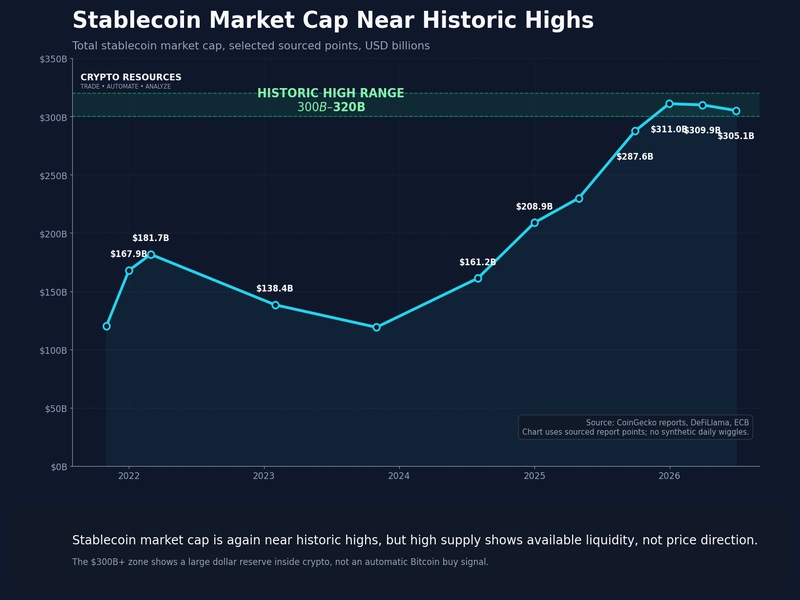
Stablecoins are often described as digital dollars. That explanation is correct, but too basic for the current market. What matters now is why the combined supply of USDT and USDC is again sitting near record levels.
When stablecoin market cap rises or remains high, it shows how much capital has not left the crypto system. That money can wait for trades, sit on exchanges, work in DeFi, support settlement, or back open positions.
For traders, this is a separate layer of the macro backdrop. External dollar liquidity runs through rates, Treasury yields, and the Fed’s balance sheet. Internal crypto liquidity is often visible through stablecoins.
The larger this layer becomes, the shorter the distance between waiting and trading. Capital does not need to move through a bank, a payment rail, or a fiat deposit process. It is already close to trading pairs, DeFi protocols, and exchange infrastructure.
High stablecoin market cap does not forecast price direction. It shows the size of the dollar reserve already available inside the market.
Why High Stablecoin Supply Still Does Not Mean Growth
High stablecoin supply shows that capital exists. It does not show that this capital is already willing to buy risk.
After sell-offs, stablecoin market cap can also look strong. Traders sell BTC and altcoins, lock in dollar value, but keep funds inside crypto instead of withdrawing them. From the outside, that still looks like liquidity in the system. In practice, it can be a defensive position.
This often creates a false sense of strength. The market sees a lot of USDT and USDC, but price does not rise because the money remains on the sidelines.
A bullish scenario needs the move from cash into assets. That shift is not visible through supply alone. It has to be confirmed by price, volume, Bitcoin dominance, ETH/BTC, and derivatives.
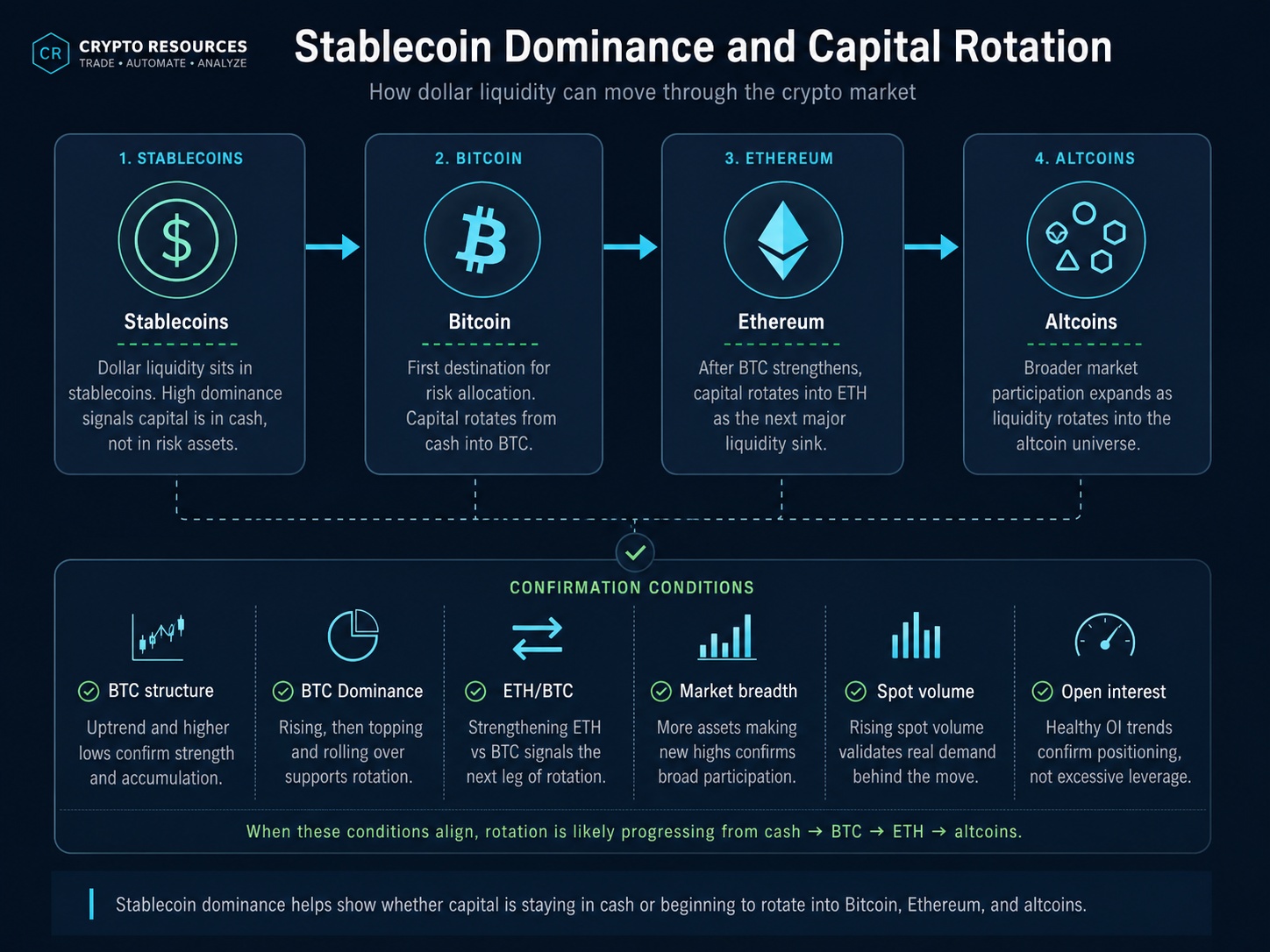
If stablecoin supply is high, BTC holds structure, spot volume improves, and Bitcoin dominance stops pressing altcoins lower, the liquidity reserve starts to matter for risk.
If capital stays in cash, BTC dominance rises, and market breadth remains weak, this is still only a large dollar reserve inside crypto, not confirmed demand.
What Stablecoin Dominance Shows
Stablecoin dominance shows how much of total crypto market capitalization is sitting in dollar tokens rather than volatile assets. For a trader, this can be more useful than looking at the total amount of USDT and USDC alone.
If stablecoin market cap rises faster than the rest of the market, the share of cash inside crypto is increasing. That can mean preparation for future buying, but it can also mean capital has moved away from risk after a drop in Bitcoin and altcoins.
Rising USDT and USDC dominance against BTC often shows that market participants prefer dollar exposure over risk. In that phase, the market can have a large liquidity reserve, but that liquidity is not yet supporting upside.
For a bullish setup, the stronger signal is a turn lower in stablecoin dominance. If the share of stablecoins starts to fall while Bitcoin, Ethereum, and the broader market rise on spot volume, that starts to look like capital moving from cash into assets.
Stablecoin dominance should be read together with BTC Dominance. If stablecoin share falls, Bitcoin dominance weakens, ETH/BTC rises, and market breadth expands, the altcoin rotation setup becomes stronger.
USDT and USDC Dominance: Where Liquidity Sits
USDT remains the main stablecoin for exchange liquidity. It is deeply embedded in trading pairs, futures markets, transfers between venues, and short-term trader activity.
USDT often reflects the speculative layer of the market. Growth or stability in its supply shows how much dollar liquidity sits close to exchanges and active trading strategies.
USDC has a different role. It is more closely linked to DeFi, payments, tokenized assets, corporate infrastructure, and more regulated use cases.
USDC matters not only because it is the second-largest dollar stablecoin. Its activity shows how dollar liquidity is moving beyond pure exchange speculation: into settlement, RWA, on-chain finance, and infrastructure products.
USDT often shows the trader dollar. USDC often shows the infrastructure dollar.
The cleaner signal is not growth in one token alone, but expansion across the whole dollar layer: exchanges, DeFi, networks, payment use cases, tokenized assets, and real transfer volumes.
How Stablecoin Market Cap Affects Bitcoin
Bitcoin usually receives liquidity first. When the market leaves defensive mode, capital rarely moves straight into the riskiest altcoins. It normally tests BTC first because Bitcoin is the most liquid and widely understood asset in crypto.
High stablecoin market cap creates a useful base for that process. The money is already inside the system, and Bitcoin remains the first asset for risk allocation.
But stablecoins only become support for BTC when market structure confirms demand. High supply on its own can sit idle.
For Bitcoin, the setup is stronger when:
- stablecoin market cap holds near record levels;
- BTC holds its key structure;
- spot volume confirms buying;
- the futures market is not overheated;
- the dollar and Treasury yields are not creating strong pressure.
In that regime, stablecoins work as a liquidity reserve. The move is not triggered by supply itself, but by demand starting to use that reserve.
Why Altcoins Need More Than High USDT and USDC Supply
Altcoins need more than a large pool of USDT and USDC. They need capital to move further out on the risk curve.
Rotation usually develops in stages:
- capital concentrates in Bitcoin;
- Ethereum starts to strengthen after BTC stabilizes;
- Bitcoin dominance then falls and the move spreads into altcoins.
If stablecoin market cap is high but BTC dominance keeps rising, the market has not entered a broad altcoin regime. Capital may be inside crypto, but it is still choosing the most liquid asset.
Altcoins need separate confirmation:
- ETH/BTC shows sustained recovery;
- BTC Dominance loses momentum;
- a broad group of altcoins starts outperforming Bitcoin;
- market breadth improves;
- the move is supported by spot demand;
- open interest does not detach from price and volume;
- liquidations do not become the main source of upside.
Stablecoins create the liquidity reserve. Market structure shows where that liquidity is actually going.
Where the Market Can Get It Wrong
The main mistake is looking only at total stablecoin market cap. The same amount of stablecoins can describe different market regimes.
On exchanges, stablecoins can turn into trades quickly. In DeFi, they may support lending, farming, arbitrage, and settlement. On Tron, they are often used for cheap transfers. On Ethereum and L2 networks, they are more visible in DeFi, RWA, and on-chain infrastructure.
There is also a difference between liquidity held by traders, market makers, protocols, and corporate users. They all use stablecoins, but not all of them create buying demand for BTC or altcoins.
Peg risk matters as well. As long as a stablecoin holds close to $1, the market treats it as cash. If the peg breaks, the stablecoin itself becomes a source of stress.
That is why supply alone is not enough. Peg stability, volume, network distribution, exchange balances, and the reaction of risk assets all matter.
How to Read Stablecoins Through Crypto Resources
Stablecoins near record highs show the liquidity backdrop. The next step is checking whether those dollars are actually entering the market.
Market Median shows the broader market phase and breadth. If stablecoin market cap is high but the median remains weak, capital is not spreading widely yet.
Open interest screeners show where positioning is growing faster than price and volume. This helps separate real demand from futures-driven overheating.
Premium Index shows the imbalance between futures and spot. If the move is driven mainly by futures premium, the structure is weaker.
Liquidation screeners show what is feeding the move: new demand or forced position closures.
First, check whether the system has a large dollar reserve. Then check whether that reserve is turning into demand through price, volume, breadth, open interest, Premium Index, and liquidations.
What to Watch Next
The focus now is not only total stablecoin market cap, but its structure. A level near record highs does not answer the main question: is the money preparing to buy, or is it still waiting?
A stronger scenario needs several conditions at once: high stablecoin supply, a stable peg, firm BTC structure, ETH/BTC recovery, less pressure from BTC Dominance, and improving market breadth.
A weaker scenario looks different: stablecoins remain elevated, capital stays in cash, BTC Dominance rises, altcoins fail to outperform Bitcoin, and individual moves are driven mainly by futures leverage.
USDC also deserves attention. Its growth can reflect more than trading. It can point to expanding on-chain settlement, RWA activity, and infrastructure demand.
High stablecoin market cap gives the market room to move. But that reserve only becomes a real move after confirmation from price, volume, dominance, ETH/BTC, and derivatives.
FAQ
Why does stablecoin market cap near highs matter for crypto?
It shows that a large pool of dollar liquidity is already inside crypto infrastructure. That capital can move quickly into Bitcoin, Ethereum, or altcoins if market structure confirms demand.
What does stablecoin dominance show?
Stablecoin dominance shows the share of USDT, USDC, and other dollar tokens within total crypto market capitalization. A rising share often points to capital moving into cash, while a falling share during a market advance can show money moving back into risk.
Does growth in USDT and USDC mean Bitcoin will rise?
No. High supply shows that capital exists, but it does not guarantee BTC buying. The money can remain in cash, DeFi, arbitrage, or margin for futures positions.
What is the difference between USDT and USDC in market analysis?
USDT is more closely tied to exchange trading and trader liquidity. USDC is more common in DeFi, payments, tokenized assets, and institutional infrastructure.
Why do altcoins need more than high stablecoin supply?
Altcoins need real risk rotation, not just a large dollar reserve. That rotation is confirmed by falling Bitcoin dominance, ETH/BTC recovery, better market breadth, and spot demand.
Conclusion
Stablecoin market cap near record levels shows that a large dollar reserve has built up inside crypto. This is a strong macro backdrop for Bitcoin and altcoins, but not a buy signal on its own.
The main question is where that capital goes. If it moves from stablecoins into BTC, then ETH, and then the broader market, rotation begins. If the money stays in cash, it is only parked dollar liquidity inside crypto.
For traders, the useful read comes from the full stack: stablecoin supply, stablecoin dominance, Bitcoin structure, ETH/BTC, market breadth, spot volume, and derivatives. Taken together, these data points show whether the market is ready to move or simply holding record liquidity on the sidelines.