
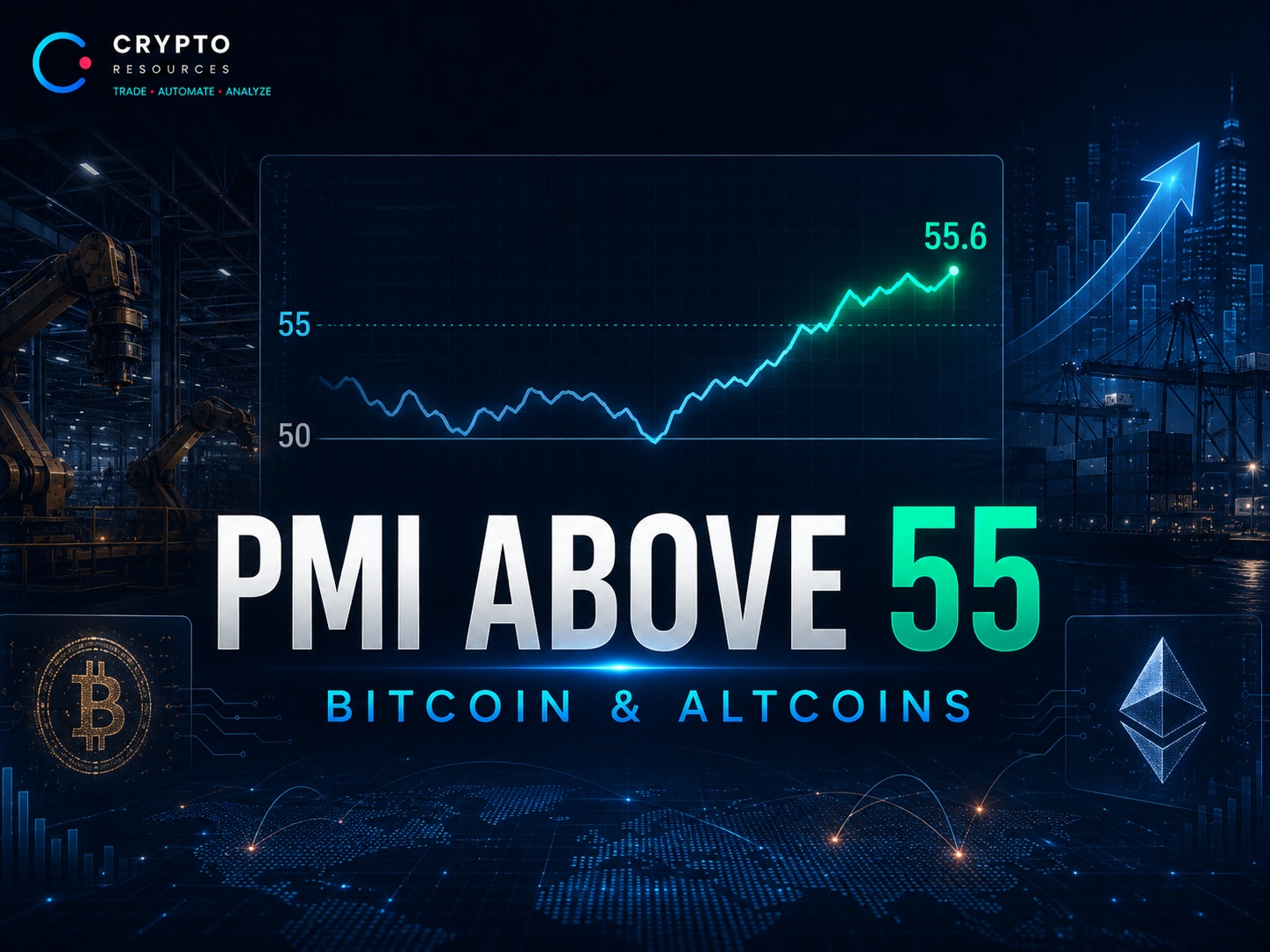
The US ISM Manufacturing PMI rose to 55.6 in July from 53.3 a month earlier. This was its highest reading since May 2022 and a clear sign that US manufacturing is gaining momentum.
For crypto, this is a strong macro backdrop, but not a buy signal on its own. Production, new orders, employment, and backlogs all expanded. That kind of environment makes it easier for capital to move into risk assets.
Prices are the weak spot. The Prices Index came in at 71.1. Manufacturing is accelerating, but input costs are still rising across a large part of the sector. For the Federal Reserve, that is not a clean low-inflation growth signal.
What a PMI Reading Above 55 Means
PMI stands for Purchasing Managers’ Index. It is based on surveys of purchasing and supply managers at manufacturing companies.
These managers see changes in orders, output, inventories, hiring, and delivery times before they show up in slower official data.
The headline manufacturing PMI is built from five main components:
- new orders;
- production;
- employment;
- supplier deliveries;
- manufacturing inventories.
PMI is a diffusion index. It measures how widely conditions are improving or deteriorating across surveyed companies. A reading of 55.6 does not mean manufacturing output increased by 55.6%.
The 50 level separates expansion from contraction. Anything above 50 signals growth in manufacturing activity compared with the previous month.
There is no official threshold at 55. Markets still pay attention to this area because it usually reflects firm expansion rather than weak growth close to neutral.
Direction also matters. The move from 53.3 to 55.6 shows that manufacturing is not only expanding, but expanding at a faster pace.
What Was Inside the July ISM Report
The headline result was supported by several strong components:
- Production — 58.5: factory output accelerated sharply;
- New Orders — 56.7: demand continued to grow;
- Employment — 52.8: hiring moved above 50 for the first time in 33 months;
- Backlog of Orders — 55.0: unfinished orders increased;
- Inventories — 51.2: manufacturing inventories stayed in expansion;
- Prices — 71.1: higher input costs remained widespread;
- Supplier Deliveries — 58.9: delivery times continued to lengthen.
The main positive is that the report was not driven by one component alone. Production rose much faster than new orders, but backlogs also increased while customer inventories remained low. That can support factory activity over the coming months.
Supplier Deliveries needs a careful reading. A value above 50 means deliveries are slowing. Sometimes that reflects strong demand and busy suppliers. Sometimes it reflects shortages, transport constraints, and supply-chain stress.
The July report had both layers. Demand and output improved, while manufacturers continued to report tariffs, expensive materials, and longer delivery times.
How a Strong PMI Affects Crypto
PMI does not affect Bitcoin through a direct economic link. Its influence runs through expectations for growth, inflation, and monetary policy.
The market usually reads it through this chain:
PMI → growth and inflation expectations → Fed policy → yields and the dollar → cost of capital → demand for risk.
A strong report can support markets when economic growth improves without creating another inflation shock. Recession risk falls, and investors become more willing to allocate capital to equities, Bitcoin, and other risk assets.
The reaction changes when stronger production comes with persistent price pressure. Markets may reprice the expected path of Fed policy, pushing Treasury yields and the dollar higher.
For crypto, that means a higher cost of capital and less supportive liquidity conditions. Bitcoin usually handles that environment better than most altcoins. Altcoins need not only a better macro backdrop, but also a market willing to move further out on the risk curve.
This is why traders look beyond the headline PMI. The size of the surprise, the Prices Index, employment, the bond-market reaction, and the dollar all matter after the release.
For Bitcoin, the best setup is faster growth without a sustained rise in yields or the dollar.
Why PMI Is Being Linked to Altseason
The major altcoin cycles of 2017 and 2021 developed during periods of strong business activity. US manufacturing PMI was firmly in expansion and, at times, well above 55.
In 2021, the index remained close to or above 60 for several months. Crypto was also moving through a broad cycle across Bitcoin, Ethereum, DeFi, NFTs, and a large group of altcoins.
That overlap is not enough to treat PMI as an altseason trigger. Both cycles were also supported by loose financial conditions, expanding global liquidity, new participants, rising leverage, and strong crypto-specific narratives.
Capital rotation inside crypto often develops in stages:
- liquidity first concentrates in Bitcoin;
- Ethereum begins to strengthen once BTC becomes more stable;
- falling Bitcoin dominance allows the move to spread across altcoins.
PMI above 55 improves the external backdrop for risk. The rotation itself still has to appear inside crypto.
What Traders Need to See Inside Crypto
For Bitcoin, a strong PMI can be a supportive macro signal. For altcoins, that is not enough. Traders need evidence that capital is actually moving beyond BTC.
The setup looks stronger when:
- Bitcoin holds its market structure;
- BTC dominance loses momentum and turns lower;
- ETH/BTC shows sustained recovery;
- a broad group of altcoins begins to outperform Bitcoin;
- spot volume supports the advance;
- open interest rises in line with price and volume;
- the Premium Index remains below overheated levels;
- liquidations do not become the main source of momentum.
Price growth driven mainly by open interest is more fragile. Leverage can accelerate a move, but it also creates the next zone of forced liquidation.
A spot-led advance usually has a stronger base. Demand is less dependent on futures leverage and less concentrated in a small group of overheated contracts.
How to Use PMI in a Trading Framework
PMI works best as a market-regime filter. It does not provide a precise entry and does not replace market structure.
Weak PMI combined with tight financial conditions calls for a more defensive approach. Economic momentum is slowing, capital remains expensive, and weaker altcoins lose liquidity faster.
Accelerating PMI with easing price pressure creates a more constructive environment. Demand improves while the risk of additional Fed tightening remains contained.
Strong PMI alongside a high Prices Index creates a mixed regime. In that case, the reaction in Treasury yields, the dollar, and rate expectations matters more than the headline number alone.
Crypto Resources tools help compare the macro backdrop with conditions inside the market:
- Market Median shows the broader market phase and breadth;
- open-interest screeners track where positioning is building;
- Premium Index measures the imbalance between futures and spot;
- liquidation screeners show how much of a move is being driven by forced closures.
PMI sets the macro backdrop. Trade execution still depends on Bitcoin structure, BTC dominance, ETH/BTC, spot demand, and derivatives positioning.
What to Watch Next
The July PMI confirms a broad acceleration in US manufacturing. Production, new orders, employment, and order backlogs are all in expansion.
Prices remain the main constraint. The Prices Index has declined for three consecutive months, but 71.1 still points to widespread increases in input costs.
A constructive crypto scenario requires stable Treasury yields and no sustained dollar rally. Altcoins also need falling Bitcoin dominance, a stronger ETH/BTC pair, and improving market breadth.
The next PMI reports will show whether manufacturing momentum can hold while price pressure continues to ease. The Fed and bond-market response will determine whether stronger growth supports risk liquidity or leads to tighter financial conditions.
FAQ
What is PMI?
PMI is the Purchasing Managers’ Index. It measures how widely orders, production, employment, deliveries, and inventories are improving or deteriorating.
What does PMI above 50 mean?
A reading above 50 signals manufacturing expansion compared with the previous month. A reading below 50 signals contraction.
Why do markets watch PMI above 55?
This area usually reflects broad industrial expansion. The official line between expansion and contraction remains 50.
Can a strong PMI be negative for Bitcoin?
Yes. If the report raises inflation expectations, markets may price in tighter Fed policy, higher Treasury yields, and a stronger dollar.
Does PMI above 55 confirm altseason?
No. Confirmation still has to come from Bitcoin structure, BTC dominance, ETH/BTC, market breadth, spot demand, and futures positioning.
Conclusion
A PMI reading of 55.6 shows that US manufacturing has moved into a firmer phase of expansion. That improves the external backdrop for Bitcoin and other risk assets, provided stronger growth does not trigger a sustained rise in Treasury yields and the dollar.
Altcoins need more than one strong macro release. A broader rotation still requires falling Bitcoin dominance, a stronger ETH/BTC pair, improving market breadth, and sustained spot demand.
PMI helps define the market regime. The setup becomes tradable only when the macro backdrop is confirmed by crypto market structure, liquidity, and positioning.