Why it matters
Most crypto blowups look the same: someone sees an impulse, jumps in late, and the market does a normal correction—turning the position into stress. Then comes the “one more add to fix it,” stops get pushed farther away, and discipline disappears. After that, it barely matters where the coin goes.
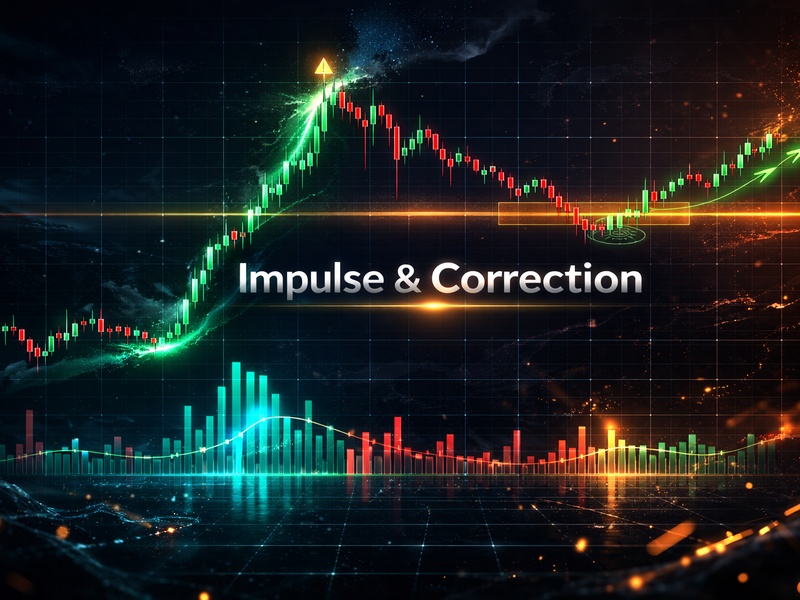
When you split price action into two parts—impulse and correction—it gets cleaner. The impulse shows direction and force. The correction shows whether the market is ready to continue or is breaking structure. In cryptocurrency, this matters even more because pullbacks can be sharp and decisions have to stay simple.
Terms and boundaries
- Impulse — a directional move with acceleration and expanding candle ranges.
- Correction (pullback) — a move against the impulse where the market cools off and trades volume.
- Retest — a return to a key level after a breakout to see whether the zone holds.
- Reclaim — price moves back through a level after a poke and holds it.
- Trend structure — the sequence of highs and lows that tells you whether the trend is intact or broken.
- Continuation — the pullback ends and the move resumes in the impulse direction.
- Reversal — the correction becomes a regime change: key levels break and hold against the trend.
Method: how an impulse forms and why the market needs a correction
An impulse appears when order flow turns aggressive—liquidity gets taken and price stops moving smoothly. It starts jumping between levels. That’s exactly when entries become late and expensive: spreads widen, slippage rises, and emotions take over.
A correction is not “noise.” It’s the market checking three things:
- does demand/supply show up on the pullback
- can the market hold the new level
- was the impulse a one-off liquidity event or something stronger
For a trader, it comes down to this: corrections create the clean entry points, where risk can be tied to structure instead of hope.
Where pullback zones tend to form
Instead of chasing “magic levels,” focus on places where a pullback makes sense. Most often that’s:
- the consolidation area right before the impulse started
- a broken level that the market likes to retest
- a past reaction area with clear liquidity memory
- the “middle of the move” in calmer regimes
- Fibonacci retracement levels as a reference, but only if price actually reacts
A good pullback zone should answer one question quickly: does it hold or not.
Confirmations that a correction is ending
In cryptocurrency, pullbacks easily look like reversals on lower timeframes. You need signals that keep you out of knife-catching.
- the pullback stops printing new lows in an uptrend (or new highs in a downtrend)
- a reclaim forms on the key zone and price doesn’t collapse back through it
- counter-trend pushes get shorter and candles “shrink”
- on a retest, the level holds and closes start leaning back toward the impulse direction
- execution calms down: fewer jumps, fewer empty levels, entries stop feeling like a lottery
If there’s no confirmation, it’s not “missed profit.” It’s saved risk.
Core discipline rules
- an impulse is a bad place to enter “because it’s flying,” unless you had a plan before it started
- a correction is not a reversal until structure breaks
- your invalidation point must be on the chart, not in your head
- the stronger the impulse, the smaller and more cautious the initial entry
- if price accepts and holds against the trend, the continuation idea is closed—no bargaining
Common mistakes
- chasing after multiple big candles
- adding in pieces without a unified plan and one clear invalidation
- trying to catch the pullback bottom off the first green candle
- moving the stop farther “to survive”
- using the same tactics in calm markets and impulse markets
Operating playbook: before / during / after
- Before the trade: identify the impulse and key levels, mark pullback zones, decide what counts as confirmation, and define where the idea is invalid. Size should match volatility, not confidence.
- During the trade: don’t chase, wait for confirmation that the correction is ending, watch execution quality (spread, slippage), and don’t dilute risk with emotional adds. Act only when structure gives a reason.
- After the trade: record where the entry happened relative to the impulse and correction, how much execution cost you paid, which confirmations worked, and which ones failed. One result matters less than repeatable process.
Mini-cases
- Case 1: impulse up, pullback to a retest. Price breaks a level, accelerates, then returns to the retest zone. The entry is not the first touch—it comes after the zone holds and a reclaim forms. Invalidation is acceptance below the retest zone.
- Case 2: deep correction without structure break. The pullback is sharp and noisy, but the key trend low is not broken and held. Entry comes after the pullback “runs out of push” and closes start leaning back toward the impulse.
- Case 3: correction turns into reversal. Price breaks structure and holds against the trend. There’s no need to “prove” anything to the market: the continuation plan is closed and the playbook shifts to the new regime.
FAQ
- How do you tell a correction from a reversal? A reversal is a structure break with acceptance and holding against the trend. Without that, it’s a pullback.
- Do Fibonacci retracement levels matter? As a reference, yes. What matters more is price response and confirmation, not the number on the grid.
- Where is it better to enter: in the impulse or on the pullback? Pullbacks usually offer cheaper execution and cleaner risk. Impulse entries are only justified if they were planned in advance.
- Why are corrections so sharp in cryptocurrency? Higher volatility, often thinner liquidity, and leverage that accelerates both the move and the pullback.
- What matters more: a precise level or discipline? Discipline. Risk and execution mistakes ruin results faster than a slightly wrong level.
Product block
Impulse moves and corrections rarely line up with your schedule. The market can impulse at night and correct during the day—or the other way around. Two tools help here. Crypto screeners let you quickly filter for impulse coins, see when pullbacks approach workable zones, and avoid endless manual chart scanning. Trading robots help with rule-based execution: entries only when conditions are met, fixed risk, and no emotional averaging. In Crypto-Resources you can run this in demo first and see how your playbook holds up across different volatility regimes.
Conclusion
Impulse and correction in cryptocurrency are one linked sequence. The impulse shows where the market is willing to push. The correction shows whether that move has support and where “normal risk” begins.
If you respect structure and wait for confirmation, random wicks stop kicking you around. What’s left is simple work: wait for the pullback, get confirmation, cap risk, and close the scenario when it’s no longer true.
Risks
This material is for informational purposes only and is not an individual investment recommendation. Cryptocurrency markets are volatile, and substantial capital losses are possible. Any decisions should be made only within your own risk-management rules.