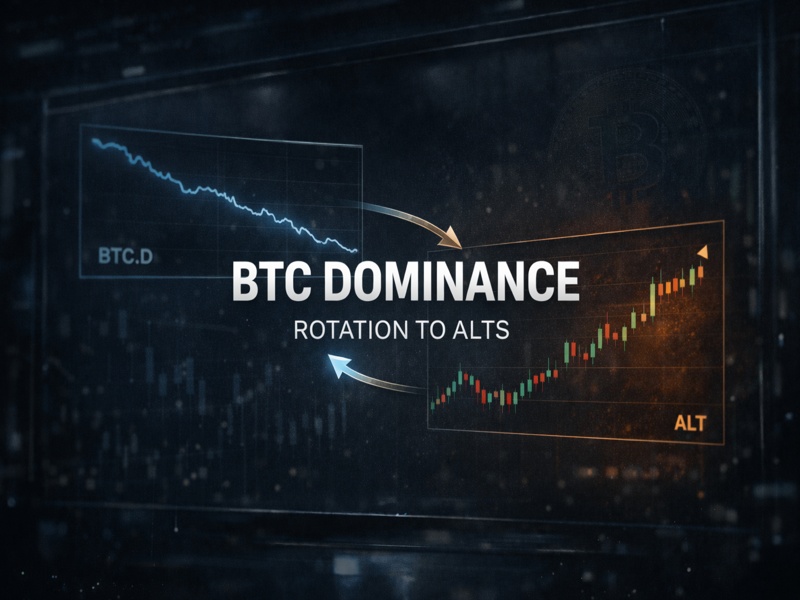
Bitcoin dominance (BTC.D) shows Bitcoin’s share of total crypto market capitalization. It is not an “entry signal” — it’s a regime gauge. It helps you see where liquidity is flowing: into BTC, into altcoins, or back into defensive positioning.
For beginners, it’s one of the clearest rotation tools: instead of guessing whether altseason has started, you work with measurable context.
What BTC.D Is And How To Interpret It Properly
In simple terms, dominance is: BTC market cap / total crypto market cap.
There is a methodology nuance:
- Different providers define “total market” differently (coin universe, stablecoins, wrapped assets, inclusion rules).
- In practice, treat dominance as trend and regime, not a precise decimal.
Operational takeaway: focus on BTC.D direction and behavior around key zones, not tiny percentage disputes.
Why Dominance Matters For Traders
BTC.D solves three practical tasks:
- Regime filter (risk-on / risk-off). Rising dominance often aligns with a preference for “quality” and defense. Falling dominance often aligns with broader risk expansion.
- Altcoin context. Even if a specific alt looks strong, the rotation regime can work against it.
- Breadth alignment. Dominance becomes much more useful when confirmed by market median/breadth and correlations.
How To Read BTC.D: Three Working Regimes
Regime 1: Dominance Rising
Often means the market prefers BTC as the core risk asset and demand for alts is weaker.
How to act:
- less aggression in alts, less leverage;
- stricter selection by liquidity and derivatives conditions;
- prioritize capital protection and discipline.
Regime 2: Dominance Falling
More often aligns with rotation into alts and higher risk appetite.
How to act:
- alts become more reasonable, but only with market-wide confirmation;
- set constraints in advance: limits, pauses, overheating filters.
Regime 3: Dominance Choppy / Sideways
An uncertainty regime: you can get local alt spikes, but not a clean, systematic rotation.
How to act:
- avoid “all-in altseason” positioning;
- trade confirmations and scenarios, not expectations.
Combining Dominance With Correlation And Market Median
This is where BTC.D turns into an operational tool.
Correlations: What To Check
- If BTC rises while correlations “unglue” and alts stop moving in sync, you often see sector distribution.
- If everything stays glued into one correlation block, alt moves are more likely broad risk-on rather than selective demand.
Simple framing: dominance shows where capital flows, correlations show how it spreads.
Market Median: Why It Matters Here
Market median/breadth answers whether the move is carried by a few names or whether the market “floor” is rising.
Working logic:
- BTC.D down + market median up → rotation into alts is healthier.
- BTC.D down but median weak → often narrow pumps/sector squeezes; higher risk.
- BTC.D up + median down → defensive regime; the environment is harsher for alts.
Derivatives Confirmations: Funding, Premium Index, OI, Liquidations
BTC.D pairs well with derivatives metrics because they price risk.
What to watch:
- Funding: aggressive alt funding during falling dominance can signal crowding.
- Premium index: perp vs spot skew often amplifies volatility and wipeouts.
- Open interest (OI): OI growth without spot support increases the chance of violent moves.
- Liquidations: repeated cascades in one direction are a strong “toxic regime” marker.
BTC vs BTC.D vs Altcoins: Regime Matrix Playbook
Two rules before the scenarios:
- Focus on BTC.D direction and regime, not tiny decimals.
- Confirm every scenario with market breadth (median) and correlations, otherwise sector pumps get mistaken for broad rotation.
Scenario A: BTC Up + BTC.D Up → Alts Usually Underperform
Meaning: capital concentrates in BTC as the core risk asset; the market is not expanding risk broadly.
Alt behavior: only the strongest names hold up; many alts lag.
Playbook:
- Portfolio: higher BTC/quality weight; alts only if liquid and setup-driven.
- Trading: avoid leverage expansion in alts; entries only after pullback/structure, no chasing.
- Confirmations: breadth weak; correlations high (market “glued”).
- Invalidation: BTC.D shifts into a sustained downtrend while total market and breadth improve.
Scenario B: BTC Up + BTC.D Down → Healthy Setup For Broad Alt Rotation
Meaning: risk appetite expands; liquidity starts spreading into alts.
Alt behavior: large caps lead first, then mid caps; breadth improves.
Playbook:
- Portfolio: increase alt exposure in steps, not one jump.
- Trading: expand the coin list only with liquidity/spread checks; take profits in parts.
- Confirmations: breadth rises; correlations diversify by sector.
- Risk flag: overheated derivatives (funding/premium/OI) increases wipeout and cascade risk.
Scenario C: BTC Down + BTC.D Up → Defensive Regime, Alts Often Drop Harder
Meaning: capital hides in BTC relative to the rest; alts can sell off faster even if BTC is falling.
Alt behavior: sharper drawdowns, structure breaks, higher volatility.
Playbook:
- Portfolio: reduce alt exposure; increase cash/defense.
- Trading: strict limits and lower frequency; no averaging without invalidation and capped risk.
- Confirmations: breadth down; correlations rise (everything sells together).
- Invalidation: BTC stabilizes, breadth stops deteriorating, BTC.D stops climbing.
Scenario D: BTC Down + BTC.D Down → Broad Sell-Off / Position Unwind
Meaning: pressure hits everything; often a forced unwind phase.
Alt behavior: unstable swings, long wicks, bounces without follow-through.
Playbook:
- Portfolio: drawdown control first; new risk only selectively and small.
- Trading: short, confirmation-based plans; pauses are acceptable.
- Confirmations: breadth drops fast; liquidations add chaos.
- Invalidation: base forms, breadth stabilizes, volatility compresses.
Scenario E: BTC Range + BTC.D Up → Alts Fade Even With “Calm” BTC
Meaning: the market refuses broad rotation; alt momentum bleeds.
Playbook:
- narrow alt universe; require structure + liquidity confirmation; don’t call altseason without breadth.
Scenario F: BTC Range + BTC.D Down → Alt Rotation Without BTC Direction
Meaning: capital seeks returns in alts while BTC stays sideways.
Playbook:
- trade only liquid names; take profits more frequently and in parts; use correlations to avoid overgeneralizing a single sector move.
Mandatory Quality Filters
- Market median/breadth: is the move broad or narrow.
- Correlations: glued market vs sector rotation.
- Derivatives: funding/premium/OI shouldn’t scream overheating where you expand risk.
- Liquidity: volume and spread are a hard gate for beginners.
Mini Cases Without Charts
Case 1: BTC.D rising in a nervous market
Alts show occasional spikes but fade quickly. Action: reduce risk, prioritize liquidity, avoid chasing entries.
Case 2: BTC.D falling with breadth confirmation
More coins hold structure and the move is wider. Action: controlled expansion into alts is reasonable, with limits and derivatives overheating filters.
Case 3: BTC.D falling without correlation/median confirmation
Rotation happens only in a narrow sector or a few names. Action: don’t generalize to “the whole market,” trade selectively and reduce expectations.
Common Mistakes
- Treating BTC.D as a standalone entry signal.
- Ignoring breadth: “altseason” is assumed, not confirmed by median/breadth.
- Ignoring derivatives overheating: falling dominance does not cancel toxic funding and liquidation cascades.
- Substituting rotation logic with random low-liquidity picks.
FAQ
If BTC.D rises, is that always bad for altcoins?
Not always, but the environment is usually harsher. Alts can still move selectively, while broad alt strength is less likely.
If BTC.D falls, does that mean altseason started?
It supports the rotation narrative, but breadth confirmation via market median and correlations is required.
Why does BTC.D differ across websites?
Different definitions of “total market cap” and asset universes. Direction and regime matter more than small value differences.
How do I use BTC.D for portfolio allocation, not just trades?
As a risk distribution gauge: higher dominance → smaller alt share; sustained dominance decline with confirmations → larger alt share.
Which confirmations are most useful with dominance?
Market median/breadth, correlations, and derivatives metrics (funding/premium/OI/liquidations) to assess regime quality.
Conclusion
Bitcoin dominance is a rotation regime indicator. It helps you see whether the market is flowing toward BTC, toward alts, or back into defense. The highest value comes from confirming BTC.D with market breadth (median) and distribution (correlations), then validating the risk profile with derivatives metrics.
Within Crypto-Resources, this becomes an operational loop: correlation tables and market median help identify regime, scanners track metric shifts, and crypto trading bots enforce a predefined risk contour (limits, pauses, condition filters) and avoid entries in toxic regimes.
Risk Disclaimer: This content is for informational purposes only and is not investment advice. Crypto markets are high risk; manage exposure responsibly.