
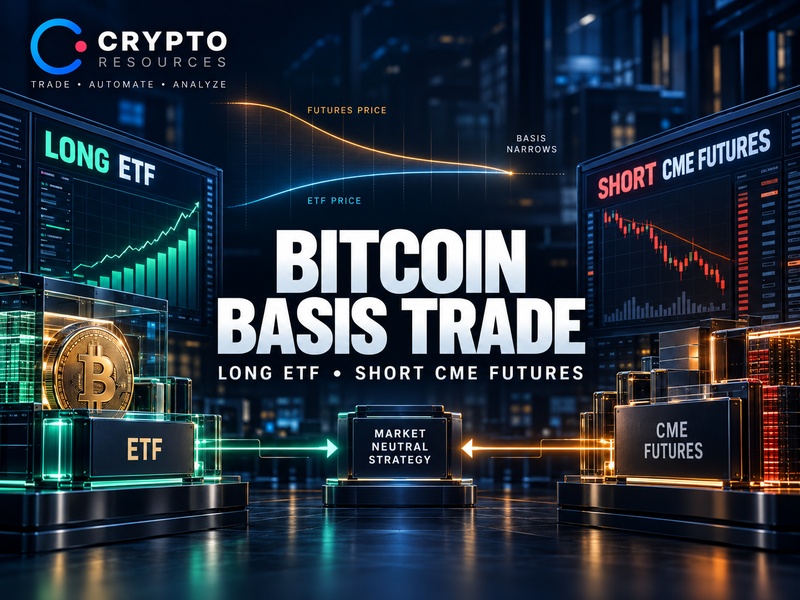
A hedge fund buys Bitcoin ETF shares while opening a short position in CME Bitcoin futures. Why take opposite sides of the same market?
Because the fund may not be betting on Bitcoin's direction at all.
The strategy is called Bitcoin cash-and-carry arbitrage, or a Bitcoin basis trade. A fund buys BTC or spot Bitcoin ETF shares and sells futures trading at a premium to the underlying asset. The goal is to capture that price difference while hedging most of the exposure to BTC's price.
This helps explain why Bitcoin ETF inflows can coincide with growing CME short positions — and why institutional futures shorts aren't necessarily bearish.
How Bitcoin Cash-and-Carry Arbitrage Works
Bitcoin futures with a fixed expiration date often trade above the spot price. The difference is called the basis.
When the premium is high enough to cover expenses, a fund can buy Bitcoin and sell an equivalent amount of CME futures.
If BTC rises, the long position gains value while the short futures position loses money. If BTC falls, the opposite happens. With properly matched positions, most of the directional exposure is offset.
As expiration approaches, the futures price converges toward the reference price used for settlement.
CME Bitcoin futures are cash-settled against the CME CF Bitcoin Reference Rate (BRR). No physical BTC is delivered when the contract expires.
The fund aims to capture the initial difference between the futures selling price and its Bitcoin purchase price, minus the costs of holding both positions.
How Much Can a Bitcoin Basis Trade Earn?
Consider a hypothetical trade with exposure equivalent to 1 BTC, before fees and financing costs.
Bitcoin trades at $100,000 on the spot market. A CME futures contract expiring in 90 days trades at $103,000.
The futures premium is 3%.
The fund buys BTC at $100,000 and shorts an equivalent amount of futures at $103,000.
Suppose Bitcoin falls to $90,000 by expiration.
The spot position loses $10,000, while the futures short gains $13,000. The gross profit is $3,000.
If BTC instead rises to $110,000, the idealized result is unchanged: the spot position gains $10,000, and the futures short loses $7,000.
Both scenarios leave the fund with the original $3,000 spread, assuming the positions are perfectly matched and the spot asset can be valued and sold at the futures settlement reference price.
A 3% return over 90 days is approximately 12.2% annualized on a simple basis.
But that isn't the fund's net return or its return on total capital employed.
Trading fees, financing costs, margin funding and execution slippage all reduce profitability. Using ETF shares introduces management fees and possible tracking differences.
The quoted annualized yield is useful for comparing opportunities, not a guaranteed investment return.
Why CME Bitcoin Futures Trade at a Premium
The futures premium reflects financing costs, time to expiration and demand for futures exposure.
During strong Bitcoin rallies, traders may bid up futures as they seek leveraged exposure. The contract can then trade at a substantial premium to spot.
That attracts arbitrage funds, which buy the underlying asset and sell futures. Their activity can help narrow the price difference.
There's an important distinction between dated CME futures and perpetual contracts on crypto exchanges.
CME futures have fixed expiration dates. Their basis generally converges toward zero at settlement.
Perpetual futures have no expiration date. They use periodic funding payments to help keep their prices aligned with spot.
A positive CME futures premium and a positive funding rate on Bybit or Binance can both reflect demand for leveraged long exposure, but they work differently.
Time to expiration also matters. A 2% premium on a one-month futures contract offers a very different annualized basis from the same premium on a six-month contract.
Why Funds Use Bitcoin ETFs Instead of Holding BTC Directly
Spot Bitcoin ETFs allow traditional investment firms to gain Bitcoin exposure through familiar brokerage and custody arrangements.
A hedge fund can buy ETF shares and short CME futures without directly holding cryptocurrency in its own wallets.
For example, it might buy shares of IBIT while selling futures against that exposure.
The ETF structure adds another consideration.
Buying ETF shares doesn't necessarily trigger an immediate Bitcoin purchase. Most trading takes place between investors on the secondary market. Additional shares are created separately through authorized participants.
As a result, ETF buying, changes in the fund's Bitcoin holdings and CME futures hedging don't always occur at the same time.
Some institutional demand for Bitcoin ETFs may therefore come from arbitrage strategies rather than outright bullish positions.
That distinction matters when interpreting daily ETF flows.
Why Hedge Fund Shorts on CME Aren't Always Bearish
The Commodity Futures Trading Commission (CFTC) publishes Commitments of Traders (COT) reports, showing futures positions across different trader categories.
One category, Leveraged Funds, includes hedge funds and other investment managers using leveraged strategies.
A large net short position in CME Bitcoin futures may look bearish. But the report only shows the futures side of those portfolios.
A fund could simultaneously hold long exposure through Bitcoin ETF shares, offsetting much of its short futures position.
Cash-and-carry trading became more accessible to traditional institutions after US spot Bitcoin ETFs launched in 2024, making it one possible explanation for substantial CME short positioning.
Still, not every short position is a basis trade.
COT reports don't reveal the complete portfolios of individual funds, and ETF ownership data cannot reliably match every long position to a specific futures hedge.
Large institutional CME shorts are evidence of futures positioning, not proof that hedge funds expect Bitcoin to fall.
When Bitcoin Basis Trades Become Less Attractive
The potential return on a new cash-and-carry trade depends on the futures premium relative to financing and execution costs.
When the premium narrows, new trades become less profitable. At some point, the remaining yield may no longer justify the capital required.
For an existing position, however, a narrowing basis can be good news. A fund may close both sides before expiration, realize much of the expected gain and redeploy its capital.
The strategy still carries several risks.
Financing costs. Higher borrowing rates eat into returns. A premium that looks attractive before expenses may offer little profit after funding costs.
Margin calls. A sharp Bitcoin rally creates mark-to-market losses on the short futures position. The fund may need to post additional cash even as its Bitcoin or ETF holdings gain value.
Basis widening. If the futures premium expands after entry, the trade moves against the fund on a mark-to-market basis. An early forced exit can lock in losses.
ETF tracking differences. Fund expenses, premiums or discounts to net asset value, and differences between the ETF price and CME's settlement benchmark can affect the outcome.
Cash-and-carry arbitrage reduces directional risk, but it doesn't eliminate liquidity, financing or execution risk.
What Happens When Funds Unwind Basis Trades?
Closing a conventional cash-and-carry position involves selling the Bitcoin or ETF holding and buying back the short CME futures.
These transactions affect different markets.
Selling BTC or ETF shares creates supply. Covering the futures short creates buying demand in the futures market.
But an ETF sale doesn't necessarily mean the fund itself must sell Bitcoin. Its BTC holdings decline through net share redemptions, not every secondary-market transaction.
An orderly reduction in basis trades therefore doesn't automatically trigger a Bitcoin selloff.
Forced unwinds are more concerning.
If funding becomes scarce or margin requirements rise sharply, multiple funds may have to close positions at the same time. Liquidity can deteriorate, spreads can widen and volatility can increase.
This also connects Bitcoin to broader financial markets.
Large investment firms allocate capital across bonds, equities and crypto. A funding squeeze elsewhere in the portfolio can force them to reduce Bitcoin exposure, even when nothing has changed in BTC's underlying market.
How Traders Should Read CME Futures Premiums and Open Interest
For institutional Bitcoin analysis, the CME futures basis and open interest are more useful together than separately.
Futures premium rises while open interest increases.
More futures positions are being opened, and the potential return on new basis trades improves. Some of that activity may be arbitrage, but directional trading can produce the same pattern.
Futures premium narrows while open interest falls.
This can accompany the unwinding of cash-and-carry positions. It can also reflect traders closing outright futures bets, so the pattern isn't conclusive.
Bitcoin rises while the CME premium stays moderate.
There's no obvious sign of excessive demand for leveraged exposure in this segment of the futures market. Spot volume and positioning across other exchanges are still needed to assess the rally.
The futures basis measures the price gap between futures and spot. Open interest measures outstanding contracts.
Neither reveals why those positions were opened.
For a fuller picture, compare CME data with COT reports, Bitcoin ETF flows and spot-market activity. Futures premiums should also be compared at similar maturities or converted to annualized rates.
Tracking Market Conditions With Crypto Resources
Understanding Bitcoin basis trades provides context for institutional positioning. Actual trading setups still depend on price, volume, leverage and liquidity.
Crypto Resources screeners track unusual price moves, trading volume, Open Interest and liquidations across supported cryptocurrency markets.
Funding rates and Premium Index data help identify imbalances between spot and perpetual futures.
CME data require separate analysis. Open interest on Bybit or Binance cannot replace CME futures positioning or COT reports.
Trap Radar PRO combines available market metrics into configurable trading conditions. Trading bots can then execute predefined strategies when those conditions are met.
These tools help assess how crypto markets respond to changing liquidity and leverage without relying on assumptions about individual hedge fund positions.
Frequently Asked Questions
Why do hedge funds buy Bitcoin ETFs and short CME futures?
They may be capturing the premium between futures and spot prices. The short futures position offsets much of the directional risk from the long ETF holding.
What is a Bitcoin cash-and-carry trade?
It's an arbitrage strategy involving a long position in Bitcoin or a spot BTC instrument and a short position in a higher-priced dated futures contract. The trader aims to profit as the prices converge.
Do large hedge fund shorts on CME predict a Bitcoin decline?
No. Some shorts hedge long BTC or ETF exposure. COT reports show futures positions, not the complete portfolios behind them.
What's the difference between the CME futures premium and funding rates?
The CME basis reflects the price difference between dated futures and spot, with time to expiration determining the annualized premium. Funding rates are periodic payments used by perpetual futures markets.
Is Bitcoin cash-and-carry arbitrage risk-free?
No. Financing costs, margin calls, basis widening, ETF tracking differences and forced liquidations can all produce losses.
What to Watch Next
ETF flows, CME futures premiums and open interest can help traders assess how institutional Bitcoin exposure is being built or unwound.
A rising futures premium alongside ETF inflows may attract basis traders. If the premium later contracts while open interest falls, some of those positions may be closing.
But neither pattern proves what hedge funds are doing. BTC price action, spot volume, ETF activity and broader liquidity conditions still matter.
A hedge fund can buy Bitcoin and short futures without taking a directional view. ETF purchases and CME shorts may be two sides of the same trade — not independent bullish or bearish signals.
Risk Disclaimer
This article is for informational and analytical purposes only and does not constitute investment advice. Bitcoin cash-and-carry arbitrage involves financing, liquidity, margin and execution risks.
Even hedged positions can incur significant losses if market conditions deteriorate or positions must be closed early.