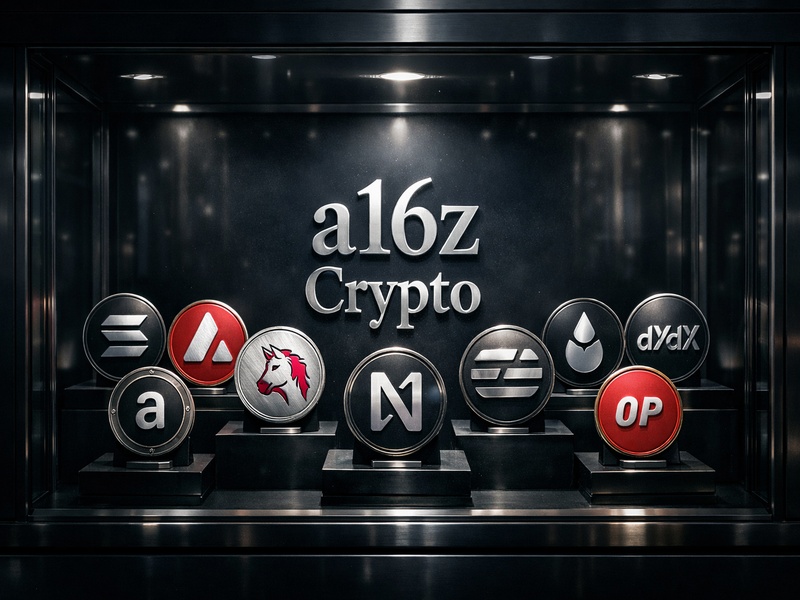
What Counts as the Public a16z Crypto Portfolio
The public a16z list is not a complete snapshot of all the fund’s current positions. It is the disclosed part of its scope: networks, protocols, infrastructure projects, and services the fund has shown to the market. For a private investor, that is enough. What matters is not the hidden composition of the fund, but the circle of assets and themes that can be verified and used as a quality filter.
This approach removes a lot of noise right away. We are not trying to copy the fund in full, and we are not treating its public database as an exact map of its current positions. We take the visible a16z scope and extract the coins that are available on spot markets and suitable for a working list.
Liquid Coins From the Public a16z Crypto Scope
There is no reason for a private investor to pull the entire a16z project catalog into one article. What matters is a short list of liquid names that the market has known for a long time and that are available to buy on major spot exchanges.
- Solana (SOL)
- Avalanche (AVAX)
- Uniswap (UNI)
- NEAR Protocol (NEAR)
- Aptos (APT)
- Lido DAO (LDO)
- Optimism (OP)
- dYdX (DYDX)
- Arweave (AR)
- Celo (CELO)
- Worldcoin (WLD)
- Flow (FLOW)
This is not a random pile of coins. The list includes a network layer, a financial layer, and an additional infrastructure layer. That structure keeps the portfolio from collapsing into a single theme or turning into a bet on one isolated narrative.
How to Read This List
Solana (SOL), Avalanche (AVAX), NEAR Protocol (NEAR), Aptos (APT), and Optimism (OP) cover the network layer. These are blockchains and ecosystems where users, applications, liquidity, and the core flow of capital live.
Uniswap (UNI), Lido DAO (LDO), and dYdX (DYDX) make up the financial layer. These projects sit closer to exchange activity, liquidity, staking, and trading mechanics inside the crypto market.
Arweave (AR), Celo (CELO), Worldcoin (WLD), and Flow (FLOW) add infrastructure and application-level exposure. This is not the core. It is an additional layer that improves diversification but should not overload the entire structure.
Portfolio Model
We are not inventing the real weights of a16z. Below is a private allocation model built from the liquid coins in its public scope.
50% — Core Networks and Ecosystems
- Solana (SOL)
- Avalanche (AVAX)
- NEAR Protocol (NEAR)
- Aptos (APT)
- Optimism (OP)
This is the foundation. If an investor is going to hold altcoins as an asset class at all, the main allocation should sit in the network layer.
30% — DeFi and Market Mechanics
- Uniswap (UNI)
- Lido DAO (LDO)
- dYdX (DYDX)
This is the layer through which money moves inside the market. It usually looks stronger than random narrative-driven coins that have no clear role in market structure.
20% — Additional Infrastructure and Application Layer
- Arweave (AR)
- Celo (CELO)
- Worldcoin (WLD)
- Flow (FLOW)
This part adds growth potential and broadens the portfolio beyond core networks and DeFi. The weight is lower because the dispersion in demand quality and project maturity is higher here.
How a Private Investor Should Read a Portfolio Like This
The mere fact that a fund is associated with a project is not a buy signal. It is only a quality filter that helps cut off a large share of weak ideas before deeper analysis begins.
After that, standard discipline takes over:
- liquidity;
- market depth;
- supply structure;
- unlock schedule;
- quality of demand;
- behavior of the asset in the current market regime.
If the asset fails that check, the fund’s brand does not save the situation.
What to Check Before Entering
Start with liquidity. A weak order book and poor market depth can quickly turn even a strong idea into poor execution.
Next comes supply. If heavy unlocks are ahead or if constant new issuance creates ongoing pressure, that can damage price behavior for a long time.
Then comes market regime. Even strong coins can go nowhere for months if capital is not flowing into altcoins or if the market is focused on another segment.
The last filter is the role of the asset. Some coins are tied to a network and its usage. Others depend more heavily on a specific product, team, or application layer. Mixing these stories without understanding their nature is a bad habit.
How to Build a Watchlist
A short list from the public a16z scope is not meant for mechanically buying everything on it. It is meant for proper observation of quality names.
A working model looks like this:
- core layer — network assets;
- financial layer — DeFi;
- additional layer — infrastructure and application stories.
A watchlist built this way is easier to monitor, easier to filter, and easier to update than a broad list of dozens of names with different levels of liquidity and maturity.
How to Use a Whitelist in Spot-Bot
The public a16z scope can be turned into a whitelist for Spot-Bot. To do that, the short list is cleaned of coins with weak liquidity, heavy unlocks, and an unsuitable market regime. After that, the algorithm operates inside a preselected set.
The advantage of this approach is obvious. Trading stays in spot. There is no futures liquidation mechanism. The market risk of the coins remains, but the overall setup becomes cleaner: the universe is already filtered, and the idea set is tied not to random noise but to a strong public scope.
Common Mistakes
Buying everything just because a project was once associated with a16z.
Giving the same weight to network assets, DeFi names, and thinner application-layer stories.
Ignoring liquidity, unlocks, and supply structure.
Treating the fund’s public database as an exact copy of its current portfolio.
Running an algorithm across the broad market when the universe can first be narrowed to a higher-quality whitelist.
FAQ
Can you simply build a basket from all coins associated with a16z?
No. For a private investor, a short liquid list works better than a broad catalog.
Why does the article not include the full a16z project list?
Because for investment logic, a working set of liquid publicly traded coins matters more than a full register of companies and services.
Why is the main weight placed in networks?
Because networks hold users, applications, liquidity, and the main flow of capital.
Why is DeFi separated into its own layer?
Because exchange activity, liquidity, staking, and trading mechanics form a distinct market layer with its own demand logic.
Where does Spot-Bot fit into this model?
In the whitelist. First, a short set of liquid coins is built. Then it is cleaned by risk filters, and only after that is the algorithm connected.
Conclusion
The public a16z crypto scope is useful not because it can be copied blindly, but because it sharply narrows the search field. Instead of an endless tail of weak altcoins, the investor gets a short set of liquid names around which institutional interest has stood for years.
That is enough to build a watchlist, allocate capital through a clear model, and use a whitelist in Spot-Bot without pulling in unnecessary noise and weaker names.
Risk Disclaimer
Cryptocurrencies remain a volatile asset class. Even strong names from the public a16z scope can go through deep drawdowns and long sideways periods.
A fund’s public list does not replace your own selection process. Before entering an asset, you need to check liquidity, supply structure, and market regime.