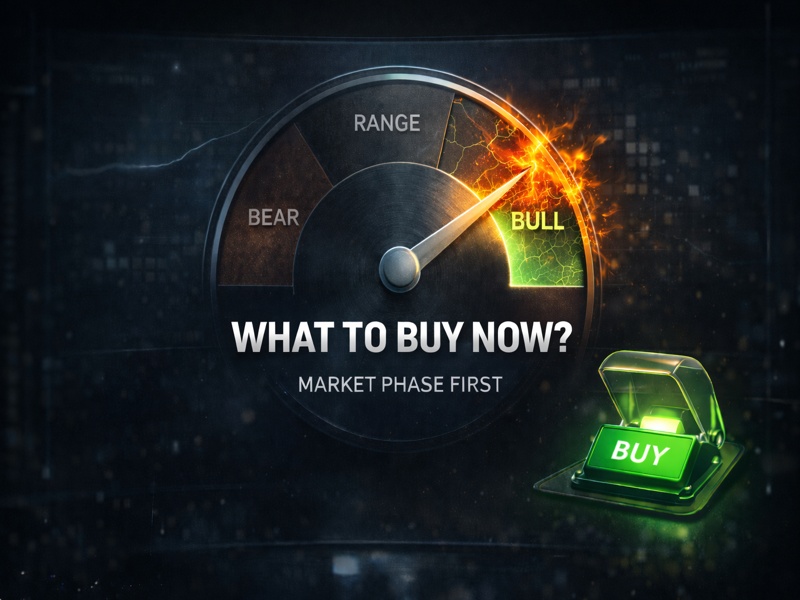
The query “what crypto to buy now” usually means one thing: people want a simple answer and a short list. In crypto, a list without context becomes a coin flip. The decision should start with three inputs: time horizon, market phase, and move confirmation.
Why “What To Buy Now” Is The Wrong Question Without Market Phase
The same asset can be reasonable in one regime and toxic in another. Beginners usually lose not because they picked the “wrong coin,” but because they entered in the wrong phase without a clear execution policy.
A basic frame:
- In bull regimes, the market forgives mistakes but punishes overheating and late entries.
- In bear regimes, patience and selection beat “averaging into endless downtrends.”
- In ranges, discipline and filters matter most, otherwise activity rises while quality drops.
Tier-1, Bitcoin, Ethereum, And “Best Altcoins”: How To Think About It
It helps to separate assets by quality and portfolio role.
Tier-1 (practical view):
- This typically means Bitcoin (BTC) and Ethereum (ETH) as core market assets.
Large-cap altcoins:
- These are ecosystem leaders, but they depend more on regime: in risk-off they can drop much harder than BTC.
Operational takeaway: Tier-1 is about not losing to obvious mistakes; altcoins are about beta upside, but only when the regime allows it.
Define The Market Phase: Bull, Bear, Or Range
Don’t “feel” the phase—measure it.
Simple signals:
- Bull phase: structure holds, pullbacks are bought, breadth expands.
- Bear phase: rebounds are weak, structure breaks, breadth contracts.
- Range: choppy action, impulses fade quickly, more signals but lower quality.
Market Median And Correlations: How To Stop Buying Endless Downtrends
Two questions that save beginners:
- Breadth (market median): is the move broad or carried by a few names.
- Correlations: is the market glued to BTC or rotating by sectors.
Working logic:
- Weak breadth + high correlations often means one leader drives everything; forcing alts adds risk.
- Rising breadth + correlations diversifying is where rotation becomes healthier.
Move Confirmation: Why “Buying What Starts Moving” Can Be More Rational
Beginners often pick “the most down” and hope it rebounds. That’s unreliable without confirmation.
A more controllable approach:
- For shorter horizons, focus on assets that start moving with visible participation.
One confirmation proxy is open interest (OI), but it should never be used alone.
How To Use Open Interest (OI) Without Self-Deception
OI is useful when it answers: “is the move supported by positioning, or is it just noise.”
A minimal playbook:
- Price up + OI up: participation supports the move, but overheating risk rises—check derivatives filters.
- Price up + OI down: the move can be driven by short covering/position reduction; follow-through may be weaker.
- Price down + OI up: pressure often increases and wipeout risk grows; tighten limits.
Overheating Filters: Funding, Premium Index, Liquidity
To avoid buying the top of a spike, add stop-factors:
- Funding and funding cadence: overheated conditions raise the odds of sharp pullbacks and stop sweeps.
- Premium index: strong perp-vs-spot skew makes the market more fragile.
- Liquidity and volume: wide spreads and thin books are execution risk, not “opportunity.”
A Beginner Decision Policy
Step 1. Horizon and role
Long-term accumulation and a 1–2 week trade are different risk policies.
Step 2. Market phase
Use breadth (median) and structure to decide whether risk is expanding or contracting.
Step 3. Asset selection
Liquidity and derivatives conditions first, idea second.
Step 4. Confirmation
Confirm with structure + OI + no obvious overheating in funding/premium.
Step 5. Exit plan
Stepwise profit-taking and predefined invalidation beat “waiting for it to come back.”
Mini Cases
Case 1: Market green, breadth rising, correlations diversifying
Meaning: the regime supports controlled risk expansion. Action: Tier-1 as base, alts selectively with confirmation and limits.
Case 2: Market weak, breadth flat, BTC dominates
Meaning: alts often stall and fake-start. Action: quality-first and fewer experiments.
Case 3: “Most dumped coin,” but OI rises while price falls
Meaning: not a bargain by default; often a high-risk zone. Action: wait for structure, don’t buy out of sympathy.
FAQ
What’s better for beginners: Bitcoin or Ethereum?
Both are commonly treated as Tier-1. The better choice depends on horizon and drawdown tolerance.
Should I buy “the strongest altcoins”?
Only when the regime supports it: breadth rising and derivatives conditions not overheated.
Why is “most dumped” often worse than “starting to move”?
Because dumped assets can keep sliding, while confirmed moves provide a clearer risk framework.
Is OI enough to buy?
No. OI is one component. You still need structure and overheating filters (funding/premium/liquidity).
How do I avoid emotional buys?
Lock a policy: phase → selection → confirmation → exit plan. Without it, “now” becomes gambling.
Conclusion
“What crypto to buy now” is best reframed into a controllable process: market phase first, then asset quality, then move confirmation. Tier-1 (BTC/ETH) often covers the base case, while altcoins make sense when risk is expanding and breadth/correlations confirm the rotation.
In Crypto-Resources, this becomes operational: market median and correlations help classify the phase, scanners highlight assets where moves are supported by metrics, and a spot bot operates only in “green” regimes and waits for a valid setup before entry. Basic indicators and free metrics are available to build discipline before scaling risk.
Risk Disclaimer: This content is informational only and not investment advice. Crypto is high risk; manage exposure responsibly.