
Democrats Take Congress: What It Means for Bitcoin and Crypto in 2027
Annotation: Democrats have won both chambers of the US Congress. Bitcoin initially fell to $75,600 before recovering above $80,000. We examine the implications for the CLARITY Act, Trump-linked tokens, stablecoins, and US crypto regulation.
Short Description: How the Democrats' victory in the 2026 US midterms could affect Bitcoin, altcoins, crypto legislation, and trading conditions in 2027.
Democrats won majorities in both the House of Representatives and the Senate in the November 3, 2026, US midterm elections. Republicans lost control of Congress, leaving President Donald Trump facing two years of opposition from lawmakers.
For the crypto industry, the political landscape has changed. Republicans had pushed for lighter digital asset regulation and clearer rules for US crypto businesses. Democrats will now set the congressional legislative agenda.
Bitcoin's reaction was less predictable. After an initial sell-off, BTC quickly recovered. Some DeFi tokens even outperformed the broader market despite uncertainty over future legislation.
Attention shifted to the possibility of ending the war with Iran, falling oil prices, and the outlook for US inflation.
Why Bitcoin Recovered After the Democratic Victory
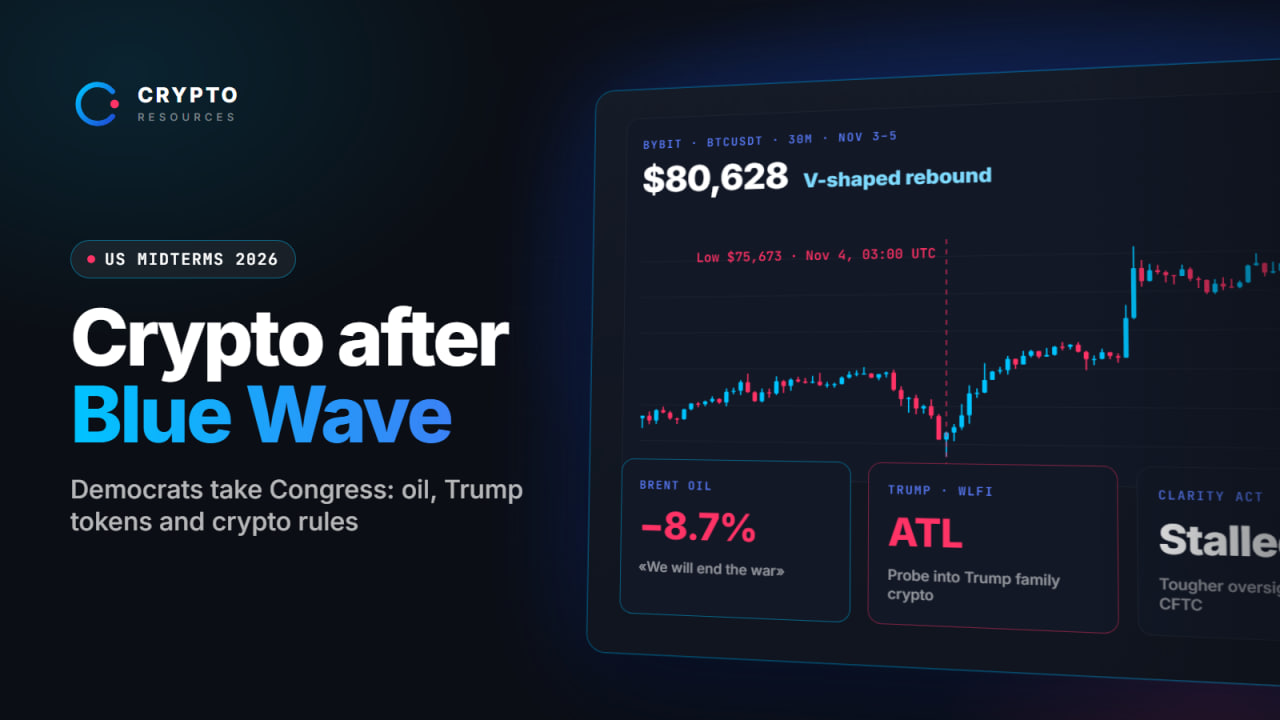
Bitcoin fell to approximately $75,600 on election night, its lowest level in several weeks. The initial decline reflected concerns about crypto legislation and the regulatory direction of the US government.
By November 4, BTC had recovered above $80,000.
US equities also advanced, gold gained, and Treasury yields declined.
The election result was partly priced in. Investors had anticipated a Democratic victory, reducing the potential for a prolonged market reaction once the outcome became clear.
Short covering may have helped accelerate the rebound. Falling oil prices also improved sentiment across risk assets.
Oil Prices, the Iran War, and Inflation
Brent crude futures plunged 8.7% to $94.62 per barrel on November 4 as traders priced in a greater chance of the US-Israeli war with Iran coming to an end.
Senate Democratic leader Chuck Schumer pledged to push for an end to the conflict. Once the new Congress takes office, Democrats will have more leverage over the administration's military policies through legislation, budget decisions, and congressional oversight.
Sustained declines in energy prices could ease inflation, improve expectations for Federal Reserve interest rates, and support risk assets.
But oil was not the only factor behind Bitcoin's recovery. Short covering, changing investor expectations, and the equity market rebound also played a role.
The war remains unresolved. Renewed escalation could push oil back above $100 and reverse the improvement in market sentiment.
For Bitcoin, inflation, interest rates, and liquidity matter more than which party controls Congress.
CLARITY Act: US Crypto Legislation Faces Another Setback
The future of the CLARITY Act is one of the biggest concerns for the US crypto industry.
The bill was designed to clarify the respective roles of the Securities and Exchange Commission (SEC) and Commodity Futures Trading Commission (CFTC), establish requirements for crypto exchanges and intermediaries, and define how different digital assets should be regulated.
On September 15, 2026, the Senate failed to advance the legislation. A procedural vote to end debate received 49 votes in favor and 50 against, falling short of the required 60.
All Democrats who participated voted against the measure, alongside several Republicans.
Disagreements centered on investor protections, DeFi regulation, and restrictions on crypto dealings by government officials, including the president.
With Democrats now set to control Congress, passing the current version of the CLARITY Act looks even less likely.
That does not mean Democrats oppose crypto legislation altogether. More than 70 House Democrats had previously supported the bill.
The incoming Congress, however, may demand stronger provisions on consumer protection, financial transparency, and conflicts of interest.
If the bill fails to pass before the current congressional term ends, lawmakers will have to restart the legislative process.
The immediate concern for US crypto businesses is not an outright ban. It is another delay in getting the regulatory clarity they expected in 2026.
Trump Tokens: Political Risk Becomes Trading Risk
Trump-linked cryptocurrencies came under pressure even as Bitcoin recovered.
On November 4, the TRUMP memecoin was down approximately 7%, while World Liberty Financial's WLFI token had lost around 5% at the time of the morning market snapshot.
Democrats plan to intensify investigations into the business interests of Trump and his family. Potential targets include cryptocurrency ventures, foreign investments, and possible conflicts of interest.
Some inquiries began before the election. Democrats had already requested information about foreign investments in World Liberty Financial.
Once they control Congress, they will have greater authority to hold hearings and compel the production of documents. New subpoenas could follow as early as February 2027.
Three assets need to be distinguished:
- TRUMP — a speculative memecoin highly sensitive to political developments and news.
- WLFI — a token within the World Liberty Financial ecosystem, exposed to investigations and developments affecting the project.
- USD1 — a dollar-pegged stablecoin whose stability depends on reserves, redemption mechanisms, and the issuer's financial condition.
Investigations into affiliated businesses do not automatically threaten USD1's dollar peg.
For TRUMP and WLFI, however, political headlines can directly influence prices.
These tokens carry additional trading risks. They may keep falling while Bitcoin rallies, but favorable news can also trigger violent short squeezes.
SEC, CFTC, and Tokenized Stocks: What Could Change?
The election does not remove the SEC's or CFTC's authority or automatically reverse existing regulatory decisions.
The new Congress can, however, increase oversight of both agencies, hold hearings, request documents, and challenge their regulatory priorities.
Temporary exemptions from existing rules are particularly vulnerable to scrutiny.
On September 17, 2026, the SEC allowed certain platforms to trade tokenized US equities using blockchain infrastructure.
The authorization is temporary and subject to specific conditions. It is not equivalent to a federal law governing tokenization.
A Democratic majority does not revoke the decision, but it could bring additional oversight and questions about the terms under which these products operate.
Tokenization is already developing under existing securities laws. Banks and financial institutions do not necessarily need the CLARITY Act to use blockchain technology for specific operations.
Tokenized asset markets can continue growing even if broader crypto legislation stalls.
That does not guarantee higher prices for every crypto token associated with real-world asset tokenization.
Stablecoins: Lower Political Risk, Clearer Rules
Unlike the CLARITY Act, federal legislation for payment stablecoins has already been enacted.
President Trump signed the GENIUS Act into law on July 18, 2025. It establishes federal requirements for stablecoin issuers, reserve backing, redemptions, and regulatory oversight.
The law's main provisions and the rules adopted by the Office of the Comptroller of the Currency (OCC) are scheduled to take effect on January 18, 2027.
Payment stablecoins therefore have a legislative framework, although issuers must still comply with the new requirements.
Changing an enacted federal law is considerably harder than revising individual SEC decisions. A change in congressional control does not repeal existing legislation.
Payment stablecoins consequently face less immediate legislative uncertainty than many other parts of the US crypto industry.
Bitcoin, DeFi, and Altcoins: Different Markets, Different Reactions
Crypto trading on November 4 showed that political uncertainty does not necessarily produce a market-wide sell-off.
While Trump-linked tokens declined, the CoinDesk DeFi Select Index gained approximately 5%, outperforming the broader crypto market. INJ and ENA were among the leading performers.
This happened despite DeFi regulation remaining one of the most disputed parts of the CLARITY Act.
Legislative uncertainty did not prevent traders from buying DeFi tokens during the market recovery.
The factors affecting each sector remain different.
Bitcoin is driven largely by global liquidity, Federal Reserve policy, institutional demand, and capital flows.
Ethereum and DeFi respond to user activity, trading volume, infrastructure development, and regulatory expectations.
Politically linked tokens can move independently of the broader market as investigations, public statements, and reputational risks affect demand.
Stablecoins and tokenization depend more directly on financial infrastructure, existing legislation, and regulatory requirements.
The election did not establish a single direction for crypto prices. Capital continued rotating between different groups of assets.
How to Trade Crypto After the US Midterm Elections
For short-term traders, the immediate concern is how political developments affect price, open interest, trading volume, and liquidations.
According to a November 4 market snapshot, futures trading volume rose 27% over the preceding rolling 24 hours, while aggregate open interest increased just 3%.
Trading activity surged without a comparable rise in outstanding positions. These figures alone, however, cannot tell us how much volume came from new entries, position closures, or reversals.
Liquidations reached approximately $469 million over the same rolling 24-hour window. This was the figure at the time of the snapshot, not the final total for the November 4 calendar day.
Scenario 1. Bitcoin Sells Off, Then Recovers
Bitcoin initially fell toward $75,600 before reclaiming $80,000.
Similar moves are worth examining for falling prices, declining open interest, and long liquidations.
If price reclaims local support or resistance levels after widespread forced closures and holds above them, a recovery setup may develop.
Liquidations alone do not confirm a bottom. Prices can keep falling even after a large amount of leveraged exposure has been wiped out.
Scenario 2. Politically Linked Tokens Keep Falling
TRUMP and WLFI may remain under pressure even when Bitcoin is recovering.
Buying every new low is dangerous, but so is opening a short after an extended collapse.
A price rally accompanied by falling open interest may indicate short covering rather than fresh buying demand.
Trap Radar PRO allows traders to monitor these conditions using open interest, liquidations, CVD, funding rates, and trading volume.
For example, a sharp rally following heavy short liquidations, combined with declining OI, may suggest that short sellers are being forced out.
A fresh short entry requires evidence that buying momentum is fading. A large squeeze alone is not enough.
Scenario 3. Bitcoin Rallies While Altcoins Lag
Bitcoin recovering above $80,000 does not mean the entire crypto market has entered a sustained uptrend.
Traders can assess broader altcoin conditions using the free Market Median indicator from Crypto Resources.
It measures the median deviation of cryptocurrencies from their regression channels and tracks Median RSI and the percentage of assets trading above their 200-period simple moving average (SMA200).
If Bitcoin rallies while market breadth remains weak, the recovery may be concentrated in a relatively small group of large-cap assets.
RegDev readings above +10% can signal an overheated market. Readings below −10% can help identify areas where buyers may respond, but neither level is a standalone entry signal.
Market Median provides a broader market filter, while Trap Radar PRO helps traders identify individual setups involving liquidations and changes in open interest.
What to Expect From Crypto in 2027
The new Congress will take office in January 2027. Until then, existing laws remain in place, while the SEC and CFTC continue operating under their current authority.
Three developments deserve attention over the coming months:
- The Iran war and oil prices. Easing geopolitical tensions could reduce inflationary pressure and support risk assets.
- Federal Reserve policy. Interest rates and liquidity conditions will continue to influence demand for Bitcoin and altcoins.
- Crypto legislation. The current CLARITY Act faces poor prospects under the incoming Congress. The GENIUS Act has already been enacted, while tokenization continues developing under existing laws.
Investigations into cryptocurrency businesses associated with the Trump family could add another source of volatility.
A Democratic victory does not automatically mean a crypto bear market. Republican support for the industry did not guarantee a sustained rally, either.
The next major moves in Bitcoin and altcoins will depend on capital flows, liquidity, and market positioning — not political headlines alone.
FAQ
Why Did Bitcoin Rise After the Democrats Won Congress?
The election outcome was partly priced in. Improving equity market sentiment, short covering, and expectations of lower inflation following the decline in oil prices also supported the recovery.
What Happens to the CLARITY Act After the 2026 Elections?
The bill failed a procedural vote in the Senate on September 15. The Democrats' victory makes passage in its current form even more difficult. Negotiations over crypto market regulation may continue under a revised proposal in 2027.
Why Are TRUMP and WLFI Falling While Bitcoin Rises?
Both tokens are associated with the Trump family's political and commercial activities. Plans to intensify investigations introduce risks that can outweigh a broader crypto market recovery.
Will US Stablecoin Regulation Change?
The GENIUS Act has already been signed into law, with its main provisions scheduled to take effect on January 18, 2027. Congress may propose amendments, but the election results do not automatically repeal the law.
This article is for informational purposes only and does not constitute financial or investment advice. Cryptocurrency and derivatives trading involves a substantial risk of capital loss.