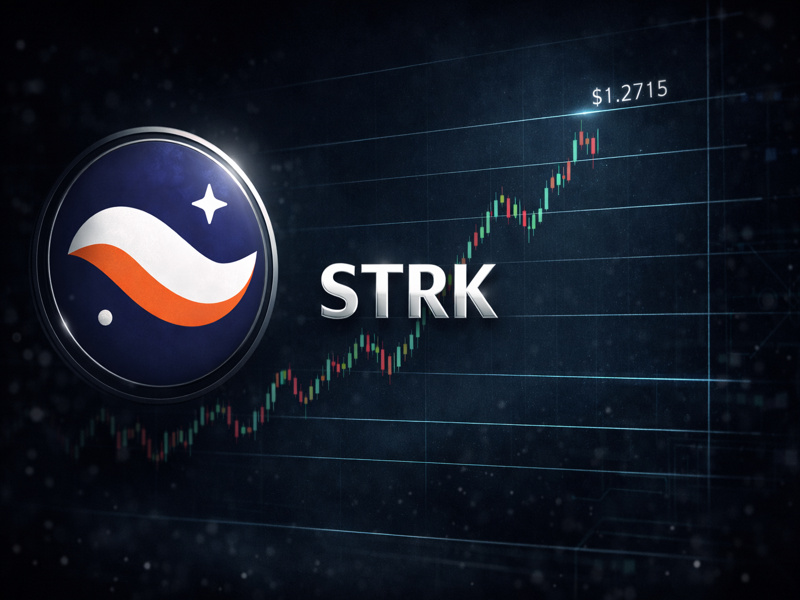
A STRK outlook is more usable as a scenario target map: clear anchors, a step-by-step target ladder, confirmation rules, and a defined invalidation point. This structure reduces “chasing” and forces a consistent execution process.
STRK Scenario Target Map For 2026: The Working Format
A scenario map is not one “end-of-year number.” It is a set of operational zones:
- targets are climbed in steps;
- each next target becomes active only after the prior one is confirmed;
- confirmation relies on D/W closes and a retest, not a single wick;
- if anchors break, the ladder is recalculated.
Context As Of The Fix Date And Supply Calendar Risks
Aggregators show STRK around $0.048–$0.049, with an all-time high near $4.41 (Feb 20, 2024) and an all-time low near $0.0428 (Feb 06, 2026).
A key STRK risk is the supply calendar. Starknet documentation describes recurring unlocks on the 15th of each month, with up to 1.27% (127M tokens) per month during Apr 15, 2025 → Mar 15, 2027.
Tokenomist lists the next unlock date as March 15, 2026.
Anchor Points: High 0.800 And Low 0.037
This ladder uses your anchor levels:
- Low (anchor low): 0.037
- High (impulse cap): 0.800
This keeps the 2026 plan grounded around acceptance zones rather than forcing an automatic return to the early listing peak.
Fibonacci Target Ladder: Targets And Confirmation Rules
Range: 0.800 → 0.037. Targets are zones, not exact-to-the-cent points.
Target 1 (0.236): 0.2171
Activation:
- D/W closes above the zone;
- retest from above with holding;
- no chasing into the level.
Target 2 (0.382–0.5): 0.3285 – 0.4185
Activation:
- 0.382 reclaimed and held on a retest;
- no “leverage rush” (OI should not accelerate faster than price);
- scale out in parts on approach and after acceptance.
Target 3 (0.618–0.786): 0.5085 – 0.6367
Activation:
- stepwise advance with reclaimed levels acting as support;
- no repeated cascade flushes on pullbacks;
- no leverage increases mid-move.
Target 4 (impulse cap): 0.8000
Activation:
- approach without toxic derivatives conditions;
- if broken, 0.800 must hold as support via closes and a retest.
Target 5 (extensions, upper branch): 1.0075 and 1.2715 (1.272 / 1.618)
Activation:
- 0.800 is confirmed support;
- the market stays risk-on;
- unlock windows do not break key zones.
Scenario invalidation: sustained acceptance below 0.037 triggers a recalculation of anchors and targets.
BTC Regime Filter: Pi Cycle As A Risk Constraint
Pi Cycle Top is commonly described as a crossover between the 111-day SMA and 2×350-day SMA on BTC price. In execution terms it is a regime overheating filter, not a direct entry signal.
Practical rules for STRK:
- in overheated BTC regimes: smaller size, earlier scaling out, stricter confirmations;
- in neutral regimes: the “break → retest → hold” workflow tends to be more reliable.
STRK Derivatives: Funding, OI, Liquidations As Go/No-Go Filters
A minimal quality check uses three inputs:
- Funding: persistent skew increases reversal risk.
- Open Interest: if OI grows faster than price, the move becomes fragile.
- Liquidations: repeated cascade flushes near a key zone often signal unstable positioning.
Operating rule:
- if derivatives overheat, reduce risk first and require a new confirmation before treating the next target as active.
Cross-Checking Public 2026 Estimates: How To Map Ranges To Targets
Public “price prediction” pages differ because methods differ: models, editorial scenarios, and growth-rate calculators.
Neutral cross-check:
- CoinCodex: end-2026 estimate around $0.08496 (model).
- Changelly: 2026 range roughly $0.1464 – $0.1698 (editorial scenario).
- PricePrediction.net: 2026 minimum around $0.1066 (model/technical approach).
- AMBCrypto: 2026 range $0.18 – $0.28.
- Kraken price prediction: a “rate-based” calculator (e.g., 5%/yr) showing values around €0.041 for 2026; it is conditional, not a market forecast.
Mapping to this ladder:
- $0.08–$0.17 aligns with stabilization / moderate recovery, typically below Target 1;
- $0.18–$0.28 sits near Target 1 (0.2171), but Target 1 is active only after closes and a retest;
- 0.33+ (Target 2 and higher) requires a stronger regime and stricter derivatives and unlock-window controls.
Execution Checklist: Before Entry, During The Move, After The Pullback
Before entry (60–120 seconds):
- identify the nearest target and the next scale-out zone;
- check the supply calendar: the 15th and the next unlock date;
- review funding/OI/liquidations for one-way crowding;
- set the confirmation rule (closes + retest) and invalidation (below 0.037).
During the move:
- scale out in parts: on approach and after acceptance;
- do not increase leverage mid-move;
- if derivatives overheat, reduce risk and wait for renewed confirmation.
After the pullback:
- re-entry/add-ons only after a retest and holding via closes;
- if the level fails to hold, step the scenario down one rung.
Mini Cases (2–3)
Case 1: Unlock window is near, price approaches Target 1
Event: monthly unlock cadence on the 15th.
Reaction: wider ranges and false breaks.
Action: smaller size, confirmation-only entries, finer scaling out, no market add-ons.
Case 2: Price rises while OI grows faster than price
Reaction: fragility increases; liquidation flush risk rises.
Action: partial scale-out before the target, pause add-ons, wait for normalization.
Case 3: 0.382 breaks without a retest
Reaction: higher probability of returning into the range.
Action: do not treat Target 2 as active; wait for retest and holding via closes.
FAQ (5)
1) Why are targets ranges instead of one exact number?
Liquidity is accepted in zones. Ranges support stepwise execution and retests better than single-point guesses.
2) What is the practical base target for 2026 in a moderate recovery?
Target 1 (0.2171) after confirmation via closes and a retest.
3) What counts as confirmation: wicks or closes?
Closes on D/W plus a retest from above with holding.
4) How should STRK unlocks be handled?
As a regime factor: smaller size, more partial exits, confirmation-only adds, margin control first.
5) Where is scenario invalidation?
Sustained acceptance below 0.037 triggers a recalculation of anchors and targets.
Conclusion
The 2026 STRK ladder using 0.800 → 0.037 is structured and executable: 0.2171, then 0.3285–0.4185, then 0.5085–0.6367, and only after strength is confirmed, a test of 0.800. The 1.0075 / 1.2715 extension targets are an upper-branch scenario and become relevant only after 0.800 turns into confirmed support.
A practical way to keep this process disciplined is to separate context from execution: market screeners track regime metrics (OI, funding, liquidations, volume and related signals), while trading bots enforce a fixed risk process with limits, pauses, and entry blocking in toxic conditions. Crypto-Resources includes both paid and free tools and demo testing to evaluate behavior on live data without rushing decisions.
Risk Disclaimer: crypto markets are volatile and high-risk; targets and levels do not guarantee outcomes. This material is informational and not investment advice.