Summary: 2026 Targets And Scenario Invalidation
This outlook is structured as a target map, not a single year-end number. The ladder is stepwise: a higher target becomes actionable only after the prior one is confirmed via closes and a retest.
Snapshot date: Feb 21, 2026. CoinGecko shows SOL around $86.
CoinGecko lists ATH $293.31 and ATL $0.5008.
For an operational cycle range, anchors are high $295 (Jan 2025) and low $8 (Dec 2022) as levels the market actually traded through.
2026 targets (zones):
- Target 1: ~$75.73 (0.236)
- Target 2: ~$117.63–$151.50 (0.382–0.5)
- Target 3: ~$185.37–$233.58 (0.618–0.786)
- Target 4: ~$295.00 (range high)
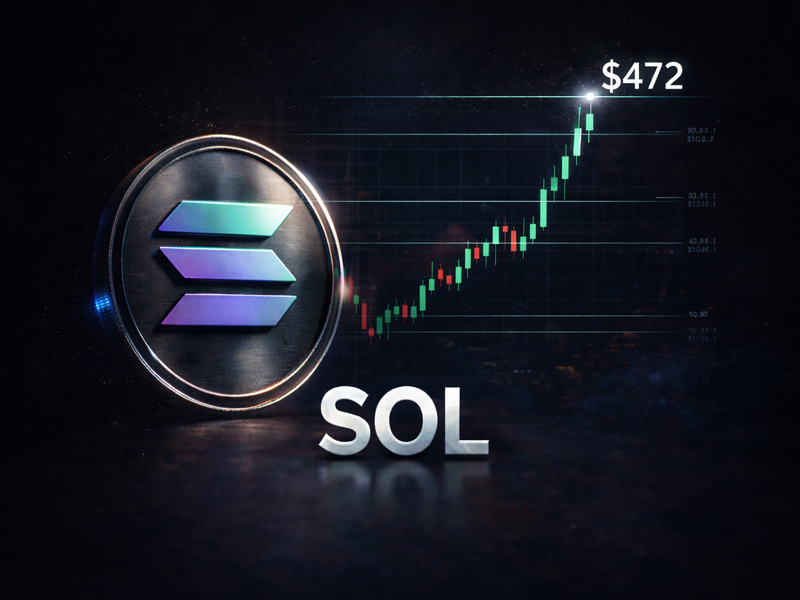
- Target 5: ~$373.06 and ~$472.37 (1.272 and 1.618, upper branch)
Scenario invalidation: sustained acceptance below $8 means anchors changed and the ladder must be recalculated.
What Drives SOL In 2026: Regime, Derivatives, Supply
Market liquidity regime. In risk-on conditions SOL tends to reclaim levels in steps. In risk-off it more often produces false breaks and pullbacks.
Derivatives positioning. Funding, OI, and liquidation clusters help judge whether the move is healthy or leverage-fragile.
Supply dynamics. SOL is influenced by both unlock-style events and ongoing issuance via staking and inflation.
SOL Supply: Unlock Calendars And Staking Issuance
Unlock calendars. SOL has public trackers for upcoming distribution/unlock events, including Tokenomist and Tokentrack.
Operationally, any meaningful supply window is treated as higher-volatility, confirmation-first territory.
Staking issuance and inflation. Solana describes inflation as starting at 8% annually, decreasing by 15% year-over-year, reaching a long-term 1.5% rate.
This is continuous supply flow rather than a one-off unlock.
Fibonacci Targets And Confirmation Rules
The ladder is built on $295 → $8. Targets are zones, not precise points.
Confirmation rules: D/W closes, retest and hold from above, no chasing into targets, no leverage increases mid-move.
Interpretation:
- Target 1 (~$75.73): acceptance zone after a decline.
- Target 2 (~$117–$151): base recovery corridor.
- Target 3 (~$185–$233): strong branch requiring cleaner conditions.
- Target 4 (~$295): major resistance/ceiling zone of the range.
- Target 5 (~$373 / ~$472): upper branch only after ~$295 becomes support.
BTC Regime Filter: Pi Cycle As A Risk Rule
Pi Cycle Top is used as a BTC overheating regime filter based on the 111-day SMA and 2×350-day SMA.
For SOL it is a risk rule: when overheating appears, reduce leverage and scale out faster.
SOL Derivatives Filters: Funding, OI, Liquidations
Funding: persistent skew increases pullback risk.
OI: if OI grows faster than price, fragility rises.
Liquidations: cascades around targets increase wick-and-revert probability.
Operational rule: in overheated derivatives conditions, targets are scale-out zones, not aggressive add-on zones.
Cross-Checking Public 2026 Estimates And Mapping To Scenarios
- CoinCodex: end-2026 model estimate around $113.94.
- Kraken: 2026 around $86.31 under a 5% assumption (conditional calculator).
- Cryptopolitan: 2026 minimum around $71.04 is referenced.
- MEXC: a technical recovery idea toward $95–$105 by March 2026.
- Bitget: very aggressive scenarios up to $500 in 2026 appear in some posts (upper-branch marketing framing).
Mapping: $70–$110 sits around current price and the approach to the lower side of Target 2; $117–$151 corresponds to Target 2 activation after confirmations; above $185 shifts into the strong branch where regime and derivatives controls become decisive.
Execution Checklist, Mini Cases, FAQ
Before entry: define nearest target and next scale-out zone; check upcoming supply windows; assess funding/OI/liquidations; define invalidation; pre-plan at least two partial exits.
During the move: scale out in steps; do not increase leverage mid-move; if OI accelerates faster than price, reduce risk and wait for new confirmations.
After pullback: re-entry only after retest and holding; closes below a reclaimed zone step the scenario down.
Mini cases.
- Case 1: SOL approaches Target 2 while funding is skewed. Action: partial exits into the zone, retest-only re-entry.
- Case 2: Price rises while OI grows faster than price. Action: pause add-ons, scale out earlier.
- Case 3: Closes confirm a level but the retest is weak. Action: treat the level as unaccepted until retest holds.
FAQ.
Why are targets zones, not one exact price?
Markets accept price in liquidity zones; zones fit stepwise scaling out.
What counts as confirmation: wicks or closes?
Closes (D/W) plus a retest and hold from above.
Which target is a base case in a recovery?
Target 2 lower area (~$117) after confirmation and holding.
How does staking inflation matter for supply?
It is continuous issuance; in overheated regimes, risk control and faster scale-outs matter more.
Where is invalidation?
Sustained acceptance below $8 triggers a recalculation.
Conclusion
A practical SOL 2026 target map reads stepwise: ~$75.73, then ~$117–$151, then ~$185–$233, with ~$295 as the range-high zone. ~$373 / ~$472 is an upper-branch extension only after ~$295 holds as support. Execution quality is primarily driven by BTC regime, derivatives overheating, and supply-window discipline.
Crypto-Resources supports this workflow with two layers: market screeners for regime metrics (volume, funding, OI, liquidations and related signals) and trading bots enforcing a fixed risk contour with limits, pauses, regime filters and entry blocking in toxic conditions. Paid and free tools are available, with demo testing.
Risk Disclaimer: crypto markets are high-risk; targets and levels do not guarantee outcomes. This material is informational and not investment advice.