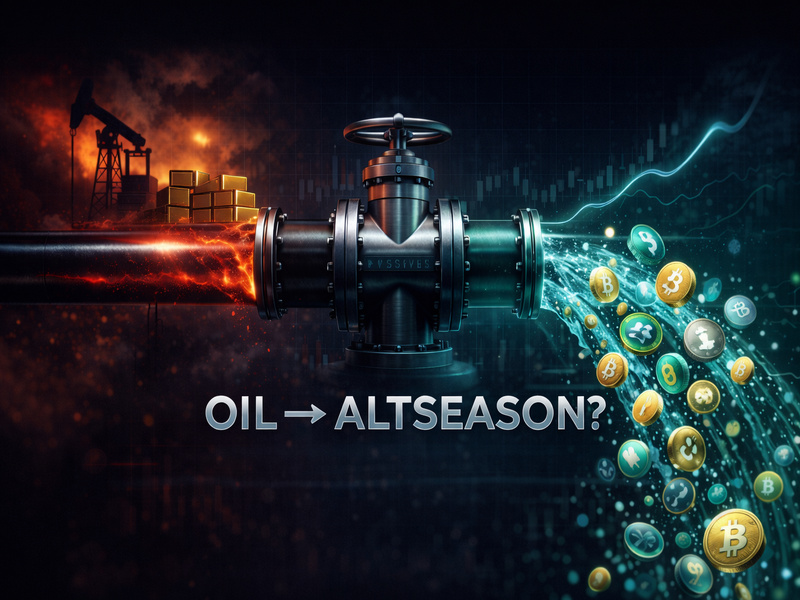
Context on 09.03.2026: what the market has already priced in
On 09.03.2026, oil is reacting to the Iran war shock with a spike toward the ~$119 area, with markets focusing on supply and shipping risks around the Strait of Hormuz.
At the same time, gold is holding in the zone of all-time highs, reflecting strong demand for safety. In late January 2026, gold printed above $5,000 per ounce, with a peak around $5,589.
That combination usually means one thing: markets are paying for protection, and conditions for risk assets tighten.
How we define an altseason so we don’t argue about labels
Altseason is not a chat mood. It is a regime where a broad set of large altcoins outperforms BTC over the same horizon. A clean criterion many traders use is the Altcoin Season Index logic: if 75% of the top-100 coins (excluding stablecoins and wrapped assets) outperform Bitcoin over the last 90 days, the market is in altseason.
That removes the guesswork and gives us measurable conditions.
Why expensive oil usually pressures altcoins first
Oil spikes transmit an inflation impulse through energy. From a policy perspective, that often pushes expectations toward tighter conditions—or at minimum delays any “quick easing” narrative.
In the current setup, markets are already discussing the risk that an oil shock lifts inflation expectations and hardens rate expectations. In standard oil-shock transmission logic, central banks may tighten after an oil spike because inflation and inflation expectations rise, which worsens conditions for growth.
For crypto that typically means:
- risk appetite compresses
- leverage becomes more expensive and shrinks
- altcoins suffer more because liquidity is thinner
So “oil up” as a starting point usually looks like risk-off, not a direct altseason trigger.
Where the “oil → easing → altseason” idea comes from
This scenario is not about oil “causing” an altseason. It’s about the second step: if the energy shock turns into slower growth and financial stress, markets can begin pricing liquidity support and a softer policy stance.
Historically, large-scale asset purchases returned during systemic stress. For example, on 23 March 2020 the Fed stated it would increase purchases of Treasuries and MBS as needed to support market functioning.
In that framework, the altseason window appears later—not on the oil spike itself, but when the regime turns liquidity-driven.
Why past altseasons don’t support a simple “high oil → alts rally” formula
Looking across prior cycles, oil is not a universal switch.
In 2017, oil was relatively moderate. In 2021, oil was materially higher on average. Altseasons were possible in both cycles for reasons far broader than oil: liquidity regime, risk appetite, leverage structure, and capital rotation inside crypto.
The practical conclusion: oil is an important backdrop, not a button.
A workable model on 09.03.2026: treat oil and gold as risk filters
The combination of “oil sharply up” + “gold at all-time highs” usually means:
- markets are defensive
- risk-off dominates
- conditions for alts are worse than for BTC
In that environment, it’s expensive to force an altseason narrative off a single macro factor. It’s cheaper to hold scenarios and wait for regime confirmation.
What we use to confirm a regime shift in crypto
We only accept “altseason has started” after confirmation inside the market, not from headlines.
- the 90-day altseason index moving toward a zone where most top alts consistently outperform BTC
- BTC dominance behavior: declining dominance during broad market expansion is typically better for alts
- ETH/BTC relative strength as a risk appetite barometer
Inside the market, we confirm regime through events:
- open interest screeners
- funding screeners
- liquidations screeners
- premium index
- pump/dump
The goal is to trade confirmed regime, not expectation.
Typical mistakes around “macro triggers”
- buying alts on the first bounce while the market remains risk-off
- assuming “altseason soon” applies to everything without liquidity selection
- rewriting rules after every candle
- confusing a local relief move with a durable rotation
Discipline: what actually makes the difference in these phases
During shock regimes spreads widen, wicks get larger, and the cost of impulsive decisions increases. The edge comes from a playbook:
- regime-based permissions
- event confirmation
- series-based execution
- batch changes instead of constant tweaks
Operating playbook
Before: treat the macro backdrop as a regime filter, set asset and risk permissions, define confirmation criteria via dominance/index and internal events.
During: avoid impulse entries, validate quality through open interest/funding/liquidations/premium index/pump-dump, keep rules stable through the series.
After: review the series, separate regime effects from execution quality, adjust permissions in batches.
Mini-cases
Case 1: oil spikes and gold stays at highs
Risk-off is the base regime. Alts are usually weaker. We operate with strict permissions and scenarios that do not depend on believing in sustained alt strength without confirmation.
Case 2: markets begin pricing easing after the shock
If policy and liquidity expectations genuinely shift, a window to expand risk can appear. Alt permissions come only after confirmation via relative strength and dominance/index behavior.
Case 3: “alts are up,” but leverage is overheating internally
Even if some alts pump, funding/liquidations can flag overheating. That is not a moment to widen risk automatically—only targeted permissions with strict regime control.
FAQ
Can oil alone trigger an altseason?
Most of the time, no. Higher oil usually tightens the inflation backdrop and compresses risk appetite. Altseason needs liquidity expansion and capital rotation.
Why does record-high gold matter for crypto?
It signals demand for protection. In those periods, conditions for risk assets are tighter.
How do we confirm that altseason has actually started?
By sustained broad outperformance vs BTC on a 90-day window and by BTC dominance behavior.
What matters more: macro headlines or market structure?
Macro sets the backdrop; market structure decides permissions. Trading a single headline in these phases is expensive.
Where does algo trading fit in this framework?
In execution discipline and regime control: the algorithm follows the playbook, and we manage permissions and scenario switching.
Product block
At Crypto-Resources we operate by regime. In risk-off phases and stress moves we use crypto bot ST-Bot (rule-based short scenarios), and when recovery is confirmed we shift part of the scenarios into Spot-Bot. Regime context is managed through Market Median, the correlation table with a leader, median RSI, MA200, and overbought/oversold. Event confirmation comes from screeners for open interest, funding, liquidations, premium index, and pump/dump.
Conclusion
High oil is not a reliable altseason switch. On 09.03.2026 it is more consistent with a risk-off regime, while an alt window tends to appear later—if the market moves into a liquidity-expansion regime and that shift is confirmed by dominance/index behavior and internal market structure. We trade confirmed regime, not expectation.
Risks
This material is for informational purposes only and is not an individual investment recommendation. Crypto markets are volatile, and total capital loss is possible.