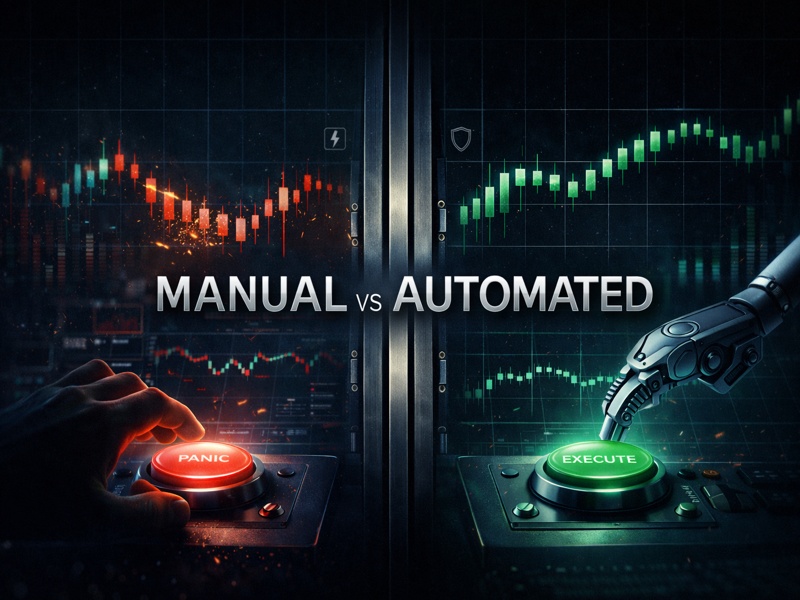
Manual cryptocurrency trading gives flexibility and a strong sense of control, but it most often breaks at execution: late entries, unnecessary adds, moving the stop, trying to “sit through” a bad tape. Automated cryptocurrency trading makes the process repeatable and keeps risk limits in place—if rules are defined in advance and not rewritten mid-move.
In practice, the working model is rarely “either/or.” The durable setup is role separation: the trader controls regime and risk permissions, while trading robots execute the protocol.
Terms and boundaries
- Manual trading: the trader analyzes, enters, exits, and manages positions.
- Automated trading: a bot executes trades via API using predefined conditions and constraints.
- Semi-automated trading: the trader sets regime, universe, and limits, while the bot handles execution and enforcement.
- Market regime: the background that changes probabilities and execution cost—trend/range, risk-on/risk-off, overheating/cooling.
- Safety perimeter: non-negotiable constraints—API keys with withdrawals disabled, limits, pause rules, and an emergency stop. On the platform, we build connections this way: trading-only API with withdrawals disabled. (Crypto-Resources)
Where manual cryptocurrency trading is stronger
Manual work wins when context and management decisions matter.
- Regime shifts: recognizing when the market moved into stress or back into stability.
- Exceptions: news shocks, sudden wicks, liquidity deterioration, “uneven” order books.
- Portfolio logic: deciding what to trade and what to stand down from.
- Risk permissions: enabling a scenario, tightening limits, or putting trading on pause.
This is the layer we keep with the human operator: top-level control that should not be replaced by a start button.
Where manual trading tends to break
Manual trading problems in crypto are usually the same.
- Emotions: chasing candles, trying to “get it back,” moving the invalidation point.
- Fatigue: the market is 24/7, and decision quality doesn’t survive endless monitoring.
- Rule drift: the same setup gets interpreted differently depending on mood.
- Costly execution: “waiting for confirmation” turns into “entering after the move,” paid through slippage.
The strategy is not what fails—discipline does.
Where automated cryptocurrency trading is stronger
Automation wins when process stability matters.
- Repeatability: one rule is executed the same way every time.
- Risk management as a default: limits and prohibitions are enforced without debate.
- Speed: if conditions are met, the action is taken—no hesitation, no second guessing.
- Transparency: logs, stats, and real-time limit control. On Crypto-Resources this is part of the baseline perimeter: trade logs, performance stats, and risk limits. (Crypto-Resources)
Automated crypto trading: risks and how to contain them
Automation doesn’t remove risk. It makes risk manageable if you respect the constraints.
- Logic mistakes scale: a bot executes rules, it doesn’t “feel the market.”
- Stress events degrade execution: wider spreads, thinner depth, more wicks.
- Technical risks: latency, partial fills, connection quality.
- The #1 management mistake: changing settings after every trade instead of working in series.
We contain this with plain, old-school controls: daily loss limits, frequency limits, stress-trigger pauses, and an emergency stop. We also use protective entry sizing so exposure stays controlled and the system keeps room for rule-based averaging. (Crypto-Resources)
Crypto screeners for manual and semi-automated trading
If a bot is execution discipline, screeners are regime visibility. Our Crypto-Resources screeners are built around practical triggers: pump/dump behavior, open interest moves, and liquidation clusters, with the ability to open a trade directly from the browser. (Crypto-Resources)
This is how we use them in manual and semi-automated workflows:
- For opportunity selection: the screener shows where real movement is happening and where the market is imbalanced.
- For regime validation: we read leverage pressure through OI/liquidations and read positioning skew through the Premium Index, treated as a regime indicator rather than an entry signal. (Crypto-Resources)
- For noise filtering: Median RSI gives a market “temperature” and helps decide where screener alerts are actionable and where they should be ignored. (Crypto-Resources)
- For phase context: Market Median shows how far the altcoin market is from its normal state using a regression-based approach and helps filter alerts by context. (Crypto-Resources)
The manual part stays simple: we don’t hunt the perfect candle; we decide whether the market is suitable for execution.
How we run it on Crypto-Resources
Two core scenarios:
- Spot-Bot: a spot trend model built around “leader → altcoins.” We pick a leader (BTC/ETH/SOL), select altcoins with strong correlation to the leader, and enter only when conditions confirm on both the leader and the alt. (Crypto-Resources)
- ST-Bot: a futures pump-short model designed for overheated moves and stress spikes, where entry discipline, limits, and rule-based management are critical. (Crypto-Resources)
Our manual involvement is not “trade instead of the bot.” Manual involvement is regime control: enable, restrict, pause.
Mini-cases based on real regimes and how we adjust the protocol
These cases are not “perfect conditions.” They are about how the process changes when the market changes.
- Feb 28, 2026: escalation and a sharp risk-off session. On headlines about strikes on Iran, crypto sold off and Bitcoin posted a daily drop around 6% and traded below the $64k area. (Yahoo Finance) On a day like this we don’t get bolder—we tighten. For ST-Bot we switch to a more conservative risk profile, harden entry-frequency constraints, take profit more actively on impulse legs, and avoid expanding exposure without conditions. For Spot-Bot we often choose a pause until regime normalizes, because spot entries during abrupt risk-off frequently pay a high execution cost. The signal layer comes from screeners (pump/dump, OI, liquidations) and regime filters (Market Median, Median RSI, Premium Index) so decisions aren’t made off the headline alone. (Crypto-Resources)
- November 2024: Trump’s election win and a fast risk-on. The market flipped into broad euphoria: Bitcoin was reported up about +32% from Nov 5, Ethereum +37%, and Dogecoin +150%+. (Reuters) Here the logic is the opposite: Spot-Bot gets its natural environment—trend execution and leader/correlation workflows are easier to control—while ST-Bot is not used as an emotional attempt to “pick the top.” It runs only on its own conditions and within strict constraints.
- January–February 2026: impulse burnout through derivatives. When the market shows OI fading and the move losing fuel, we treat it as regime fatigue and tighten entry permissions early: fewer trades, more filtering, fewer attempts to “sit through” noise. This is where the combination of screeners and regime metrics is most useful. (Crypto-Resources)
Across all cases, the principle stays the same: we define the regime; the bot executes.
Operating playbook: before / during / after
- Before: check regime via Market Median and temperature via Median RSI, evaluate derivatives pressure via Premium Index, scan OI/liquidations for stress, set risk limits and pause conditions. (Crypto-Resources)
- During: don’t rewrite rules mid-session, monitor execution deterioration and stress signals, treat pause as part of the system rather than a sign of weakness.
- After: review trades in series using logs, evaluate regime fit, and apply changes in batches rather than “after one emotional trade.”
That’s how systematic trading is built: not by chasing entries, but by holding the process.
Common mistakes when choosing manual vs automated
- Trying to automate chaos: no playbook, but a bot is running.
- Manual intervention without procedure: changing risk, adding exposure “because it feels right.”
- Ignoring regime: running one profile in calm markets and in stress markets.
- Skipping screeners and aggregated metrics: picking trades off a single chart with no breadth context.
- Trading without daily limits and without a clear emergency stop.
FAQ
- Can you fully rely on automated cryptocurrency trading? Rarely. Regime control and risk permissions still require management.
- Why use crypto screeners if you already run trading bots? To read context and select situations; the bot executes, the screener saves time and enforces selection discipline. (Crypto-Resources)
- Do Spot-Bot and ST-Bot replace manual trading? They replace manual execution. The manual layer remains regime control and risk permissions.
- What matters most in automation? Risk limits, regime filters, and execution stability.
- What’s the safest way to start? Demo first, tight limits, then expand permissions only after a trade series and review. (Crypto-Resources)
On Crypto-Resources, manual and automated cryptocurrency trading don’t compete—they split responsibilities. We use screeners (pump/dump, open interest, liquidations) and regime metrics (Market Median, Median RSI, Premium Index) to make a clear market decision, then let bots execute the protocol: Spot-Bot runs the “leader → altcoins” workflow, ST-Bot runs the pump-short scenario. That is what semi-automated trading looks like in practice: regime is handled manually, execution follows a strict playbook. (Crypto-Resources)
Conclusion
Manual cryptocurrency trading is strong on context and regime control. Automated cryptocurrency trading is strong on discipline, repeatability, and limit enforcement. The stable model is hybrid: we set regime and constraints; trading robots execute the protocol without impulse decisions.
Risks
This material is for informational purposes only and is not an individual investment recommendation. Cryptocurrency markets are volatile, and substantial capital losses are possible. Any decisions must be made within your own risk-management framework.