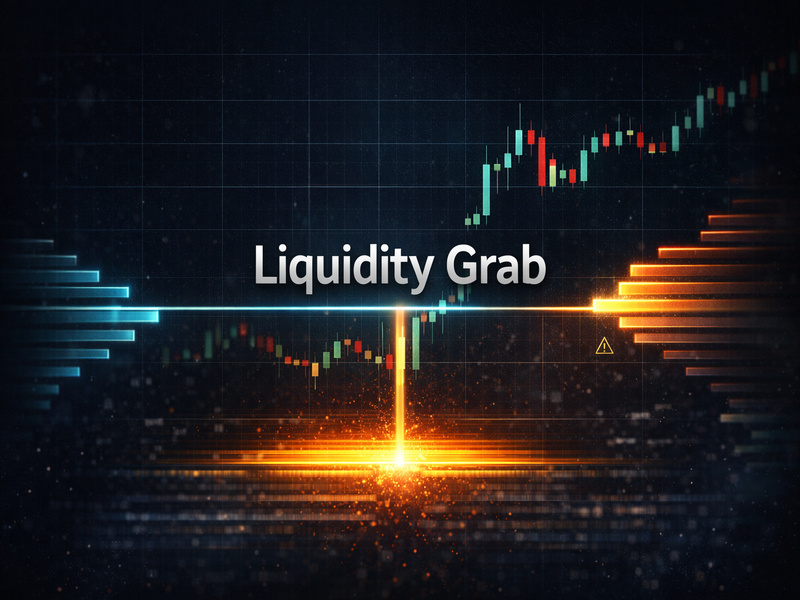
A sharp level poke, a long wick, a quick return, and then a move in the opposite direction—many traders call that “manipulation.” In practice, the market often does something simpler: it takes liquidity where it is concentrated—stops, margin thresholds, and forced liquidation zones.
The trader’s job is not to hunt for villains, but to follow a protocol for entering after a liquidity sweep: wait for confirmation, control execution quality, and define a clear invalidation point.
Terms and boundaries
- Liquidity — tradable volume that can be executed without meaningfully moving price.
- Liquidity grab (liquidity sweep) — a move into an area packed with stops and liquidation flow, where execution is easier.
- Liquidation zone — a price area where a large share of leveraged positions gets force-closed.
- Liquidation cascade — a chain reaction where forced closures amplify the move and trigger more liquidations.
- Absorption — opposing volume holds a level despite heavy trade flow.
- Iceberg — hidden limit volume that replenishes in smaller visible slices.
- Reclaim — price returns back above/below a swept level and holds it.
- Fragile liquidity — conditions where depth collapses, spreads widen, and price jumps between levels.
The mechanics: why price moves where “most got liquidated”
Where stops and liquidation thresholds cluster, there is ready-made trade flow. Price is drawn to those areas for two reasons:
- Execution of size: opposing liquidity appears automatically when stops and liquidations trigger.
- Flow acceleration: cascades create one-sided pressure and price travels quickly until it meets durable depth.
This is why clean-looking levels get swept and why entries without confirmation often end up paying for someone else’s flow.
Internal vs external liquidity
To assess liquidity grabs properly, separate two layers of “fuel.”
- Internal liquidity is what you see and execute inside a single venue: the order book, spreads, near-mid depth, and how fast liquidity refills. When internal liquidity breaks, the market prints sharp pushes and wicks because the nearest real depth is farther than it looks.
- External liquidity is the market’s ability to pull opposing volume from outside: other exchanges, arbitrage flows, spot/perp linking, and participants hedging across venues. When external liquidity is strong, a sweep is more likely to stabilize and revert. When external liquidity is weak, the move tends to extend in steps.
The practical rule is simple: “wick entries” are only acceptable when the market shows external liquidity is back online and internal liquidity is no longer fragile.
Where to look for liquidation zones and sweep areas
A reliable approach is to focus on repeatable liquidity sources:
- recent highs/lows, equal highs/lows, range boundaries, round numbers
- long consolidations where positions and leverage built up
- areas that previously produced fast wicks and poor execution conditions
- leverage build-ups during directional moves, where the market becomes stretched
If you have data access: liquidation heatmaps, OI dynamics, funding, and premium index help separate random noise from zones that can actually fuel a cascade.
“Where market maker limits are stacked”: a realistic view
Public data only gives behavior and probabilities, not certainty:
- repeated reactions at recurring levels where the market trades volume instead of slicing through
- iceberg-style behavior: heavy prints with limited progress and “refilling” depth
- quote withdrawal behavior: liquidity gets consumed, does not refill, spreads widen, and price jumps to the next depth pocket
A limit wall is not a promise of reversal. In a playbook it means one thing: entries require confirmation, not a screenshot of the book.
Entry from liquidation areas: actionable confirmations
Entering from a liquidation zone is not “buying the wick.” It is buying after the market shows flow exhaustion and structure repair.
- Reclaim: price returns through the swept level and holds.
- Reduced follow-through: the next push produces a smaller extension and meets opposing flow sooner.
- Absorption: trade flow remains high, but price stops progressing in the sweep direction.
- Execution normalization: spreads tighten, depth returns closer to mid, and the “level jumping” fades.
- Clear invalidation point: if price re-enters the sweep zone and holds there, the scenario is closed—no bargaining.
This is the “human” entry framework: confirmation, controlled costs, and a clear exit when wrong.
Core discipline rules
- Regime and execution first, entry second. If liquidity is fragile, the market can be “right” while your entry is simply expensive.
- In sweep zones, limit execution is the default; market execution is only for predefined cases.
- Do not increase size while spreads widen and depth collapses.
- Fading the first sweep without confirmation is a bet, not a system.
- Every trade has an invalidation level tied to structure, not hope.
Common mistakes
- buying or selling the first wick without reclaim and hold
- trying to “catch the bottom” with market orders in fragile liquidity
- adding without one unified invalidation point and without total risk control
- ignoring that liquidity grabs often come in waves
- applying calm-market execution rules to impulse conditions
Operating playbook: before / during / after
- Before the trade: mark obvious liquidity areas, define entry confirmations, choose execution type, set a slippage cap, and set the invalidation point.
- During the trade: wait for reclaim or absorption, monitor spread and depth, avoid chasing, keep risk contained, and act on structure.
- After the trade: compare plan vs actual execution, measure entry cost, record which confirmations worked, and update regime-specific rules.
Mini-cases
- Case 1: range low swept, then reclaimed. Price pokes below, collects flow, then reclaims and holds. Entry is only after reclaim; invalidation sits under the area where the scenario becomes false again.
- Case 2: a double liquidity grab. The first wick fails to reverse; the second push extends less and shows absorption. Entry follows structure repair and stabilized execution conditions.
- Case 3: the break is real. The sweep holds in the move direction, with no return and no depth recovery. A counter entry is canceled; the scenario is closed by the playbook.
FAQ
- Is a liquidity grab always manipulation? No. It’s often the result of stop clustering, leverage, and liquidity fragility under stress.
- Why does price often reverse after liquidations? Forced flow exhausts, and the market finds a level where durable opposing liquidity appears. It’s a scenario, not a guarantee.
- How do you separate a false sweep from a real breakout? Reclaim and hold, absorption signals, and execution normalization. Without them you’re guessing.
- Can you enter “where everyone got liquidated”? Yes, if structure confirms and you have a clear invalidation point. Otherwise it’s wick trading.
- What matters more: level precision or execution quality? In sweep regimes, execution quality and risk control dominate; slippage and protocol errors destroy edge fastest.
Product block
To track regime and validate scenarios, market screeners and execution automation are practical tools. In Crypto-Resources, liquidation screeners are available for free to anyone, and they come together with open interest (OI), funding, and premium index—so you can see where the market is stretched, where cascade fuel is building, and how liquidity conditions are changing. Paid and free tools are available as well, plus demo testing to validate a process without pressure on capital.
Conclusion
Liquidity grabs are a repeatable market mechanic: price moves toward concentrated flow, and liquidation cascades accelerate that move. A workable entry is not on the wick, but after structure repairs—reclaim, absorption, and execution normalization.
A playbook built around liquidity conditions creates consistency: execution-quality controls, slippage caps, fixed risk, and clean scenario closure when structure does not confirm.
Risks
This material is for informational purposes only and is not an individual investment recommendation. Crypto markets are volatile, and substantial capital losses are possible. Any decisions should be made only within your own risk management rules.