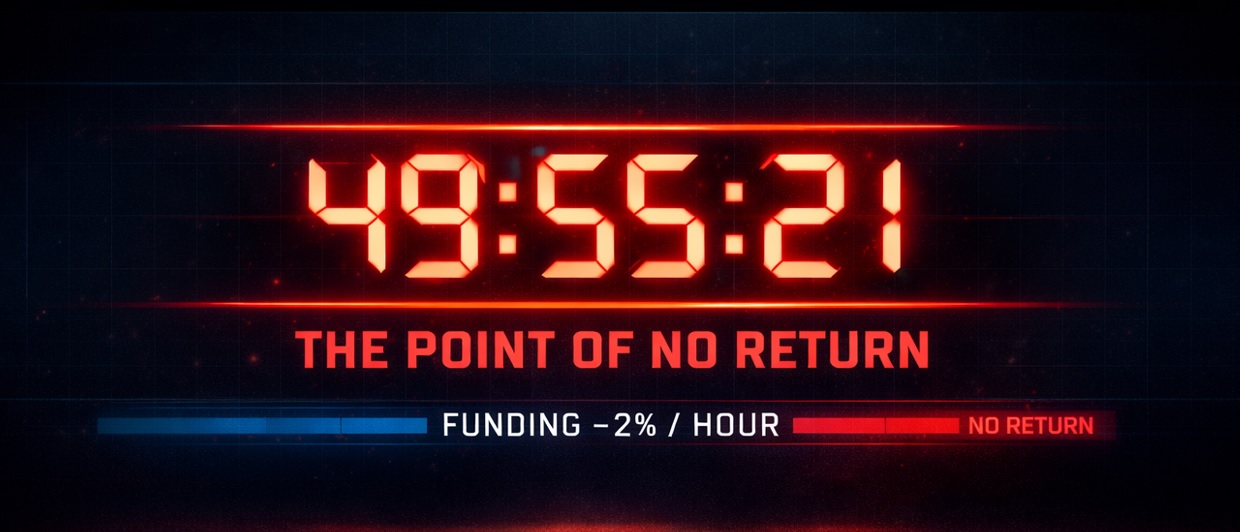
On crypto exchanges where perpetual futures are available on altcoins, you can lose a trade not because direction was wrong, but because holding the position becomes too expensive. The harshest version is hourly funding on thin, newly listed coins: low volume, short history, low float, and heavy control by a market maker or a large player.
A common setup looks like this: a coin pumps hundreds of percent, you open a short, and you see -2% funding charged every hour. Even a small position can quickly turn into something that is mathematically hard to bring back into profit.
Why it happens mostly on thin and new coins
On large, liquid contracts, extreme and frequent funding is less common. On low-cap or newly listed tokens, imbalances and liquidity gaps are more likely, so holding costs can become abnormal.
Funding is a recurring transfer between longs and shorts. When funding is negative, shorts pay longs. If it’s charged every hour, the cost accelerates fast.
Key detail: funding is charged on position notional, not on margin
This is where leverage becomes dangerous.
payment per period = position notional × |rate|
If your position is $10 notional and funding is -2% per hour, you pay:
$10 × 0.02 = $0.20 per hour
Leverage does not reduce that. Higher leverage lowers margin, but funding is still charged on notional.
“Annualized” scale to understand how extreme it is
If you convert -2% per hour into a simple annualized rate:
2% × 24 × 365 = 17,520% per year on notional.
That number is not an investment claim. It’s a scale indicator of how fast holding costs can drain a short.
The point of no return: why it’s easy to compute for a short
A short has a hard cap on profit: maximum 100% of notional if price goes to zero. You cannot earn more than the position notional.
So the point of no return is when total funding paid equals the maximum possible profit on the short.
With hourly funding:
- max profit = N
- hourly cost = N × f
- time to point of no return = N / (N × f) = 1 / f
Examples:
- 0.5% per hour → 200 hours ≈ 8.3 days
- 1% per hour → 100 hours ≈ 4.2 days
- 2% per hour → 50 hours ≈ 2.1 days
At -2%/hour, after 50 hours you have paid 100% of notional in funding. Beyond that, even “perfect direction” cannot produce net profit.
Why this is especially dangerous when shorting a pump
Shorting an overextended coin can be correct conceptually, but the market can keep the imbalance longer than expected. If funding is charged hourly, the position becomes a time race.
In that environment, the priority is not calling the exact top, but understanding holding math: how many hours you can afford under these terms.
What to do if you’re already stuck in hourly funding
Below are three practical options. The right choice depends on margin buffer, leverage, liquidity, and whether you have a plan.
Option 1. Close the position and stop paying
The direct exit. You lock the loss or abandon the idea, but you stop the recurring payment that can grind down your account.
This is often the correct move when:
- margin is thin,
- the instrument is illiquid,
- every hour makes the math worse.
Option 2. Lock the same coin to neutralize funding flow
You open a long on the same coin at similar notional size. Then:
- the short pays when funding is negative,
- the long receives under the same funding,
- net funding becomes close to zero, minus fees and exchange mechanics.
Risks of using a lock here
- A lock does not remove margin risk. One leg can be pressured by wicks, and thin coins can move violently.
- Rug pulls and liquidity gaps remain real risks.
- Exchange-side risk remains: forced reductions, risk-limit changes, ADL. If one leg is reduced, the lock becomes unbalanced and liquidation risk returns.
When to place the lock
Placing a lock early is safer than doing it in panic:
- don’t wait for +80–100% against your entry,
- place the lock near the level where a stop would normally be, for example around +10%.
That keeps the action controlled and preserves margin buffer.
Option 3. Average in—only after conditions cool down and within risk limits
Averaging in is only acceptable when:
- the market cools and liquidity improves,
- funding is no longer extreme, or you already neutralized the funding flow with Option 2,
- your balance and margin allow an add without breaking limits.
Averaging in does not replace Options 1 and 2. If conditions worsen again, be ready to close or lock by rules.
Summary
Hourly funding on thin, newly listed coins is not a small fee. It can flip the math of a short. At -2% per hour, the point of no return is roughly 50 hours: you pay 100% of notional in funding, and after that net profit becomes unrealistic even with perfect direction.
On crypto-resources.com, this is handled at the process level: our crypto trading bots and screeners can filter out hourly funding regimes before entry, together with filters for volume and token age. That reduces the chance of getting trapped by holding costs instead of price.